
Join Our JEE Preparation Group
Prep with like-minded aspirants; Get access to free daily tests and study material.
Sign in
Please select an account to continue using cracku.in
↓ →
Join Our JEE Preparation Group
Prep with like-minded aspirants; Get access to free daily tests and study material.
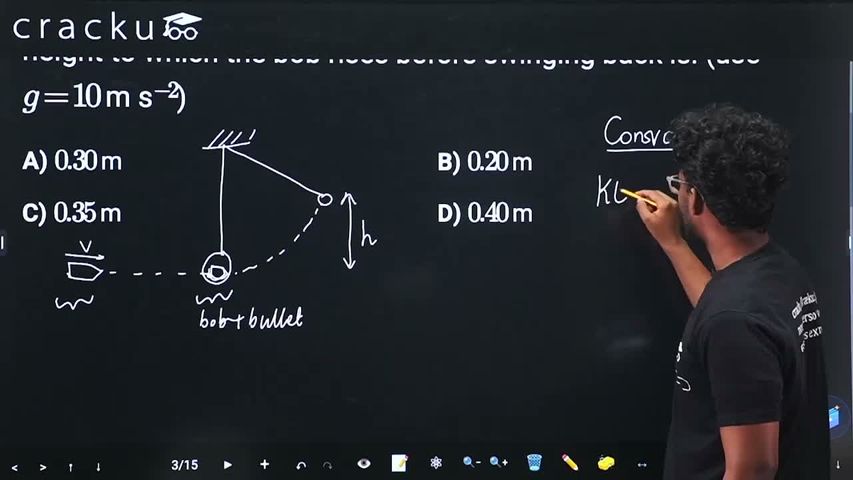
A simple pendulum of length $$1$$ m has a wooden bob of mass $$1$$ kg. It is struck by a bullet of mass $$10^{-2}$$ kg moving with a speed of $$2 \times 10^{2}$$ m s$$^{-1}$$. The bullet gets embedded into the bob. The height to which the bob rises before swinging back is. (use $$g = 10$$ m s$$^{-2}$$)
A bullet of mass 0.01 kg moving at 200 m/s embeds into a 1 kg pendulum bob. In this perfectly inelastic collision, linear momentum is conserved: $$m_{\text{bullet}}u=(m_{\text{bullet}}+m_{\text{bob}})v$$. Substituting gives $$0.01\times200=(0.01+1)\times v\,,\quad2=1.01\,v\,,\quad v=\frac{2}{1.01}\approx1.98\approx2\text{ m/s}\,.$$
After the collision, the combined system converts kinetic energy to potential energy during its rise: $$\frac{1}{2}(m_{\text{bullet}}+m_{\text{bob}})v^2=(m_{\text{bullet}}+m_{\text{bob}})gh\,.$$ Cancelling the mass yields $$h=\frac{v^2}{2g}\,.$$ Substituting $$v=2$$ m/s and $$g=10$$ m/s$$^2$$ gives $$h=\frac{4}{20}=0.20\text{ m}\,.$$
The correct answer is Option B: 0.20 m.
Was this solution helpful?
Click on the Email ☝️ to Watch the Video Solution
Create a FREE account and get:
_1.webp)

Educational materials for JEE preparation

Ask our AI anything

AI can make mistakes. Please verify important information.
AI can make mistakes. Please verify important information.
