
Join Our JEE Preparation Group
Prep with like-minded aspirants; Get access to free daily tests and study material.
Sign in
Please select an account to continue using cracku.in
↓ →
Join Our JEE Preparation Group
Prep with like-minded aspirants; Get access to free daily tests and study material.
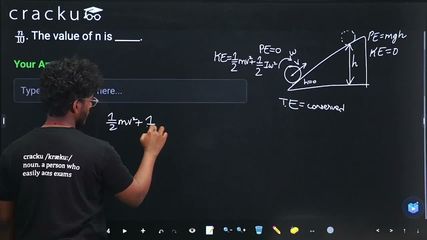
A solid sphere and a hollow cylinder roll up without slipping on same inclined plane with same initial speed $$\upsilon$$. The sphere and the cylinder reaches upto maximum heights $$h_1$$ and $$h_2$$, respectively, above the initial level. The ratio $$h_1 : h_2$$ is $$\frac{n}{10}$$. The value of n is _____.
Correct Answer: 7
A solid sphere and a hollow cylinder roll up an incline with the same initial velocity $$v$$. The ratio of the heights they reach is $$\frac{h_1}{h_2} = \frac{n}{10}$$. We need to find $$n$$.
Apply energy conservation for rolling bodies.
For a body rolling without slipping, the total kinetic energy converts to potential energy at the maximum height:
$$ \frac{1}{2}mv^2 + \frac{1}{2}I\omega^2 = mgh $$
Using $$\omega = v/r$$ (rolling condition): $$\frac{1}{2}mv^2\left(1 + \frac{I}{mr^2}\right) = mgh$$
$$ h = \frac{v^2}{2g}\left(1 + \frac{I}{mr^2}\right) $$
Calculate height for the solid sphere.
For a solid sphere: $$I = \frac{2}{5}mr^2$$, so $$\frac{I}{mr^2} = \frac{2}{5}$$
$$ h_1 = \frac{v^2}{2g}\left(1 + \frac{2}{5}\right) = \frac{v^2}{2g} \times \frac{7}{5} = \frac{7v^2}{10g} $$
Calculate height for the hollow cylinder.
For a hollow cylinder (thin-walled): $$I = mr^2$$, so $$\frac{I}{mr^2} = 1$$
$$ h_2 = \frac{v^2}{2g}(1 + 1) = \frac{v^2}{g} $$
Find the ratio.
$$ \frac{h_1}{h_2} = \frac{7v^2/(10g)}{v^2/g} = \frac{7v^2}{10g} \times \frac{g}{v^2} = \frac{7}{10} $$
Therefore $$n = 7$$.
The answer is $$\boxed{7}$$.
Was this solution helpful?
Click on the Email ☝️ to Watch the Video Solution
Create a FREE account and get:
_1.webp)

Educational materials for JEE preparation

Ask our AI anything

AI can make mistakes. Please verify important information.
AI can make mistakes. Please verify important information.
