
Join Our JEE Preparation Group
Prep with like-minded aspirants; Get access to free daily tests and study material.
Sign in
Please select an account to continue using cracku.in
↓ →
Join Our JEE Preparation Group
Prep with like-minded aspirants; Get access to free daily tests and study material.
As shown below, bob A of a pendulum having massless string of length 'R' is released from $$60^{\circ}$$ to the vertical. It hits another bob B of half the mass that is at rest on a friction less table in the center. Assuming elastic collision, the magnitude of the velocity of bob A after the collision will be (take g as acceleration due to gravity.)
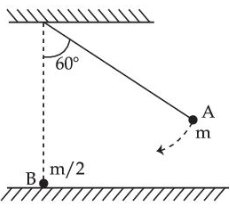
Velocity of bob A just before collision:
$$h = R(1 - \cos 60^\circ) = \frac{R}{2}$$
$$v_0 = \sqrt{2gh} \implies v_0 = \sqrt{2g\left(\frac{R}{2}\right)} = \sqrt{Rg}$$
For perfectly elastic collision ($$e = 1$$) between $$m_A = m$$ and $$m_B = \frac{m}{2}$$ (with $$v_B = 0$$):
$$v_A = \left(\frac{m_A - m_B}{m_A + m_B}\right)v_0$$
$$v_A = \left(\frac{m - \frac{m}{2}}{m + \frac{m}{2}}\right)\sqrt{Rg} \implies v_A = \left(\frac{\frac{m}{2}}{\frac{3m}{2}}\right)\sqrt{Rg} = \frac{1}{3}\sqrt{Rg}$$
Was this solution helpful?
Create a FREE account and get:
_1.webp)

Educational materials for JEE preparation

Ask our AI anything

AI can make mistakes. Please verify important information.
AI can make mistakes. Please verify important information.
