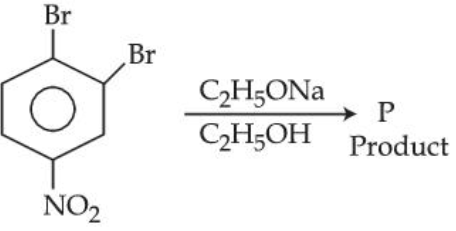
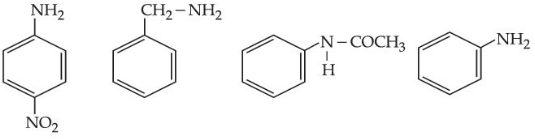
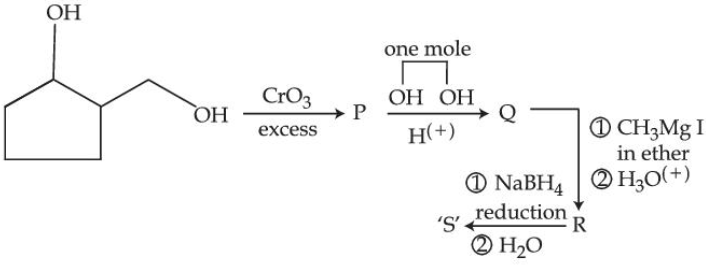
For the following questions answer them individually
Let $$x_{1},x_{2},...x_{10}$$ be ten observations such that $$\sum_{i=1}^{10}(x_{i}-2)=30,\sum_{i=1}^{10}(x_{i}-\beta)^{2}=98,\beta > 2$$, and their variance is $$\frac{4}{5}$$. If $$\mu$$ and $$\sigma^{2}$$ are respectively the mean and the variance of $$2(x_{1}-1)+4\beta, 2(x_{2}-1)+4\beta,....,2(x_{10}-1)+4\beta$$, then $$\frac{\beta \mu}{\sigma^{2}}$$ is equal to :
Consider an A. P. of positive integers, whose sum of the first three terms is 54 and the sum of the first twenty terms lies between 1600 and 1800. Then its $$11^{th}$$ term is :
The number of solutions of the equation $$\left(\dfrac{9}{x}-\dfrac{9}{\sqrt{x}}+2\right)\left(\dfrac{2}{x}-\dfrac{7}{\sqrt{x}}+3\right)=0$$ is:
Define a relation R on the interval $$[0,\frac{\pi}{2})$$ by $$xRy$$ if and only if$$\sec^{2} x-\tan^{2} y=1$$. Then R is :
Two parabolas have the same focus (4,3) and their directrices are the x-axis and the y-axis, respectively. If these parabolas intersects at the points A and B, then $$(AB)^{2}$$ is equal to :
Let P be the set of seven digit numbers with sum of their digits equal to 11 . If the numbers in P are formed by using the digits 1,2 and 3 only, then the number of elements in the set $$P$$ is :
Let $$\overrightarrow{a}=\hat{i}+2\hat{j}+\hat{k}$$ and $$\overrightarrow{b}=2\hat{i}+7hat{j}+3\hat{k}$$. Let $$L_{1}:\overrightarrow{r}=(-\hat{i}+2\hat{j}+\hat{k})+\lambda \overrightarrow{a},\lambda \in R$$. and $$L_{2}: \overrightarrow{r}=(\hat{j}+\hat{k})+\mu \overrightarrow{b}, \mu \in R$$ be two lines. If the line $$L_{3}$$ passes through the point of intersection of $$L_{1}$$ and $$L_{2}$$, and is parallel to $$\overrightarrow{a}+\overrightarrow{b}$$, then $$L_{3}$$ passes through the point :
Let $$\overrightarrow{r}=2\hat{i}-\hat{j}+3\hat{k}, \overrightarrow{c}=3\hat{i}-5\hat{j}+\hat{k}$$ and $$\overrightarrow{c}$$ be a vector such that $$\overrightarrow{c} \times \overrightarrow{c} = \overrightarrow{c} \times \overrightarrow{b}$$ and $$(\overrightarrow{a}+\overrightarrow{c}).(\overrightarrow{b}.\overrightarrow{c})=168$$. Then the maximum value of $$|\overrightarrow{c}|^{2}$$ is :
The integral $$80\int_{0}^{\frac{\pi}{4}}\left(\frac{\sin \theta + \cos \theta}{9+16\sin 2\theta}\right)d\theta$$ is equaol to :
Let the ellipse $$E_{1}:\frac{x^{2}}{a^{2}}+\frac{y^{2}}{b^{2}}=1,a > b$$ and $$E_{2}:\frac{x^{2}}{A^{2}}+\frac{y^{2}}{B^{2}}=1,A < B$$ have same eccentricity $$\frac{1}{\sqrt{3}}$$. Let the product of their lengths of latus rectums be $$\frac{32}{\sqrt{3}}$$, and the distance between the foci of $$E_{1}$$ be 4. If $$E_{1}$$ and $$E_{2}$$ meet at $$A,B,C$$ and $$D,$$ then the area of the quadrilateral $$ABCD$$ equals: