
Join Our JEE Preparation Group
Prep with like-minded aspirants; Get access to free daily tests and study material.
Sign in
Please select an account to continue using cracku.in
↓ →
Join Our JEE Preparation Group
Prep with like-minded aspirants; Get access to free daily tests and study material.
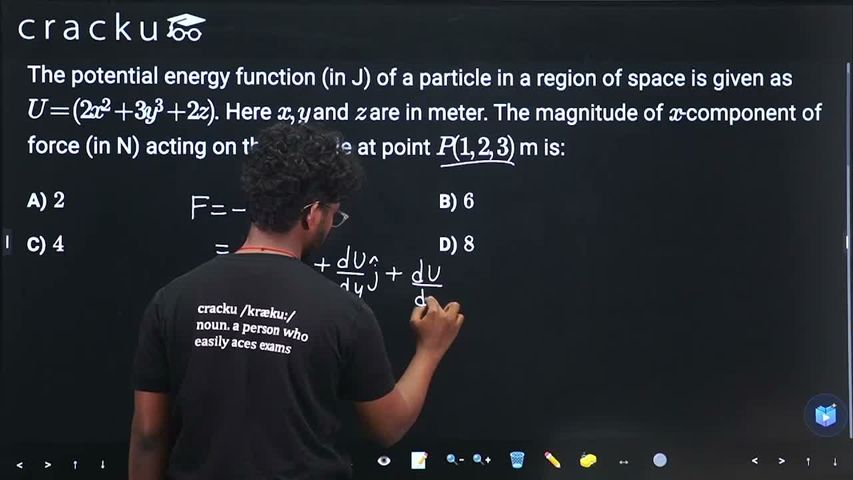
The potential energy function (in J) of a particle in a region of space is given as $$U = (2x^2 + 3y^3 + 2z)$$. Here $$x, y$$ and $$z$$ are in meter. The magnitude of $$x$$-component of force (in N) acting on the particle at point $$P(1, 2, 3)$$ m is:
We need to find the magnitude of the x-component of force at point P(1, 2, 3) given the potential energy function $$U = 2x^2 + 3y^3 + 2z$$.
The force is the negative gradient of the potential energy:
$$\vec{F} = -\nabla U = -\left(\frac{\partial U}{\partial x}\hat{i} + \frac{\partial U}{\partial y}\hat{j} + \frac{\partial U}{\partial z}\hat{k}\right)$$
Therefore, the x-component of force is:
$$F_x = -\frac{\partial U}{\partial x}$$
$$\frac{\partial U}{\partial x} = \frac{\partial}{\partial x}(2x^2 + 3y^3 + 2z) = 4x$$
(The terms $$3y^3$$ and $$2z$$ are treated as constants when differentiating with respect to $$x$$.)
$$F_x = -4x$$
At $$x = 1$$:
$$F_x = -4(1) = -4 \text{ N}$$
The magnitude of the x-component of force is $$|F_x| = 4$$ N.
The correct answer is Option (3): 4 N.
Was this solution helpful?
Click on the Email ☝️ to Watch the Video Solution
Create a FREE account and get:
_1.webp)

Educational materials for JEE preparation

Ask our AI anything

AI can make mistakes. Please verify important information.
AI can make mistakes. Please verify important information.
