
Join Our JEE Preparation Group
Prep with like-minded aspirants; Get access to free daily tests and study material.
Sign in
Please select an account to continue using cracku.in
↓ →
Join Our JEE Preparation Group
Prep with like-minded aspirants; Get access to free daily tests and study material.
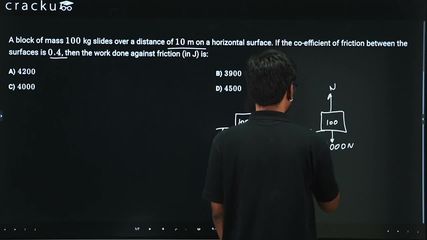
A block of mass $$100$$ kg slides over a distance of $$10$$ m on a horizontal surface. If the co-efficient of friction between the surfaces is $$0.4$$, then the work done against friction (in J) is:
We need to find the work done against friction when a 100 kg block slides 10 m on a horizontal surface with a coefficient of friction of 0.4.
The kinetic friction force on a horizontal surface is:
$$f = \mu m g$$
where $$\mu$$ is the coefficient of friction, $$m$$ is the mass, and $$g$$ is the acceleration due to gravity.
$$f = 0.4 \times 100 \times 10 = 400 \text{ N}$$
(using $$g = 10$$ m/s$$^2$$)
Work done against friction is:
$$W = f \times d = 400 \times 10 = 4000 \text{ J}$$
where $$d = 10$$ m is the distance.
Note: The work done against friction is positive because the friction force opposes the direction of motion. The energy is converted into heat.
The correct answer is Option (3): 4000 J.
Was this solution helpful?
Click on the Email ☝️ to Watch the Video Solution
Create a FREE account and get:
_1.webp)

Educational materials for JEE preparation

Ask our AI anything

AI can make mistakes. Please verify important information.
AI can make mistakes. Please verify important information.
