
Join Our JEE Preparation Group
Prep with like-minded aspirants; Get access to free daily tests and study material.
Sign in
Please select an account to continue using cracku.in
↓ →
Join Our JEE Preparation Group
Prep with like-minded aspirants; Get access to free daily tests and study material.
Given below are two statements. One is labelled as Assertion (A) and the other is labelled as Reason (R).
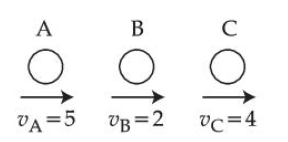
Assertion (A) :
Three identical spheres of same mass undergo one dimensional motion as shown in figure with initial velocities $$v_A = 5\,\text{m/s},\; v_B = 2\,\text{m/s},\; v_C = 4\,\text{m/s}$$. If we wait sufficiently long for elastic collision to happen, then $$v_A = 4\,\text{m/s},\; v_B = 2\,\text{m/s},\; v_C = 5\,\text{m/s}$$, will be the final velocities.
Reason (R): In an elastic collision between identical masses, two objects exchange their velocities. In the light of the above statements, choose the correct answer from the options given below :
When 2 bodies of the same mass undergo elastic collision, their velocities get exchanged.
In the given system, since ball A is faster than ball B, which is slower than ball C, first ball A and ball B will collide and exchange their velocities.
$$v_{A,\ final}=2$$ m/s and $$v_B'=5$$ m/s
Then, ball B and ball C will collide and exchange their velocities
$$v_{B,\ final\ }=4$$ m/s and $$v_{c,\ final\ }=5$$
Therefore, final velocities of the balls are $$v_{A,\ final}=2$$ m/s, $$v_{B,\ final\ }=4$$ m/s and $$v_{c,\ final\ }=5$$
Was this solution helpful?
Create a FREE account and get:
_1.webp)

Educational materials for JEE preparation

Ask our AI anything

AI can make mistakes. Please verify important information.
AI can make mistakes. Please verify important information.
