
Join Our JEE Preparation Group
Prep with like-minded aspirants; Get access to free daily tests and study material.
Sign in
Please select an account to continue using cracku.in
↓ →
Join Our JEE Preparation Group
Prep with like-minded aspirants; Get access to free daily tests and study material.
Two identical symmetric double convex lenses of focal length f are cut into two equal parts $$L_{1}, L_{2}$$ by AB plane and $$L_{3}, L_{4}$$ by XY plane as shown in figure respectively. The ratio of focal lengths of lenses $$L_{1}$$ and $$L_{3}$$ is
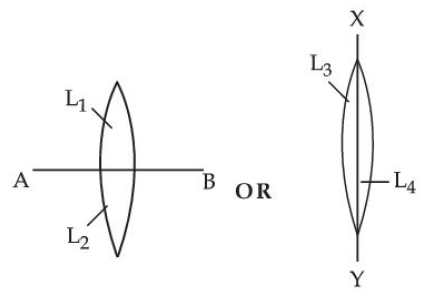
For the original equiconvex lens of focal length $$f$$:
$$\frac{1}{f} = (\mu - 1)\left(\frac{1}{R} - \frac{1}{-R}\right) = \frac{2(\mu - 1)}{R}$$
For part $$L_1$$ (cut along horizontal plane AB):
The curvature of the surfaces remains unchanged. $$f_1 = f$$
For part $$L_3$$ (cut along vertical plane XY):
One surface becomes plane ($$R_2 = \infty$$), making it a planoconvex lens.
$$\frac{1}{f_3} = (\mu - 1)\left(\frac{1}{R} - \frac{1}{\infty}\right) = \frac{\mu - 1}{R} = \frac{1}{2f} \implies f_3 = 2f$$
Ratio of focal lengths of $$L_1$$ and $$L_3$$: $$\frac{f_1}{f_3} = \frac{f}{2f} = \frac{1}{2}$$
Was this solution helpful?
Create a FREE account and get:
_1.webp)

Educational materials for JEE preparation

Ask our AI anything

AI can make mistakes. Please verify important information.
AI can make mistakes. Please verify important information.
