
Join Our JEE Preparation Group
Prep with like-minded aspirants; Get access to free daily tests and study material.
Sign in
Please select an account to continue using cracku.in
↓ →
Join Our JEE Preparation Group
Prep with like-minded aspirants; Get access to free daily tests and study material.
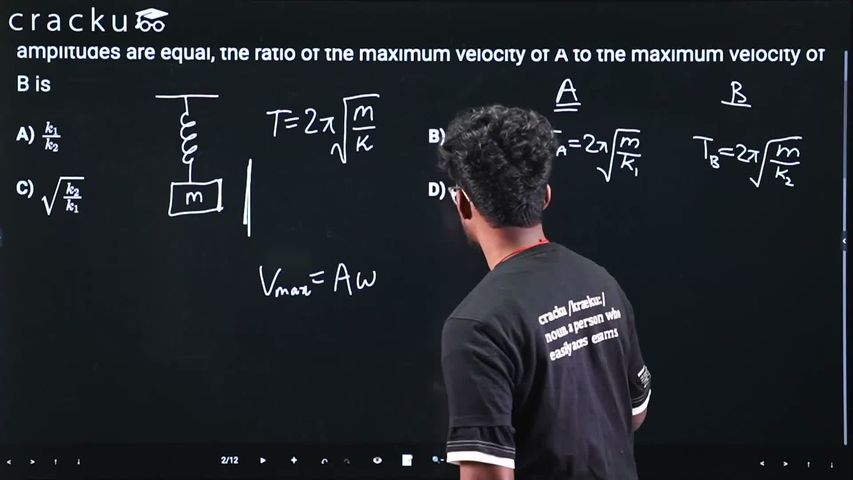
Two bodies A and B of equal mass are suspended from two massless springs of spring constant $$k_{1}$$ and $$k_{2}$$, respectively. If the bodies oscillate vertically such that their amplitudes are equal, the ratio of the maximum velocity of A to the maximum velocity of B is
Two bodies A and B each have mass m and are attached to springs with constants $$k_1$$ and $$k_2$$ respectively. They execute simple harmonic motion with equal amplitude A, and we wish to find the ratio of their maximum velocities.
The maximum velocity in simple harmonic motion is given by the formula:
$$v_{max} = A\omega = A\sqrt{\frac{k}{m}}$$
Applying this result to bodies A and B, we have:
$$\frac{v_{A,max}}{v_{B,max}} = \frac{A\sqrt{k_1/m}}{A\sqrt{k_2/m}} = \sqrt{\frac{k_1}{k_2}}$$
The correct answer is Option B: $$\sqrt{\frac{k_1}{k_2}}$$.
Was this solution helpful?
Click on the Email ☝️ to Watch the Video Solution
Create a FREE account and get:
_1.webp)

Educational materials for JEE preparation

Ask our AI anything

AI can make mistakes. Please verify important information.
AI can make mistakes. Please verify important information.
