Group
Group
 Group
Group

JEE Electrostatics PYQs
JEE Electrostatics PYQs are an important part of the JEE Physics syllabus. These questions help you understand how well you know the basic ideas of this chapter, such as electric charge, Coulomb’s law, electric field, electric potential, capacitance, Gauss’s law, and electrostatic force.
In the exam, electrostatics questions can come as direct numerical problems or simple concept-based questions. The good thing is that this chapter becomes much easier when your basics are clear. Once you understand the concepts properly and know which formula to use, solving questions feels much more manageable. You do not need to see this chapter as difficult. With regular practice and careful solving, you can do well in it.
In this blog, you will get a simple formula PDF, a section for important JEE Electrostatics PYQs in download format, a few practice questions with answers, and some extra questions to solve on your own. You will also learn about common mistakes students often make and a few easy tips to save time in the exam.
JEE Electrostatics Important PYQs PDF
This PDF can include the most important previous year questions from electrostatics. It may cover topics like electric charge, Coulomb’s law, electric field, electric potential, potential difference, electric dipole, capacitance, Gauss’s law, and combinations of capacitors.
Practicing these questions will help you understand the kind of problems asked in JEE. It will also improve your speed, accuracy, and confidence before the exam.
Important Formulas for JEE Electrostatics PYQs
You only need a few important formulas to solve most electrostatics questions in JEE. These formulas help you calculate force, electric field, electric potential, capacitance, and other values used in this chapter.
You can download the full formula PDF from the link above. Here is a quick look at some of the main formulas:
| Concept | Formula |
|---|---|
| Coulomb’s Law | $$F = \frac{kq_1q_2}{r^2}$$ |
| Electric Field | $$E = \frac{F}{q}$$ |
| Electric Field Due to a Point Charge | $$E = \frac{kq}{r^2}$$ |
| Electric Potential | $$V = \frac{kq}{r}$$ |
| Potential Difference | $$V = \frac{W}{q}$$ |
| Capacitance | $$C = \frac{Q}{V}$$ |
| Energy Stored in a Capacitor | $$U = \frac{1}{2}CV^2$$ |
| Capacitance of a Parallel-Plate Capacitor | $$C = \frac{\varepsilon_0A}{d}$$ |
| Capacitors in Series | $$\frac{1}{C} = \frac{1}{C_1}+\frac{1}{C_2}+\frac{1}{C_3}$$ |
| Capacitors in Parallel | $$C = C_1+C_2+C_3$$ |
These formulas are commonly used in questions based on charge, force, electric field, potential, capacitors, and stored energy. If you revise them properly, many JEE questions become easier to solve.
Top 5 Common Mistakes to Avoid in JEE Electrostatics PYQs
Many students feel that this chapter is easy, but they still lose marks because of small mistakes. Here are some common mistakes you should avoid:
Confusing electric field and electric potential
Electric field and electric potential are related, but they are not the same thing. Electric field is a vector quantity, while electric potential is a scalar quantity. This difference is very important in many questions.
Using the wrong formula for capacitors in series and parallel
This is one of the most common mistakes in electrostatics. In series, you use the reciprocal formula. In parallel, you add the capacitances directly.
Ignoring the sign of charges
The sign of charge matters a lot in electrostatics. Positive and negative charges affect the direction of force, electric field, and potential in different ways.
Not reading the distance carefully in Coulomb’s law
Sometimes students use the wrong distance between charges or forget to convert units properly. Even a small mistake here can change the final answer.
Not checking units carefully
Always use proper SI units like coulomb, newton, volt, farad, and metre. Even if your method is correct, a unit mistake can lead to the wrong answer.
List of JEE Electrostatics PYQs
Here is a short set of JEE-style electrostatics questions for practice. These include common question types from electric force, electric field, potential, and capacitance. Solving them regularly can help you become faster and more confident.
Question 1
Consider two identical metallic spheres of radius R each having charge Q and mass m. Their centers have an initial separation of 4R. Both the spheres are given an initial speed of u towards each other. The minimum value of u, so that they can just touch each other is :
(Take $$k= \frac{1}{4\pi \epsilon_{0}}$$ and assume $$kQ^{2}$$ > $$Gm^{2}$$ where G is the Gravitational constant)
correct answer:- 4
Question 2
A point charge of $$10^{-8}$$ is placed at origin. The work done in moving a point charge $$2 \mu C$$ from point A(4, 4, 2) m to B(2, 2, 1) m is _____J $$\left(\frac{1}{4\pi\epsilon _{0}}=9\times10^{9} \text{in SI units}\right)$$
correct answer:- 2
Question 3
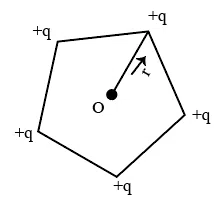
Five positive charges each having charge q are placed at the vertices of a pentagon as shown in the figure. The electric potential (V) and the electric field $$(\overrightarrow{E})$$ at the center O of the pentagon due to these five positive charges are:
correct answer:- 1
Question 4
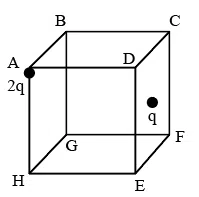
Two point charges 2q and q are placed at vertex A and centre of face CDEF of the cube as shown in figure. The electric flux passing through the cube is :
correct answer:- 4
Question 5
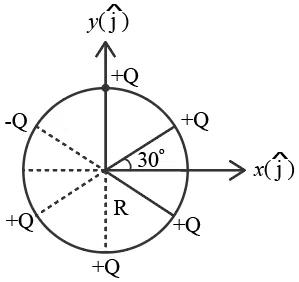
Six point charges are kept $$60^{o}$$ apart from each other on the circumference of a
circle of radius $$R$$ as shown in figure . The net electric field at the center of the circle is______.
( $$\epsilon_{o}$$ is permittivity of free space)
correct answer:- 1

Question 6
A simple pendulum has a bob with mass $$m$$ and charge $$q$$. The pendulum string has negligible mass. When a uniform and horizontal electric field it is applied, the tension in the string changes. The final tension in the string, when pendulum attains an equilibrium position is ______.
($$g$$: acceleration due to gravity)
correct answer:- 1
Question 7
Three charges+ 2q, +3q and -4q are situated at (0, -3a), (2a, 0) and (-2a, 0) respectively in the x y plane. The resultant dipole moment about origin is ___ .
correct answer:- 2
Question 8
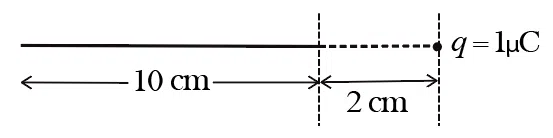
A point charge q = l $$\mu C$$ is located at a distance 2 cm from one end of a thin insulating wire of length 10 cm having a charge Q = 24 $$\mu C$$, distributed uniformly along its length, as shown in figure. Force between q and wire is __ N.
(Use: $$\frac{1}{4\pi\epsilon_{0}}=9 \times10^{9} N.m^{2}/C^{2}$$)
correct answer:- 90
Question 9
Two point charges of 1 nC and 2 nC are placed at the two corners of equilateral triangle of side 3 cm. The work done in bringing a charge of3 nC from infinity to the third corner of the triangle is __ $$\mu J$$
$$\frac{1}{4\pi \in_{\circ}}=9\times 10^{9}N.m^{2}/C^{2}$$
correct answer:- 2
Question 10
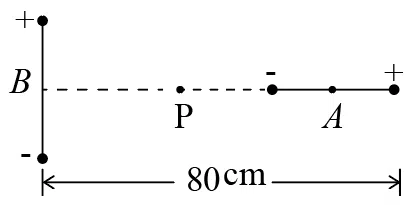
Two shorts dipoles $$(A, B)$$, $$A$$ having charges $$\pm 2\mu C$$ and length 1 cm and $$B$$ having charges $$\pm 4\mu C$$ and length 1 cm are placed with their centres 80 cm apart as shown in the figure. The electric field at a point $$P$$ , equi-distant from the centres of both dipoles is ____ N/ C.
correct answer:- 2

Question 11
Identify the correct statements :
A. Electrostatic field lines form closed loops .
B. The eleclric field lines point radially outward when charge is greater than zero.
C. The Gauss - Law is valid only for inverse - square force.
D. The workdone in moving a charged particle in a static eleclric field around a closed path is zero.
E. The motion of a particle under Coulomb's force must take place in a plane.
Choose the correct answer from the options given below:
correct answer:- 3
Question 12
A line charge of length $$\frac{'a'}{2}$$is kept at the center of an edge BC of a cube ABCDEFGH having edge length 'a' as shown in the figure. If the density of line charge is $$\lambda C$$ per unit length, then the total electric flux through
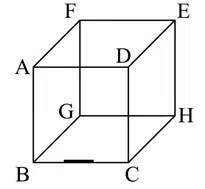
all the faces of the cube will be . (Take, $$\epsilon _o$$ as the free space permittivity)
correct answer:- 4
Question 13
Two point charges $$-4\mu c$$ and $$4\mu c$$, constituting an electric dipole, are placed at (−9, 0, 0)cm and (9, 0, 0)cm in a uniform electric field of strength $$10^{4}NC^{-1}$$. The work done on the dipole in rotating it from the equilibrium through $$180^{\circ}$$ is :
correct answer:- 2
Question 14
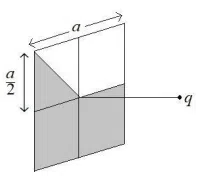
$$ \text{A square loop of sides } a=1\,m \text{ is held normally in front of a point charge } q=1\,C. \text{ The flux of the electric field through the shaded region is } \frac{5}{p}\times\frac{1}{\varepsilon_0}\,Nm^2C^{-1}, \text{ where the value of } p \text{ is } \underline{\hspace{1cm}}. $$
correct answer:- 48
Question 15
A small uncharged conducting sphere is placed in contact with an identical sphere but having $$4\times10^{-8} C$$ charge and then removed to a distance such that the force of repulsion between them is $$9\times10^{-3} N$$. The distance between them is $$ \text{ (Take } \frac{1}{4\pi \epsilon_o} \text{ as }9\times10^{9} \text{ in SI units)}$$
correct answer:- 2

Question 16
correct answer:- 4
Question 17
A particle of mass 'm' and charge 'q'is fastened to one end 'A' of a massless string having equilibrium length l, whose other end is fixed at point 'O'. The whole system is placed on a frictionless horizontal plane and is initially at rest. If uniform electric field is switched on along the direction as shown in figure, then the speed of the particle when it crosses the x -axis is
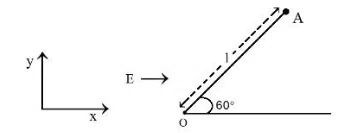
correct answer:- 2
Question 18
An electric dipole of mass m, charge q, and length $$l$$ is placed in a uniform electric field $$\overrightarrow{E} = E_{\circ}\hat{i}$$. When the dipole is rotated slightly from its equilibrium position and released, the time period of its oscillations will be:
correct answer:- 4
Question 19
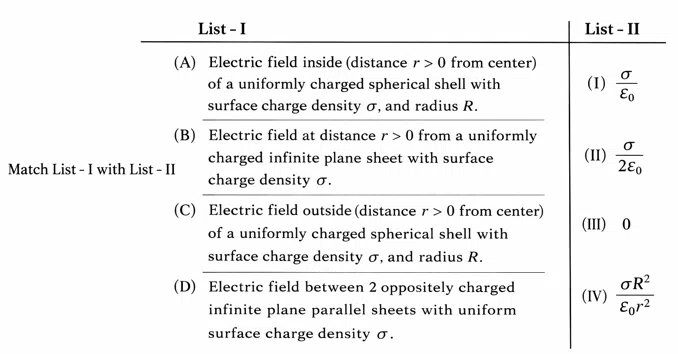
Choose the correct answer from the options given below :
correct answer:- 1
Question 20
A point particle of charge Q is located at P along the axis of an electric dipole 1 at a distance r as shown in the figure. The point P is also on the equatorial plane of a second electric dipole 2 at a distance r . The dipoles are made of opposite charge q separated by a distance 2a. For the charge particle at P not to experience any net
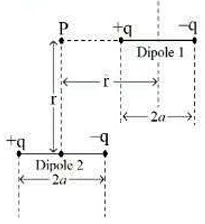
force, which of the following correctly describes the situation?
correct answer:- 4

Question 21
The electric flux is $$\phi=\alpha \sigma+\beta\lambda$$ where $$\lambda$$ and $$\sigma$$ are linear and surface charge density, respectively. $$\left(\frac{\alpha}{\beta}\right)$$ represents
correct answer:- 4
Question 22
A point charge causes an electric flux of $$-2 \times 10^{4}\,\text{N m}^2 \text{C}^{-1}$$ to pass through a spherical Gaussian surface of 8.0 cm radius, centred on the charge. The value of the point charge is : (Given $$\varepsilon_0 = 8.85 \times 10^{-12}\,\text{C}^2 \text{N}^{-1} \text{m}^{-2}$$ )
correct answer:- 4
Question 23
An electric dipole is placed at a distance of 2 cm from an infinite plane sheet having positive charge density $$\sigma_{0}$$.
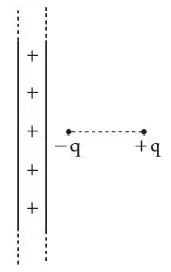
Choose the correct option from the following.
correct answer:- 4
Question 24
An infinitely long positively charged straight thread has a linear charge density $$\lambda\ Cm^{-1}$$. An electron revolves along a circular path having axis along the length of the wire. The graph that correctly represents the variation of the kinetic energy of electron as a function of radius of circular path from the wire is:
correct answer:- 3
Question 25
An infinite plane sheet of charge having uniform surface charge density $$+\sigma_s\ C/m^2$$ is placed on x−y plane. Another infinitely long line charge having uniform linear charge density $$+\lambda_e\ C/m$$ is placed at z = 4 m plane and parallel to y-axis. If the magnitude values $$|\sigma_s| = 2|\lambda_e|$$, then at point (0, 0, 2), the ratio of magnitudes of electric field values due to sheet charge to that of line charge is $$\pi\sqrt{n} : 1$$. The value of n is _____.
correct answer:- 16

Question 26
An electric dipole of dipole moment $$6 \times 10^{-6}Cm$$ is placed in uniform electric field of magnitude $$10^{6}V/m$$. Initially, the dipole moment is parallel to electric field. The work that needs to be done on the dipole to make its dipole moment opposite to the field, will be ____ J.
correct answer:- 12
Question 27
Two identical charged spheres are suspended by strings of equal lengths. The strings make an angle $$\theta$$ with each other. When suspended in water the angle remains the same. If density of the material of the sphere is $$1.5$$ g/cc, the dielectric constant of water will be ______. (Take density of water $$= 1$$ g/cc)
correct answer:- 3
Question 28
The current in a conductor is expressed as $$I = 3t^2 + 4t^3$$, where $$I$$ is in Ampere and $$t$$ is in second. The amount of electric charge that flows through a section of the conductor during $$t = 1$$ s to $$t = 2$$ s is ____________ C.
correct answer:- 22
Question 29
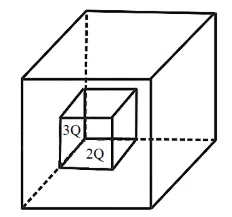
$$C_1$$ and $$C_2$$ are two hollow concentric cubes enclosing charges $$2Q$$ and $$3Q$$ respectively as shown in figure. The ratio of electric flux passing through $$C_1$$ and $$C_2$$ is
correct answer:- 1
Question 30
Suppose a uniformly charged wall provides a uniform electric field of $$2 \times 10^4 \text{ N C}^{-1}$$ normally. A charged particle of mass 2 g being suspended through a silk thread of length 20 cm and remain stayed at a distance of 10 cm from the wall. Then the charge on the particle will be $$\frac{1}{\sqrt{x}} \mu C$$ where $$x$$ = ______ [use $$g = 10 \text{ m s}^{-2}$$]
correct answer:- 3
Question 31
A thin metallic wire having cross sectional area of $$10^{-4} \text{ m}^2$$ is used to make a ring of radius $$30$$ cm. A positive charge of $$2\pi$$ C is uniformly distributed over the ring, while another positive charge of $$30$$ pC is kept at the centre of the ring. The tension in the ring is _______ N; provided that the ring does not get deformed (neglect the influence of gravity). (Given, $$\frac{1}{4\pi\epsilon_0} = 9 \times 10^9$$ SI units)
correct answer:- 3
Question 32
Two charges of $$-4 \mu$$C and $$+4 \mu$$C are placed at the points $$A(1, 0, 4)$$ m and $$B(2, -1, 5)$$ m located in an electric field $$\vec{E} = 0.20\hat{i}$$ V cm$$^{-1}$$. The magnitude of the torque acting on the dipole is $$8\sqrt{\alpha} \times 10^{-5}$$ N m, where $$\alpha$$ = _____.
correct answer:- 2
Question 33
Two charges of $$5Q$$ and $$-2Q$$ are situated at the points $$(3a, 0)$$ and $$(-5a, 0)$$ respectively. The electric flux through a sphere of radius $$4a$$ having centre at origin is:
correct answer:- 2
Question 34
An electron is moving under the influence of the electric field of a uniformly charged infinite plane sheet $$S$$ having surface charge density $$+\sigma$$. The electron at $$t = 0$$ is at a distance of $$1$$ m from $$S$$ and has a speed of $$1$$ m s$$^{-1}$$. The maximum value of $$\sigma$$, if the electron strikes $$S$$ at $$t = 1$$ s is $$\alpha \left[\frac{m\varepsilon_0}{e}\right] \frac{C}{m^2}$$. The value of $$\alpha$$ is _______.
correct answer:- 8
Question 35
An electric field is given by $$\left(6\hat{i} + 5\hat{j} + 3\hat{k}\right)$$ N C$$^{-1}$$. The electric flux through a surface area $$30\hat{i}$$ m$$^2$$ lying in YZ-plane (in SI unit) is:
correct answer:- 3
Question 36
The electrostatic potential due to an electric dipole at a distance $$r$$ varies as :
correct answer:- 2
Question 37
A particle of charge $$-q$$ and mass $$m$$ moves in a circle of radius $$r$$ around an infinitely long line charge of linear density $$+\lambda$$. Then time period will be given as: (Consider $$k$$ as Coulomb's constant)
correct answer:- 2
Question 38
Two identical charged spheres are suspended by strings of equal lengths. The string make an angle of $$37°$$ with each other. When suspended in a liquid of density $$0.7$$ g cm$$^{-3}$$, the angle remains same. If density of material of the sphere is $$1.4$$ g cm$$^{-3}$$, the dielectric constant of the liquid is _____ ($$\tan 37° = \frac{3}{4}$$)
correct answer:- 2
Question 39
Two charges $$q$$ and $$3q$$ are separated by a distance '$$r$$' in air. At a distance $$x$$ from charge $$q$$, the resultant electric field is zero. The value of $$x$$ is :
correct answer:- 3
Question 40
Force between two point charges $$q_1$$ and $$q_2$$ placed in vacuum at $$r$$ cm apart is $$F$$. Force between them when placed in a medium having dielectric $$K = 5$$ at $$\frac{r}{5}$$ cm apart will be:
correct answer:- 2
Question 41
A charge $$q$$ is placed at the center of one of the surface of a cube. The flux linked with the cube is:
correct answer:- 1
Question 42
The vehicles carrying inflammable fluids usually have metallic chains touching the ground :
correct answer:- 4
Question 43
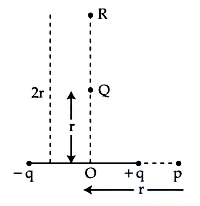
The electric field at point $$p$$ due to an electric dipole is $$E$$. The electric field at point $$R$$ on equitorial line will be $$\frac{E}{x}$$. The value of $$x$$
correct answer:- 16
Question 44
In hydrogen like system the ratio of coulombian force and gravitational force between an electron and a proton is in the order of :
correct answer:- 1
Question 45
$$\sigma$$ is the uniform surface charge density of a thin spherical shell of radius $$R$$. The electric field at any point on the surface of the spherical shell is :
correct answer:- 2
Question 46
Two identical conducting spheres $$P$$ and $$S$$ with charge $$Q$$ on each, repel each other with a force $$16 \text{ N}$$. A third identical uncharged conducting sphere $$R$$ is successively brought in contact with the two spheres. The new force of repulsion between $$P$$ and $$S$$ is :
correct answer:- 2
Question 47
Two charged conducting spheres of radii $$a$$ and $$b$$ are connected to each other by a conducting wire. The ratio of charges of the two spheres respectively is:
correct answer:- 1
Question 48
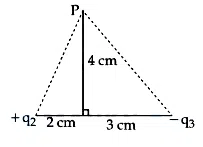
If the net electric field at point P along Y axis is zero, then the ratio of $$\left|\frac{q_2}{q_3}\right|$$ is $$\frac{8}{5\sqrt{x}}$$, where $$x =$$ _____
correct answer:- 5
Question 49
Five charges $$+q, +5q, -2q, +3q$$ and $$-4q$$ are situated as shown in the figure.
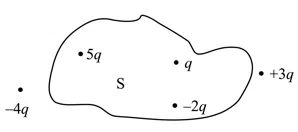
The electric flux due to this configuration through the surface $$S$$ is :
correct answer:- 1
Question 50
An electric field $$\vec{E} = (2x\hat{i}) \text{ NC}^{-1}$$ exists in space. A cube of side $$2 \text{ m}$$ is placed in the space as per figure given below.
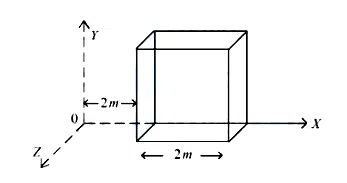
The electric flux through the cube is ______ $$\text{Nm}^2/\text{C}$$.
correct answer:- 16