
Join Our JEE Preparation Group
Prep with like-minded aspirants; Get access to free daily tests and study material.
Sign in
Please select an account to continue using cracku.in
↓ →
Join Our JEE Preparation Group
Prep with like-minded aspirants; Get access to free daily tests and study material.
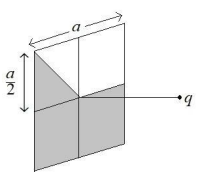
A square loop of sides $$a=1\,m$$ is held normally in front of a point charge $$q=1\,C.$$ The flux of the electric field through the shaded region is $$\frac{5}{p}\times\frac{1}{\varepsilon_0}\,Nm^2C^{-1}$$, where the value of $$p$$ is $$\underline{\hspace{1cm}}.$$
Correct Answer: 48
Use solid angle idea.
Flux through any surface due to point charge is
$$\Phi=\frac{q}{4\pi\varepsilon_0}\Omega$$
where Ω\OmegaΩ is solid angle subtended by the surface at the charge.
The charge is located on the normal through the center of the square, and from the geometry shown, the whole square subtends a solid angle corresponding to a face of a cube with charge at cube center.
Flux through entire square is therefore
$$\Phi_{\text{square}}=\frac{q}{6\varepsilon_0}$$
since total flux
$$\frac{q}{\varepsilon_0}$$
gets equally shared among 6 cube faces.
Given
q=1C
so
$$\Phi_{\text{square}}=\frac{1}{6\varepsilon_0}$$
Now look at shaded region.
its area is
$$\frac{5a^2}{8}$$
So shaded fraction of the square is
$$\frac{5}{8}$$
Flux through the whole square (one face of the imaginary cube) is
$$\frac{q}{6\varepsilon_0}$$
Hence flux through shaded region is
$$\Phi=\frac{5}{8}\cdot\frac{q}{6\varepsilon_0}$$
With
q=1
$$\Phi=\frac{5}{48\varepsilon_0}$$
Comparing with
$$\frac{5}{p}\cdot\frac{1}{\varepsilon_0}$$
we get
$$p=48$$
Click on the Email ☝️ to Watch the Video Solution
Create a FREE account and get:
_1.webp)

Educational materials for JEE preparation

Ask our AI anything

AI can make mistakes. Please verify important information.
AI can make mistakes. Please verify important information.


