
Join Our JEE Preparation Group
Prep with like-minded aspirants; Get access to free daily tests and study material.
Sign in
Please select an account to continue using cracku.in
↓ →
Join Our JEE Preparation Group
Prep with like-minded aspirants; Get access to free daily tests and study material.
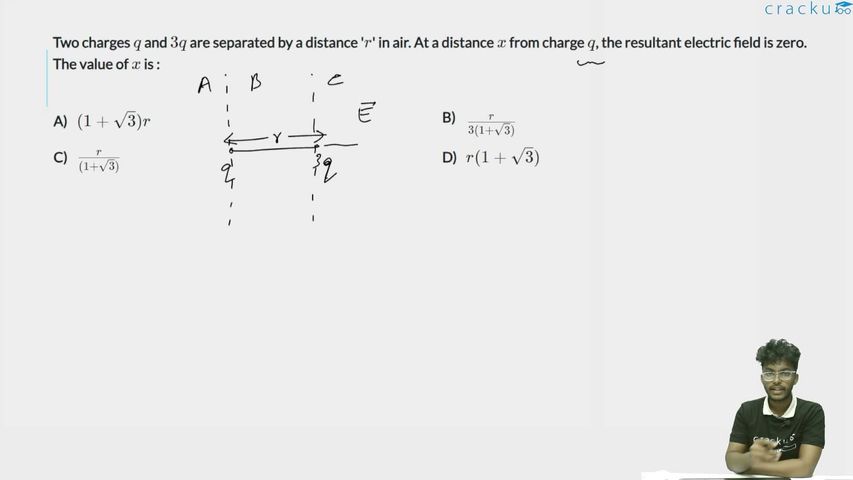
Two charges $$q$$ and $$3q$$ are separated by a distance '$$r$$' in air. At a distance $$x$$ from charge $$q$$, the resultant electric field is zero. The value of $$x$$ is :
Two charges $$q$$ and $$3q$$ are separated by a distance $$r$$. We need to find the point between them where the resultant electric field is zero. Let the charge $$q$$ be at position O and the charge $$3q$$ at position $$r$$; let the point where the electric field vanishes be at a distance $$x$$ from $$q$$ (and hence at distance $$(r - x)$$ from $$3q$$). Since both charges are positive, the zero-field point lies between them where their fields are oppositely directed.
At distance $$x$$ from $$q$$, its field points away from $$q$$ (toward $$3q$$), while the field due to $$3q$$ at distance $$(r-x)$$ points away from $$3q$$ (toward $$q$$). Setting their magnitudes equal gives:
$$\frac{kq}{x^2} = \frac{k(3q)}{(r-x)^2}$$
Canceling $$kq$$ yields $$\frac{1}{x^2} = \frac{3}{(r-x)^2}$$. Cross-multiplying gives $$(r-x)^2 = 3x^2$$, and taking the positive root (since $$x>0$$ and $$r-x>0$$) leads to $$r - x = \sqrt{3}\,x$$, hence $$r = x(1 + \sqrt{3})$$ and
$$x = \frac{r}{1 + \sqrt{3}}$$
Numerically, with $$\sqrt{3}\approx1.732$$, this yields $$x\approx\frac{r}{2.732}\approx0.366r$$, confirming the point is between the charges and closer to the smaller charge $$q$$, as expected.
The correct answer is Option (3): $$\frac{r}{1 + \sqrt{3}}$$
Was this solution helpful?
Click on the Email ☝️ to Watch the Video Solution
Create a FREE account and get:
_1.webp)

Educational materials for JEE preparation

Ask our AI anything

AI can make mistakes. Please verify important information.
AI can make mistakes. Please verify important information.
