
Join Our JEE Preparation Group
Prep with like-minded aspirants; Get access to free daily tests and study material.
Sign in
Please select an account to continue using cracku.in
↓ →
Join Our JEE Preparation Group
Prep with like-minded aspirants; Get access to free daily tests and study material.
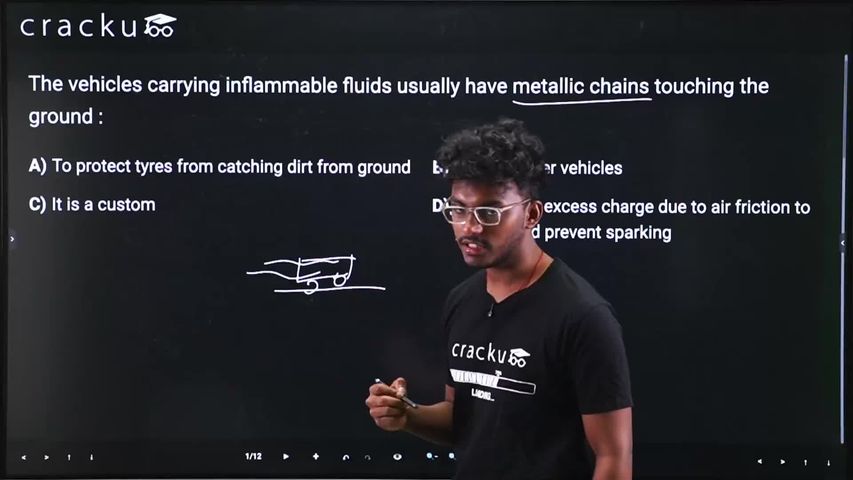
The vehicles carrying inflammable fluids usually have metallic chains touching the ground :
This question asks why vehicles carrying inflammable (flammable) fluids have metallic chains that touch the ground.
When a vehicle moves along a road, friction between the tyres and the road surface, as well as friction between the vehicle body and the air, causes a build-up of static electric charge on the vehicle's metallic body. This is similar to how rubbing a balloon on cloth creates static charge.
For ordinary vehicles, this small accumulation of charge is not a major concern. However, for vehicles carrying inflammable fluids (such as petroleum tankers), even a tiny spark can ignite the vapours and cause a catastrophic explosion.
A spark occurs when the accumulated charge reaches a high enough potential difference to ionise the surrounding air and discharge suddenly. To prevent this, metallic chains are attached to the vehicle so that they drag along the ground. Since metals are good conductors of electricity, the chain provides a continuous conducting path from the vehicle body to the ground (earth). This allows the excess charge to flow harmlessly to the earth as it builds up, keeping the vehicle at ground potential and preventing any dangerous accumulation of charge.
This is an application of the principle of earthing or grounding, which is widely used in electrical safety.
Therefore, the correct answer is Option (4): To conduct excess charge due to air friction to ground and prevent sparking.
Was this solution helpful?
Click on the Email ☝️ to Watch the Video Solution
Create a FREE account and get:
_1.webp)

Educational materials for JEE preparation

Ask our AI anything

AI can make mistakes. Please verify important information.
AI can make mistakes. Please verify important information.
