Group
Group
 Group
Group

JEE Kinematics PYQs
JEE Kinematics PYQs are an important part of the JEE Physics syllabus. They help you understand the kind of questions asked from this chapter and test how well you know the basic concepts, such as distance and displacement, speed and velocity, acceleration, equations of motion, relative motion, projectile motion, and graphs.
In the exam, kinematics questions usually come as direct numerical problems or simple concept-based questions. The good thing is that this chapter becomes much easier when your basics are clear. Once you understand the main ideas and know which formula to use, solving questions feels much more manageable. You do not need to think of kinematics as a very difficult chapter. With regular revision and smart practice, it can become one of the more scoring parts of JEE Physics.
In this blog, you will find a simple formula PDF, a section for important JEE Kinematics PYQs in download format, a few practice questions with answers, and some extra questions to solve on your own. You will also learn about common mistakes students often make and a few simple tips to save time in the exam.
JEE Kinematics Important PYQs PDF
This PDF can include the most important previous year questions from kinematics. It may cover topics like distance and displacement, speed and velocity, acceleration, equations of motion, free fall, relative motion, projectile motion, and motion graphs.
Practicing these questions will help you understand the exam pattern better. It will also improve your speed, accuracy, and confidence before the exam.
Important Formulas for JEE Kinematics PYQs
You only need a few important formulas and ideas to solve most kinematics questions in JEE. These formulas help you understand motion, calculate displacement, speed, velocity, time, acceleration, and solve graph-based questions more easily.
You can download the full formula PDF from the link . Here is a quick look at some of the main formulas:
| Concept | Formula |
|---|---|
| First Equation of Motion | $$v = u + at$$ |
| Second Equation of Motion | $$s = ut + \frac{1}{2}at^2$$ |
| Third Equation of Motion | $$v^2 = u^2 + 2as$$ |
| Average Velocity | $$v_{\text{avg}} = \frac{u+v}{2}$$ |
| Speed | $$\text{Speed} = \frac{\text{Distance}}{\text{Time}}$$ |
| Velocity | $$\text{Velocity} = \frac{\text{Displacement}}{\text{Time}}$$ |
| Acceleration | $$a = \frac{\text{Change in Velocity}}{\text{Time}}$$ |
| Relative Velocity | $$V_{AB} = V_A-V_B$$ |
| Time of Flight | $$T = \frac{2u\sin\theta}{g}$$ |
| Maximum Height of Projectile | $$H = \frac{u^2\sin^2\theta}{2g}$$ |
| Horizontal Range | $$R = \frac{u^2\sin 2\theta}{g}$$ |
These formulas are commonly used in questions based on straight-line motion, vertical motion, relative motion, projectile motion, and graph-based problems. If you revise them properly, many JEE questions will feel much easier to solve.
Top 5 Common Mistakes to Avoid in JEE Kinematics PYQs
Many students feel that kinematics is confusing at first because it includes both concepts and formulas. But most mistakes happen because small details are missed while solving. Here are some common mistakes you should avoid:
Mixing up distance and displacement
Distance and displacement are not the same. Distance is the total path covered, while displacement is the shortest straight-line distance between the starting point and ending point.
Confusing speed with velocity
Speed is a scalar quantity, while velocity is a vector quantity. Many students use them in the same way and make mistakes in concept-based questions.
Using the wrong equation of motion
Every question does not need all three equations. First check what values are given, then choose the right formula.
Ignoring the sign of acceleration
In vertical motion and slowing-down problems, sign matters a lot. A wrong sign can completely change the answer.
Misreading graphs
Questions based on displacement-time and velocity-time graphs are common. Many students read them too quickly and miss what slope or area actually means.
List of JEE Kinematics PYQs
Here is a short set of JEE-style kinematics questions for practice. These include common question types from equations of motion, velocity, acceleration, projectile motion, and relative motion. Solving them regularly can help you become faster and more confident.
Question 1
A river of width 200 m is flowing from west to east with a speed of 18 km/h. A boat, moving with speed of 36 km/h in still water, is made to travel one-round trip (bank to bank of the river). Minimum time taken by the boat for this journey and also the displacement along the river bank are _______ and ____________ respectively.
correct answer:- 3
Question 2
The velocity (v) - Distance (x) graph is shown in figure. Which graph represents accderation(a) versus distance (x) variation of this system?
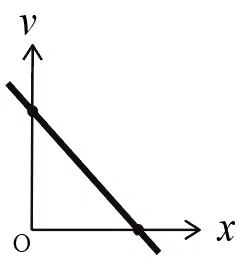
correct answer:- 4
Question 3
A paratrooper jumps from an aeroplane and opens a parachute after 2 s of free fall and starts deaccelerating with $$3m/s^{2}$$. At 10 m height from ground, while descending with the help of parachute, the speed of paratrooper is 5 m/s. The initial height of the airplane is ___ m.
($$g = 10 m/s^{2}$$)
correct answer:- 2
Question 4
A particle starts moving from time t = 0 and its coordinate is given as $$x(t)=4Tt^{3}-3t$$
A. The particle returns to its original position (origin) 0.866 units later
B. The particle is 1 unit away from origin at its turning point
C. Acceleration of the particle is non-negative
D. The particle is 0.5 units away from origin at its turning point
E. Particle neveT turns back as accelerntion is non-negative
Choose the correct answer from the options given below :
correct answer:- 2
Question 5
When the position vector $$\overrightarrow{r}=x\widehat{i}+y\widehat{j}+z\widehat{k}$$ changes sign as $$-\overrightarrow{r}$$, which one of the following vector will not flip under sign change?
correct answer:- 1

Question 6
$$\text{The position vector of a moving body at any instant of time is given as }\vec r=(5t^2\hat i-5t\hat j)\,m.\text{The magnitude and direction of velocity at } t=2\,s \text{ is:}$$
correct answer:- 4
Question 7
The motion of an airplane is represented by velocity-time graph as shown below. The distance covered by
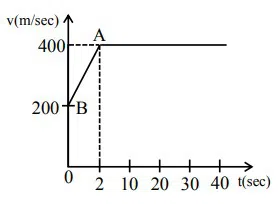
airplane in the first 30.5 second is _______ km .
correct answer:- 1
Question 8
A body travels 102.5 m in the $$n^{th}$$ second and 115.0 m in the $$(n+2)^{th}$$ second. The acceleration is:
correct answer:- 1
Question 9
The velocity-time graph of an object moving along a straight line is shown in figure. What is the distance covered by the object between $$t = 0 to t = 4 s$$ ?
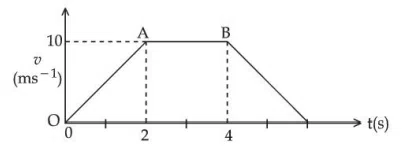
correct answer:- 1
Question 10
A particle is moving in one dimension (along $$x$$ axis) under the action of a variable force. Its initial position was $$16$$ m right of origin. The variation of its position $$x$$ with time $$t$$ is given as $$x = -3t^3 + 18t^2 + 16t$$, where $$x$$ is in m and $$t$$ is in s. The velocity of the particle when its acceleration becomes zero is _________ m s$$^{-1}$$.
correct answer:- 52

Question 11
Train A is moving along two parallel rail tracks towards north with $$72 \text{ km h}^{-1}$$ and train B is moving towards south with speed $$108 \text{ km h}^{-1}$$. Velocity of train B with respect to A and velocity of ground with respect to B are (in $$\text{m s}^{-1}$$):
correct answer:- 3
Question 12
A particle initially at rest starts moving from reference point $$x = 0$$ along x-axis, with velocity $$v$$ that varies as $$v = 4\sqrt{x}$$ m s$$^{-1}$$. The acceleration of the particle is ______ m s$$^{-2}$$.
correct answer:- 8
Question 13
A bullet is fired into a fixed target looses one third of its velocity after travelling 4 cm. It penetrates further $$D \times 10^{-3}$$ m before coming to rest. The value of $$D$$ is :
correct answer:- 1
Question 14
A body falling under gravity covers two points A and B separated by 80 m in 2 s. The distance of upper point A from the starting point is _____ m. Use g = 10 m s$$^{-2}$$
correct answer:- 45
Question 15
A body starts moving from rest with constant acceleration covers displacement $$S_1$$ in first $$(p - 1)$$ seconds and $$S_2$$ in first $$p$$ seconds. The displacement $$S_1 + S_2$$ will be made in time :
correct answer:- 2

Question 16
A particle is moving in a straight line. The variation of position $$x$$ as a function of time $$t$$ is given as $$x = (t^3 - 6t^2 + 20t + 15)$$ m. The velocity of the body when its acceleration becomes zero is:
correct answer:- 2
Question 17
The displacement and the increase in the velocity of a moving particle in the time interval of $$t$$ to $$(t + 1)$$ s are $$125 \text{ m}$$ and $$50 \text{ m s}^{-1}$$, respectively. The distance travelled by the particle in $$(t + 2)^{th}$$ s is __________ m.
correct answer:- 175
Question 18
The relation between time '$$t$$' and distance '$$x$$' is $$t = \alpha x^2 + \beta x$$, where $$\alpha$$ and $$\beta$$ are constants. The relation between acceleration $$a$$ and velocity $$v$$ is:
correct answer:- 1
Question 19
An artillery piece of mass $$M_1$$ fires a shell of mass $$M_2$$ horizontally. Instantaneously after the firing, the ratio of kinetic energy of the artillery and that of the shell is :
correct answer:- 2
Question 20
A bus moving along a straight highway with speed of $$72$$ km/h is brought to halt within $$4$$ s after applying the brakes. The distance travelled by the bus during this time (Assume the retardation is uniform) is _____ m.
correct answer:- 40

Question 21
A body moves on a frictionless plane starting from rest. If $$S_n$$ is distance moved between $$t = n - 1$$ and $$t = n$$ and $$S_{n-1}$$ is distance moved between $$t = n - 2$$ and $$t = n - 1$$, then the ratio $$\frac{S_{n-1}}{S_n}$$ is $$\left(1 - \frac{2}{x}\right)$$ for $$n = 10$$. The value of $$x$$ is ______.
correct answer:- 19
Question 22
A body projected vertically upwards with a certain speed from the top of a tower reaches the ground in $$t_1$$. If it is projected vertically downwards from the same point with the same speed, it reaches the ground in $$t_2$$. Time required to reach the ground, if it is dropped from the top of the tower, is :
correct answer:- 1
Question 23
A particle moves in a straight line so that its displacement $$x$$ at any time $$t$$ is given by $$x^2 = 1 + t^2$$. Its acceleration at any time $$t$$ is $$x^{-n}$$ where $$n =$$ ___________
correct answer:- 3
Question 24
A particle moving in a straight line covers half the distance with speed $$6$$ m/s. The other half is covered in two equal time intervals with speeds $$9$$ m/s and $$15$$ m/s respectively. The average speed of the particle during the motion is :
correct answer:- 2
Question 25
Two cars are travelling towards each other at speed of $$20 \text{ m s}^{-1}$$ each. When the cars are $$300 \text{ m}$$ apart, both the drivers apply brakes and the cars retard at the rate of $$2 \text{ m s}^{-2}$$. The distance between them when they come to rest is :
correct answer:- 2

Question 26
An object moves with speed $$v_1, v_2$$ and $$v_3$$ along a line segment $$AB, BC$$ and $$CD$$ respectively as shown in figure. Where $$AB = BC$$ and $$AD = 3AB$$, then average speed of the object will be
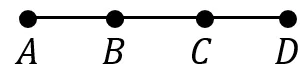
correct answer:- 3
Question 27
For a train engine moving with speed of $$20 \text{ ms}^{-1}$$, the driver must apply brakes at a distance of 500 m before the station for the train to come to rest at the station. If the brakes were applied at half of this distance, the train engine would cross the station with speed $$\sqrt{x} \text{ ms}^{-1}$$. The value of $$x$$ is ______. (Assuming same retardation is produced by brakes)
correct answer:- 200
Question 28
A projectile is thrown upward at an angle $$60 ^{o}$$ with the horizontal. The speed of the projectile is 20 m/s when its direction of motion is $$45 ^{o}$$ with the horizontal. The initial speed of the projectile is ______ m/s.
correct answer:- 4
Question 29
A boy throws a ball into air at 45° from the horizontal to land it on a roof of a building of height H . If the ball attains maximum height in 2 s and lands on the building in 3 s after launch, then value of H is ___ m. $$(g=10m/s^{2})$$
correct answer:- 4
Question 30
A particle is projected at an angle of $$30^{o}$$ from horizontal at a speed of $$ 60 m/s.$$ The height traversed by the particle in the first second is $$ h_0 $$ and height traversed in the last second, before it reaches the maximum height, is $$ h_1.$$ The ratio $$h_0:h_1 $$ is _______[Take, $$g=10m/s^{2}]$$
correct answer:- 5
Question 31
A car of mass $$m$$ moves on a banked road having radius $$' r '$$ and banking angle $$\theta.$$ To avoid slipping from the banked road, the maximum permissible speed of the car is $$v_0.$$ The coefficient of friction $$\mu$$ between the wheels of the car and the banked road is:
correct answer:- 3
Question 32
Two projectiles are fired with same initial speed from same point on ground at angles of $$(45^{\circ}-\alpha)$$ and$$ (45^{\circ}+\alpha)$$, respectively, with the horizontal direction. The ratio of their maximum heights attained is :
correct answer:- 2
Question 33
The maximum speed of a boat in still water is 27 km/h. Now this boat is moving downstream in a river flowing at 9 km/h. A man in the boat throws a ball vertically upwards with speed of 10 m/s. Range of the ball as observed by an observer at rest on the river bank, is _______ cm. (Take g = $$10 m/s^{2}$$)
correct answer:- 2000
Question 34
Two particles are located at equal distance from origin. The position vectors of those are represented by $$\overline{A}=2\widehat{i}+3n\widehat{j}+2\widehat{k}$$ and $$\overline{B}=2\widehat{i}-2\widehat{j}+4p\widehat{k}$$, respectively. If both the vectors are at right angle to each other, the value of $$n^{-1}$$ is _____ .
correct answer:- 3
Question 35
The co-ordinates of a particle moving in x-y plane are given by: $$x = 2 + 4t,\ y = 3t + 8t^2$$. The motion of the particle is:
correct answer:- 1
Question 36
A particle moving in a circle of radius $$R$$ with uniform speed takes time $$T$$ to complete one revolution. If this particle is projected with the same speed at an angle $$\theta$$ to the horizontal, the maximum height attained by it is equal to $$4R$$. The angle of projection $$\theta$$ is then given by :
correct answer:- 1
Question 37
Position of an ant (S in metres) moving in $$Y - Z$$ plane is given by $$S = 2t^2 \hat{j} + 5\hat{k}$$ (where $$t$$ is in second). The magnitude and direction of velocity of the ant at $$t = 1$$ s will be :
correct answer:- 4
Question 38
A particle starts from origin at $$t = 0$$ with a velocity $$5\hat{i} \text{ m s}^{-1}$$ and moves in $$x - y$$ plane under action of a force which produces a constant acceleration of $$(3\hat{i} + 2\hat{j}) \text{ m s}^{-2}$$. If the $$x$$-coordinate of the particle at that instant is $$84$$ m, then the speed of the particle at this time is $$\sqrt{\alpha} \text{ m s}^{-1}$$. The value of $$\alpha$$ is _______.
correct answer:- 673
Question 39
A ball rolls off the top of a stairway with horizontal velocity $$u$$. The steps are $$0.1$$ m high and $$0.1$$ m wide. The minimum velocity $$u$$ with which that ball just hits the step 5 of the stairway will be $$\sqrt{x}$$ m s$$^{-1}$$, where $$x =$$ _______ [use $$g = 10$$ m s$$^{-2}$$].
correct answer:- 2
Question 40
A particle is moving in a circle of radius $$50$$ cm in such a way that at any instant the normal and tangential components of its acceleration are equal. If its speed at $$t = 0$$ is $$4 \text{ m s}^{-1}$$, the time taken to complete the first revolution will be $$\frac{1}{\alpha}\left[1 - e^{-2\pi}\right]$$ s, where $$\alpha =$$ ______.
correct answer:- 8
Question 41
A particle of mass $$m$$ projected with a velocity $$u$$ making an angle of $$30°$$ with the horizontal. The magnitude of angular momentum of the projectile about the point of projection when the particle is at its maximum height $$h$$ is :
correct answer:- 1
Question 42
Projectiles $$A$$ and $$B$$ are thrown at angles of $$45°$$ and $$60°$$ with vertical respectively from top of a 400 m high tower. If their times of flight are same, the ratio of their speeds of projection $$v_A : v_B$$ is:
correct answer:- 4
Question 43
A vector has magnitude same as that of $$\vec{A} = 3\hat{i} + 4\hat{j}$$ and is parallel to $$\vec{B} = 4\hat{i} + 3\hat{j}$$. The $$x$$ and $$y$$ components of this vector in first quadrant are $$x$$ and 3 respectively where $$x$$ = ____.
correct answer:- 4
Question 44
A body starts falling freely from height $$H$$ hits an inclined plane in its path at height $$h$$. As a result of this perfectly elastic impact, the direction of the velocity of the body becomes horizontal. The value of $$\frac{H}{h}$$ for which the body will take the maximum time to reach the ground is _____.
correct answer:- 2
Question 45
If two vectors $$\vec{A}$$ and $$\vec{B}$$ having equal magnitude $$R$$ are inclined at an angle $$\theta$$, then
correct answer:- 3
Question 46
A body of mass $$m$$ is projected with a speed $$u$$ making an angle of $$45°$$ with the ground. The angular momentum of the body about the point of projection, at the highest point is expressed as $$\frac{\sqrt{2}mu^3}{Xg}$$. The value of $$X$$ is
correct answer:- 8
Question 47
A cyclist starts from the point $$P$$ of a circular ground of radius $$2$$ km and travels along its circumference to the point $$S$$. The displacement of a cyclist is:
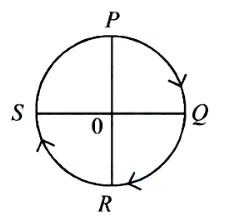
correct answer:- 1
Question 48
A man carrying a monkey on his shoulder does cycling smoothly on a circular track of radius $$9$$ m and completes 120 revolutions in 3 minutes. The magnitude of centripetal acceleration of monkey is (in $$m/s^2$$) :
correct answer:- 4
Question 49
The maximum height reached by a projectile is $$64$$ m. If the initial velocity is halved, the new maximum height of the projectile is ______ m.
correct answer:- 16
Question 50
The angle between vector $$\vec{Q}$$ and the resultant of $$(2\vec{Q} + 2\vec{P})$$ and $$(2\vec{Q} - 2\vec{P})$$ is :
correct answer:- 2
.webp)