
Join Our JEE Preparation Group
Prep with like-minded aspirants; Get access to free daily tests and study material.
Sign in
Please select an account to continue using cracku.in
↓ →
Join Our JEE Preparation Group
Prep with like-minded aspirants; Get access to free daily tests and study material.
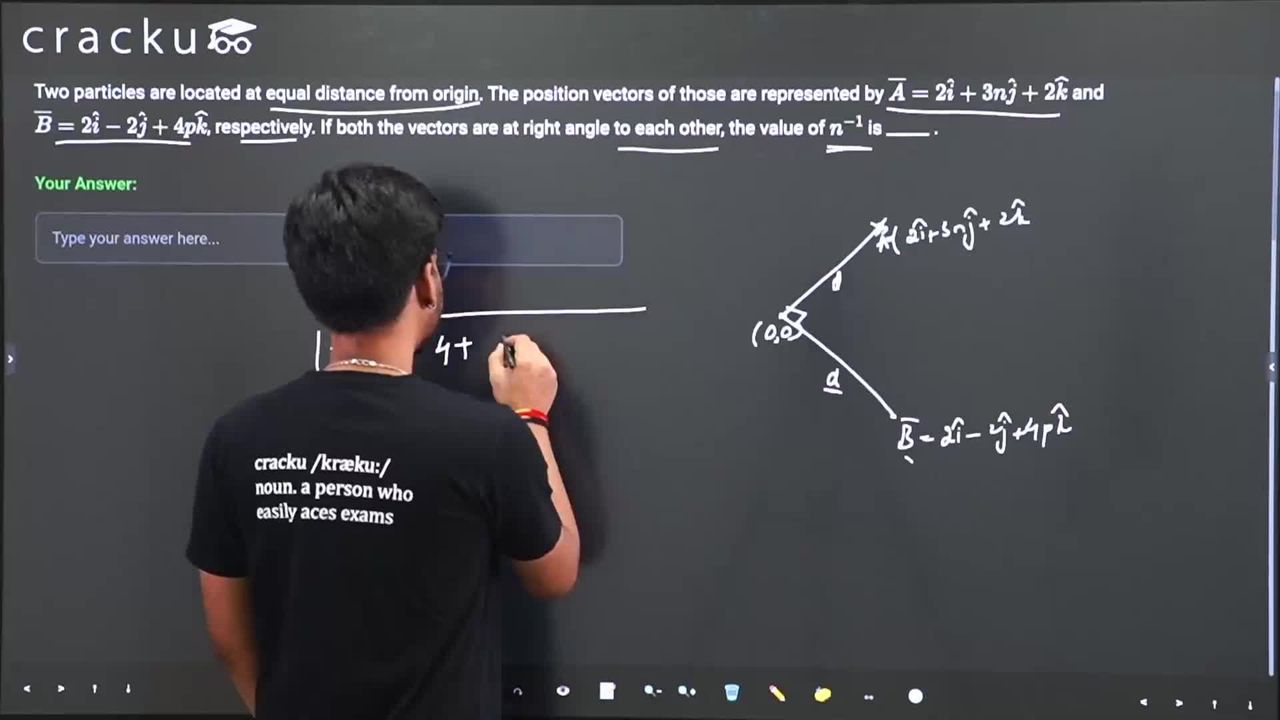
Two particles are located at equal distance from origin. The position vectors of those are represented by $$\overline{A}=2\widehat{i}+3n\widehat{j}+2\widehat{k}$$ and $$\overline{B}=2\widehat{i}-2\widehat{j}+4p\widehat{k}$$, respectively. If both the vectors are at right angle to each other, the value of $$n^{-1}$$ is _____ .
Correct Answer: 3
Let the two position vectors be $$\vec{A} = 2\hat{i} + 3n\hat{j} + 2\hat{k}$$ and $$\vec{B} = 2\hat{i} - 2\hat{j} + 4p\hat{k}$$. Since both particles are equidistant from the origin, their magnitudes are equal, that is $$|\vec{A}| = |\vec{B}|$$.
Thus we have $$ 4 + 9n^2 + 4 = 4 + 4 + 16p^2 $$ which simplifies to $$ 9n^2 = 16p^2 \quad \cdots (1).$$
Moreover, the perpendicularity condition $$\vec{A}\cdot\vec{B}=0$$ gives $$ (2)(2) + (3n)(-2) + (2)(4p) = 0 $$ or $$ 4 - 6n + 8p = 0, $$ hence $$ 8p = 6n - 4 $$ and $$ p = \frac{6n - 4}{8} = \frac{3n - 2}{4} \quad \cdots (2).$$
Substituting (2) into (1) yields $$ 9n^2 = 16 \left(\frac{3n - 2}{4}\right)^2 = 16 \cdot \frac{(3n-2)^2}{16} = (3n-2)^2, $$ so $$ 9n^2 = 9n^2 - 12n + 4, $$ which leads to $$ 0 = -12n + 4 $$ and $$ n = \frac{1}{3}. $$
Therefore, $$n^{-1} = 3$$, and the answer is 3.
Was this solution helpful?
Click on the Email ☝️ to Watch the Video Solution
Create a FREE account and get:
_1.webp)

Educational materials for JEE preparation

Ask our AI anything

AI can make mistakes. Please verify important information.
AI can make mistakes. Please verify important information.
