
Join Our JEE Preparation Group
Prep with like-minded aspirants; Get access to free daily tests and study material.
Sign in
Please select an account to continue using cracku.in
↓ →
Join Our JEE Preparation Group
Prep with like-minded aspirants; Get access to free daily tests and study material.
A car of mass $$m$$ moves on a banked road having radius $$' r '$$ and banking angle $$\theta.$$ To avoid slipping from the banked road, the maximum permissible speed of the car is $$v_0.$$ The coefficient of friction $$\mu$$ between the wheels of the car and the banked road is:
consider forces on the car on a banked road
forces acting:
for maximum speed, the car tends to slip up the incline, so friction acts down the slope
resolve forces:
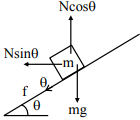
along horizontal (towards center → provides centripetal force)
N sinθ + f cosθ = m v₀² / r
along vertical (no vertical acceleration)
N cosθ − f sinθ = mg
at limiting condition:
f = μN
substitute f = μN
horizontal:
N sinθ + μN cosθ = m v₀² / r
N (sinθ + μ cosθ) = m v₀² / r …(1)
vertical:
N cosθ − μN sinθ = mg
N (cosθ − μ sinθ) = mg …(2)
divide (1) by (2):
(sinθ + μ cosθ) / (cosθ − μ sinθ) = (v₀² / rg)
cross multiply:
sinθ + μ cosθ = (v₀² / rg)(cosθ − μ sinθ)
expand:
sinθ + μ cosθ = (v₀² / rg)cosθ − (v₀² / rg)μ sinθ
collect μ terms:
μ cosθ + (v₀² / rg)μ sinθ = (v₀² / rg)cosθ − sinθ
factor μ:
μ [cosθ + (v₀² / rg) sinθ] = (v₀² / rg)cosθ − sinθ
final expression:
μ = [ (v₀² / rg)cosθ − sinθ ] / [ cosθ + (v₀² / rg) sinθ ]
$$ \mu=\frac{v_0^2-rg\tan\theta}{rg+v_0^2\tan\theta} $$
this is the required coefficient of friction for maximum speed.
Was this solution helpful?
Create a FREE account and get:
_1.webp)

Educational materials for JEE preparation

Ask our AI anything

AI can make mistakes. Please verify important information.
AI can make mistakes. Please verify important information.
