
Join Our JEE Preparation Group
Prep with like-minded aspirants; Get access to free daily tests and study material.
Sign in
Please select an account to continue using cracku.in
↓ →
Join Our JEE Preparation Group
Prep with like-minded aspirants; Get access to free daily tests and study material.
If two vectors $$\vec{A}$$ and $$\vec{B}$$ having equal magnitude $$R$$ are inclined at an angle $$\theta$$, then
We need to find $$|\vec{A} + \vec{B}|$$ for two vectors of equal magnitude $$R$$ inclined at angle $$\theta$$.
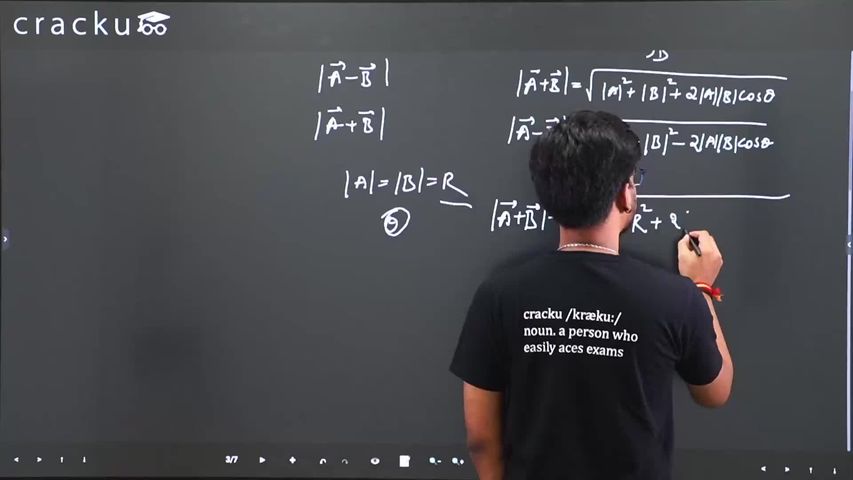
Since the magnitude of the sum of two vectors is given by the parallelogram law, $$|\vec{A} + \vec{B}|^2 = |\vec{A}|^2 + |\vec{B}|^2 + 2|\vec{A}||\vec{B}|\cos\theta$$.
Substituting $$|\vec{A}| = |\vec{B}| = R$$ into this expression gives $$|\vec{A} + \vec{B}|^2 = R^2 + R^2 + 2R^2\cos\theta = 2R^2(1 + \cos\theta)$$.
Using the double angle identity $$1 + \cos\theta = 2\cos^2\left(\frac{\theta}{2}\right)$$, it follows that $$|\vec{A} + \vec{B}|^2 = 2R^2 \times 2\cos^2\left(\frac{\theta}{2}\right) = 4R^2\cos^2\left(\frac{\theta}{2}\right)$$.
Now, taking the positive square root yields $$|\vec{A} + \vec{B}| = 2R\cos\left(\frac{\theta}{2}\right)$$.
For verification, one can similarly compute $$|\vec{A} - \vec{B}|^2 = 2R^2(1-\cos\theta) = 4R^2\sin^2\left(\frac{\theta}{2}\right)$$, giving $$|\vec{A}-\vec{B}| = 2R\sin\left(\frac{\theta}{2}\right)$$, which matches Option 1's formula but with coefficient 2 (not $$\sqrt{2}$$) and therefore Option 1 is incorrect.
The correct answer is Option 3: $$|\vec{A} + \vec{B}| = 2R\cos\frac{\theta}{2}$$.
Was this solution helpful?
Click on the Email ☝️ to Watch the Video Solution
Create a FREE account and get:
_1.webp)

Educational materials for JEE preparation

Ask our AI anything

AI can make mistakes. Please verify important information.
AI can make mistakes. Please verify important information.
