
Join Our JEE Preparation Group
Prep with like-minded aspirants; Get access to free daily tests and study material.
Sign in
Please select an account to continue using cracku.in
↓ →
Join Our JEE Preparation Group
Prep with like-minded aspirants; Get access to free daily tests and study material.
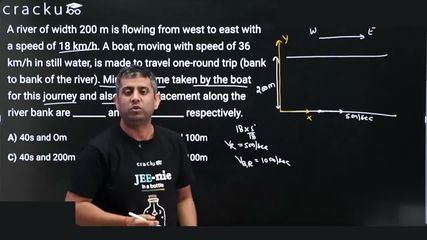
A river of width 200 m is flowing from west to east with a speed of 18 km/h. A boat, moving with speed of 36 km/h in still water, is made to travel one-round trip (bank to bank of the river). Minimum time taken by the boat for this journey and also the displacement along the river bank are _______ and ____________ respectively.
We are given that the river width is 200 m, the river speed is 18 km/h (west to east), and the boat speed in still water is 36 km/h. We need to find the minimum round-trip time and the displacement along the river bank.
First, we convert the speeds to meters per second: the river speed is $$v_r = 18 \text{ km/h} = 18 \times \frac{5}{18} = 5$$ m/s, and the boat speed in still water is $$v_b = 36 \text{ km/h} = 36 \times \frac{5}{18} = 10$$ m/s.
For the minimum crossing time, the boat should head straight across (perpendicular to the banks), so the component of its velocity perpendicular to the banks is the full 10 m/s.
The time for one crossing is then $$t_1 = \frac{\text{width}}{v_{\perp}} = \frac{200}{10} = 20$$ s, and the round-trip time is $$T = 2 \times 20 = 40$$ s.
Next, during each crossing the river current carries the boat downstream by an amount $$\text{drift} = v_r \times t_1 = 5 \times 20 = 100$$ m. On the return trip the situation is the same, so the total drift is $$\text{total drift} = 100 + 100 = 200$$ m in the direction of the river flow.
Thus, the minimum time is 40 s and the displacement along the river bank is 200 m, corresponding to Option (3): 40 s and 200 m.
Was this solution helpful?
Click on the Email ☝️ to Watch the Video Solution
Create a FREE account and get:
_1.webp)

Educational materials for JEE preparation

Ask our AI anything

AI can make mistakes. Please verify important information.
AI can make mistakes. Please verify important information.
