
Join Our JEE Preparation Group
Prep with like-minded aspirants; Get access to free daily tests and study material.
Sign in
Please select an account to continue using cracku.in
↓ →
Join Our JEE Preparation Group
Prep with like-minded aspirants; Get access to free daily tests and study material.
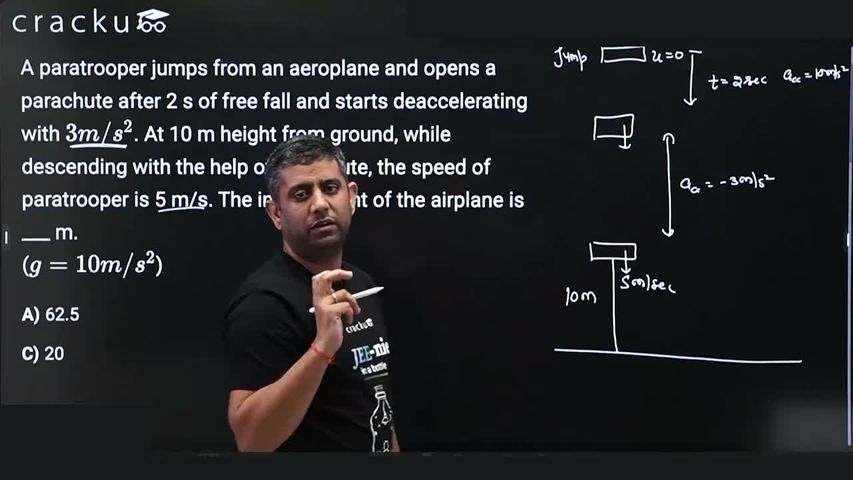
A paratrooper jumps from an aeroplane and opens a parachute after 2 s of free fall and starts deaccelerating with $$3m/s^{2}$$. At 10 m height from ground, while descending with the help of parachute, the speed of paratrooper is 5 m/s. The initial height of the airplane is ___ m.
($$g = 10 m/s^{2}$$)
We need to find the initial height of the aeroplane given the paratrooper's motion in three phases.
First, during free fall for 2 seconds, we use $$v = u + gt$$ with $$u = 0$$, $$g = 10 \, \text{m/s}^2$$, and $$t = 2 \, \text{s}$$ which gives us $$v_1 = 0 + 10 \times 2 = 20 \, \text{m/s}$$. The distance fallen is then $$s_1 = ut + \tfrac{1}{2}gt^2 = 0 + \tfrac{1}{2} \times 10 \times 4 = 20 \, \text{m}$$.
Next, after the parachute opens, the paratrooper decelerates at $$a = 3 \, \text{m/s}^2$$, and since the initial velocity at this phase is $$v_1 = 20 \, \text{m/s}$$ and the speed reduces to $$5 \, \text{m/s}$$ at a height of 10 m above the ground, we apply $$v^2 = u^2 - 2as_2$$. Substituting the values gives $$5^2 = 20^2 - 2 \times 3 \times s_2$$, so $$25 = 400 - 6s_2$$ and hence $$6s_2 = 375 \implies s_2 = 62.5 \, \text{m}$$.
Finally, since the paratrooper is then 10 m above the ground, the total height of the aeroplane is $$H = s_1 + s_2 + 10 = 20 + 62.5 + 10 = 92.5 \, \text{m}$$.
The correct answer is Option (2): 92.5 m.
Was this solution helpful?
Click on the Email ☝️ to Watch the Video Solution
Create a FREE account and get:
_1.webp)

Educational materials for JEE preparation

Ask our AI anything

AI can make mistakes. Please verify important information.
AI can make mistakes. Please verify important information.
