
Join Our JEE Preparation Group
Prep with like-minded aspirants; Get access to free daily tests and study material.
Sign in
Please select an account to continue using cracku.in
↓ →
Join Our JEE Preparation Group
Prep with like-minded aspirants; Get access to free daily tests and study material.
A particle starts moving from time t = 0 and its coordinate is given as $$x(t)=4t^{3}-3t$$
A. The particle returns to its original position (origin) 0.866 units later
B. The particle is 1 unit away from the origin at its turning point
C. Acceleration of the particle is non-negative
D. The particle is 0.5 units away from the origin at its turning point
E. Particle never turns back as acceleration is non-negative
Choose the correct answer from the options given below :
A particle starts at $$t = 0$$ with position $$x(t) = 4t^3 - 3t$$. Determine which statements are correct.
$$v(t) = x'(t) = 12t^2 - 3$$
$$a(t) = x''(t) = 24t$$
$$12t^2 - 3 = 0 \implies t^2 = 1/4 \implies t = 1/2$$ (taking $$t > 0$$)
Statement A: "The particle returns to the origin 0.866 units later."
$$x(t) = 0$$: $$4t^3 - 3t = 0 \implies t(4t^2 - 3) = 0 \implies t = 0$$ or $$t = \sqrt{3}/2 \approx 0.866$$.
The particle returns to origin at $$t = \sqrt{3}/2 \approx 0.866$$. TRUE.
Statement B: "The particle is 1 unit away from origin at its turning point."
$$x(1/2) = 4(1/8) - 3(1/2) = 1/2 - 3/2 = -1$$. Distance from origin = 1. TRUE.
Statement C: "Acceleration is non-negative."
$$a(t) = 24t \geq 0$$ for $$t \geq 0$$. TRUE.
Statement D: "The particle is 0.5 units away at its turning point."
The distance is 1, not 0.5. FALSE.
Statement E: "Particle never turns back as acceleration is non-negative."
Despite non-negative acceleration, the initial velocity $$v(0) = -3 < 0$$, so the particle moves in the negative direction first, then turns at $$t = 1/2$$. FALSE.
Correct statements: A, B, C.
The correct answer is Option 2: A, B, C Only.
Was this solution helpful?
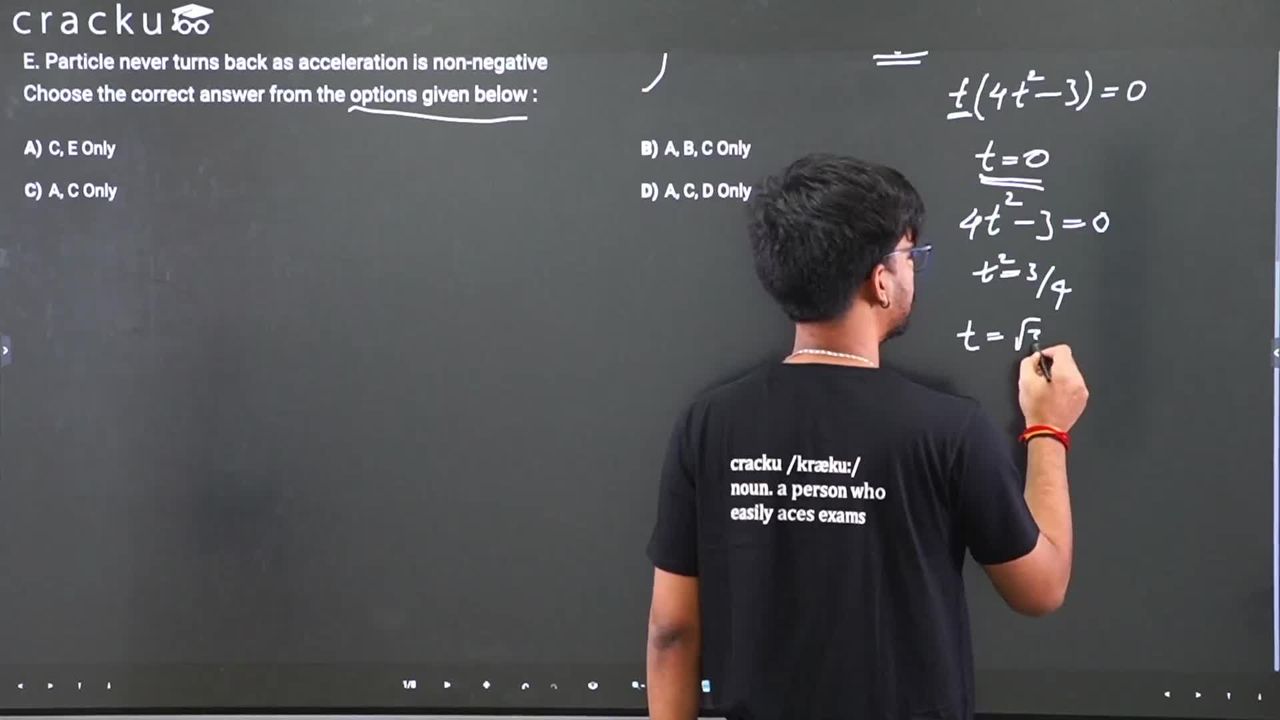
Click on the Email ☝️ to Watch the Video Solution
Create a FREE account and get:
_1.webp)

Educational materials for JEE preparation

Ask our AI anything

AI can make mistakes. Please verify important information.
AI can make mistakes. Please verify important information.
