
Join Our JEE Preparation Group
Prep with like-minded aspirants; Get access to free daily tests and study material.
Sign in
Please select an account to continue using cracku.in
↓ →
Join Our JEE Preparation Group
Prep with like-minded aspirants; Get access to free daily tests and study material.
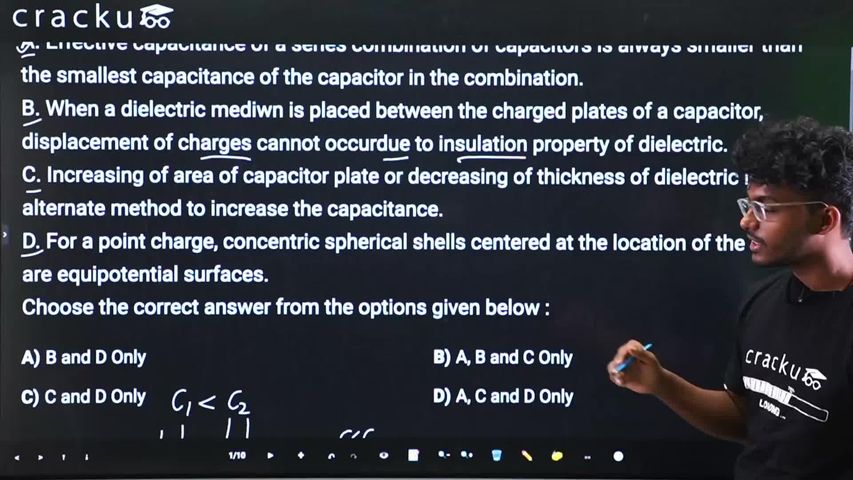
Identify the correct statements:
A. Effective capacitance of a series combination of capacitors is always smaller than the smallest capacitance of the capacitor in the combination.
B. When a dielectric mediwn is placed between the charged plates of a capacitor, displacement of charges cannot occurdue to insulation property of dielectric.
C. Increasing of area of capacitor plate or decreasing of thickness of dielectric is an alternate method to increase the capacitance.
D. For a point charge, concentric spherical shells centered at the location of the charge are equipotential surfaces.
Choose the correct answer from the options given below :
We need to identify which statements about capacitors and related concepts are correct.
Statement A: "Effective capacitance of a series combination is always smaller than the smallest capacitance."
For series: $$\frac{1}{C_{eq}} = \frac{1}{C_1} + \frac{1}{C_2} + \cdots > \frac{1}{C_{\min}}$$
Therefore $$C_{eq} < C_{\min}$$. This is TRUE.
Statement B: "When a dielectric is placed between charged plates, displacement of charges cannot occur due to insulation property."
This is FALSE. Even though a dielectric is an insulator, the electric field causes polarization - slight displacement of bound charges within molecules, creating induced surface charges. This is how dielectrics reduce the effective field.
Statement C: "Increasing area or decreasing thickness of dielectric increases capacitance."
$$C = \frac{\epsilon_0 \epsilon_r A}{d}$$. Increasing $$A$$ or decreasing $$d$$ increases $$C$$. This is TRUE.
Statement D: "For a point charge, concentric spherical shells centered at the charge are equipotential surfaces."
The potential due to a point charge is $$V = \frac{kq}{r}$$, which depends only on $$r$$. All points at the same distance from the charge have the same potential. This is TRUE.
Conclusion: Statements A, C, and D are correct.
The correct answer is Option 4: A, C and D Only.
Was this solution helpful?
Click on the Email ☝️ to Watch the Video Solution
Create a FREE account and get:
_1.webp)

Educational materials for JEE preparation

Ask our AI anything

AI can make mistakes. Please verify important information.
AI can make mistakes. Please verify important information.
