
Join Our JEE Preparation Group
Prep with like-minded aspirants; Get access to free daily tests and study material.
Sign in
Please select an account to continue using cracku.in
↓ →
Join Our JEE Preparation Group
Prep with like-minded aspirants; Get access to free daily tests and study material.
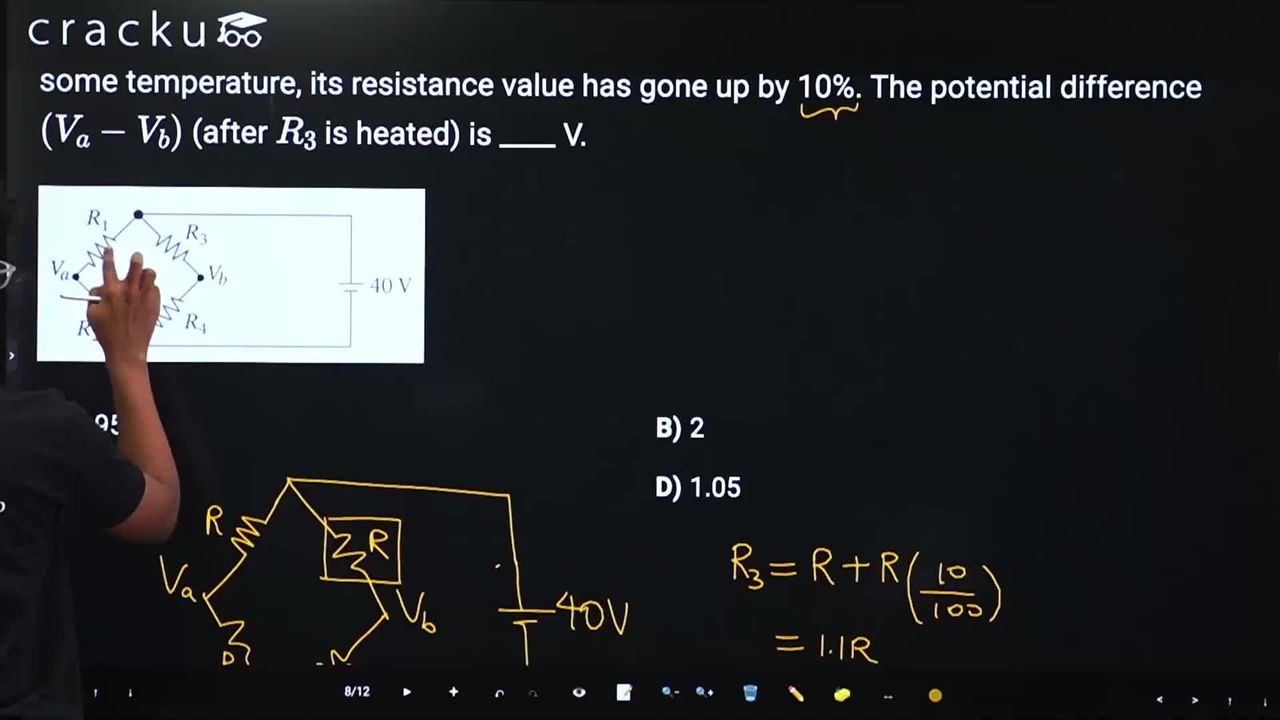
A Wheatstone bridge is initially at room temperature and all arms of the bridge have same value of resistances $$(R_{1}=R_{2}=R_{3}=R_{4})$$. When $$R_{3}$$ resistance is heated to some temperature, its resistance value has gone up by 10%. The potential difference $$(V_{a}-V_{b})$$ (after $$R_{3}$$ is heated) is ____ V.
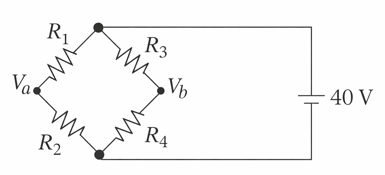
Let the initial resistance of all arms be $$R$$.
$$ R_1 = R_2 = R_4 = R_3=R $$
After heating, the resistance of $$R_3$$ increases by 10%.
$$ R_3 = R + 0.1R = 1.1R $$
The potential at node $$a$$ ($$V_a$$) is determined by the voltage divider of $$R_1$$ and $$R_2$$ across the 40 V source.
$$ V_a = 40 \times \frac{R_2}{R_1 + R_2} $$
$$ V_a = 40 \times \frac{R}{R + R} $$
$$ V_a = 20 \text{ V} $$
The potential at node $$b$$ ($$V_b$$) is determined by the voltage divider of $$R_3$$ and $$R_4$$ across the same 40 V source.
$$ V_b = 40 \times \frac{R_4}{R_3 + R_4} $$
$$ V_b = 40 \times \frac{R}{1.1R + R} $$
$$ V_b = 40 \times \frac{1}{2.1} $$
$$ V_b = \frac{400}{21} \text{ V} $$
The potential difference $$(V_a - V_b)$$ is calculated as:
$$ V_a - V_b = 20 - \frac{400}{21} $$
$$ V_a - V_b = \frac{420 - 400}{21} $$
$$ V_a - V_b = \frac{20}{21} \text{ V} $$
=0.95V
Was this solution helpful?
Click on the Email ☝️ to Watch the Video Solution
Create a FREE account and get:
_1.webp)

Educational materials for JEE preparation

Ask our AI anything

AI can make mistakes. Please verify important information.
AI can make mistakes. Please verify important information.
