
Join Our JEE Preparation Group
Prep with like-minded aspirants; Get access to free daily tests and study material.
Sign in
Please select an account to continue using cracku.in
↓ →
Join Our JEE Preparation Group
Prep with like-minded aspirants; Get access to free daily tests and study material.
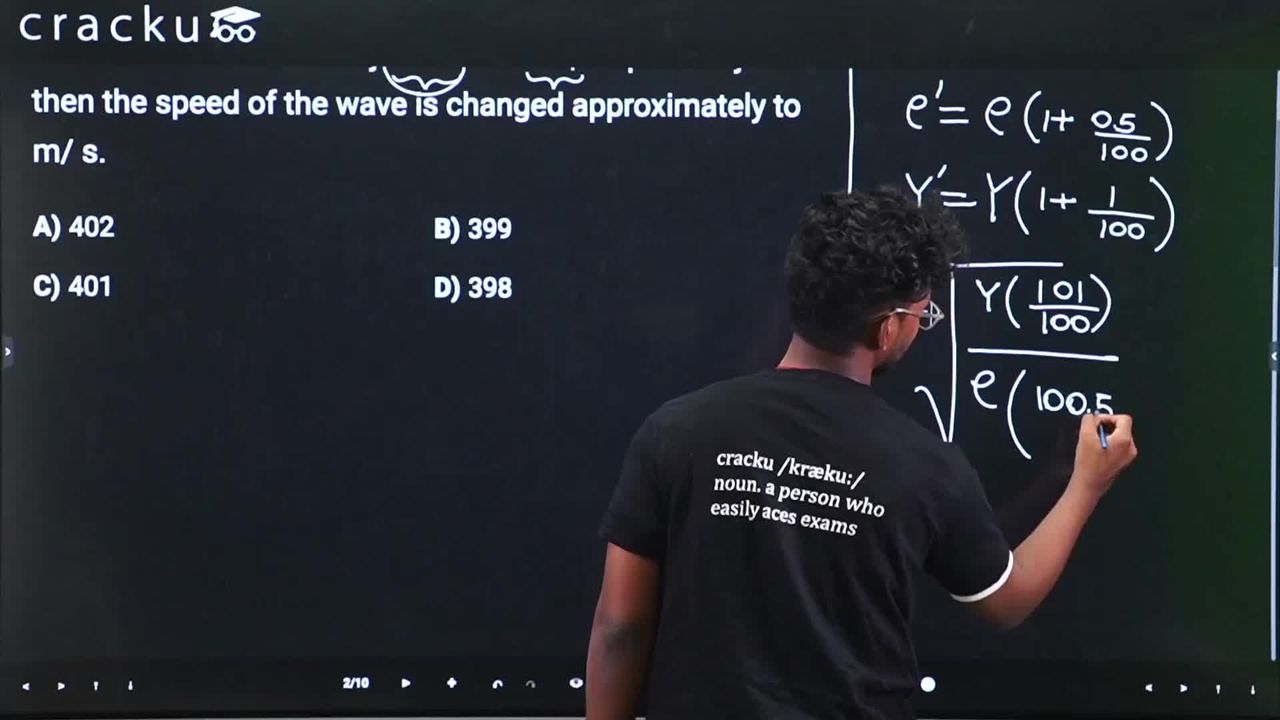
The speed of a longitudinal wave in a metallic bar is 400 m/s. If the density and Young's modulus of the bar material are increased by 0.5% and 1 %, respectively then the speed of the wave is changed approximately to m/ s.
The speed of a longitudinal wave in a solid is given by the formula:
$$v = \sqrt{\frac{Y}{\rho}}$$
where $$Y$$ is Young's modulus and $$\rho$$ is the density.
Given initial speed $$v = 400 \, \text{m/s}$$.
Density increases by 0.5%, so new density $$\rho' = \rho \left(1 + \frac{0.5}{100}\right) = 1.005\rho$$.
Young's modulus increases by 1%, so new Young's modulus $$Y' = Y \left(1 + \frac{1}{100}\right) = 1.01Y$$.
The new speed $$v'$$ is:
$$v' = \sqrt{\frac{Y'}{\rho'}} = \sqrt{\frac{1.01Y}{1.005\rho}} = \sqrt{\frac{1.01}{1.005}} \times \sqrt{\frac{Y}{\rho}} = \sqrt{\frac{1.01}{1.005}} \times 400$$
Compute the fraction $$\frac{1.01}{1.005}$$:
$$\frac{1.01}{1.005} = \frac{1010}{1005} = \frac{202}{201} \approx 1.004975$$
Now, $$\sqrt{1.004975}$$ can be approximated using $$\sqrt{1+x} \approx 1 + \frac{x}{2}$$ for small $$x$$, where $$x = 0.004975$$:
$$\sqrt{1.004975} \approx 1 + \frac{0.004975}{2} = 1 + 0.0024875 = 1.0024875$$
Thus,
$$v' \approx 1.0024875 \times 400 = 400.995 \approx 401 \, \text{m/s}$$
Alternatively, using the formula for fractional change:
$$\frac{dv}{v} = \frac{1}{2} \frac{dY}{Y} - \frac{1}{2} \frac{d\rho}{\rho}$$
Given $$\frac{dY}{Y} = 0.01$$ and $$\frac{d\rho}{\rho} = 0.005$$,
$$\frac{dv}{v} = \frac{1}{2} (0.01) - \frac{1}{2} (0.005) = 0.005 - 0.0025 = 0.0025$$
So, $$v' = v (1 + 0.0025) = 400 \times 1.0025 = 401 \, \text{m/s}$$.
Therefore, the speed changes approximately to $$401 \, \text{m/s}$$.
The correct option is C. 401.
Was this solution helpful?
Click on the Email ☝️ to Watch the Video Solution
Create a FREE account and get:
_1.webp)

Educational materials for JEE preparation

Ask our AI anything

AI can make mistakes. Please verify important information.
AI can make mistakes. Please verify important information.
