Group
Group
 Group
Group


 Preferred Source

 Google Discover

JEE Heat Transfer PYQs
JEE Heat Transfer PYQs are an important part of the JEE Physics syllabus. Practicing these questions helps you understand key ideas such as conduction, convection, radiation, thermal conductivity, Newton’s law of cooling, the Stefan–Boltzmann law, Wien’s displacement law, and heat transfer in different situations.
Questions from Heat Transfer can appear in JEE as direct numericals, concept-based problems, or questions that combine two or more ideas. The chapter may feel a little confusing at first because each mode of heat transfer works differently. Once you understand the basic principles and know which formula to use, however, the questions become much easier to solve.
Instead of memorizing every result, try to understand how heat moves from a hotter body to a colder one and what affects the rate of transfer. Regular practice with JEE Heat Transfer Questions can improve your conceptual understanding and calculation speed. Solving chapter-wise JEE Questions and attempting a JEE Mains Mock Test can also help you become more comfortable with the exam pattern.
In this blog, you will find important Heat Transfer PYQs in downloadable format, practice questions with answers, a few extra problems for self-practice, and simple tips to avoid common mistakes. You can also compare your preparation with JEE Mains Previous Papers to get a clearer idea of the level and style of questions asked in the exam.
JEE Heat Transfer Important PYQs PDF
This PDF can include some of the most useful previous-year questions from Heat Transfer. The questions may cover conduction, convection, radiation, thermal conductivity, Newton’s law of cooling, the Stefan–Boltzmann law, Wien’s displacement law, and blackbody radiation.
Practising these questions will help you understand how Heat Transfer concepts are tested in JEE. It can also improve your speed, accuracy, and ability to choose the right approach. Working through a well-organized set of previous-year questions is especially useful because it helps you recognise common patterns and avoid wasting time during the exam.
Important Heat Transfer Formula Sheet for JEE
You only need a limited number of important formulas to solve most questions from this chapter. These formulas are mainly used to calculate the rate of heat conduction, thermal resistance, heat current, radiation power, and cooling rate.
| Concept | Formula |
|---|---|
| Rate of Heat Conduction | $$\frac{Q}{t} = \frac{kA(T_1-T_2)}{L}$$ |
| Newton’s Law of Cooling | $$\frac{dT}{dt} \propto (T-T_s)$$ |
| Stefan–Boltzmann Law | $$P = \sigma\varepsilon AT^4$$ |
| Wien’s Displacement Law | $$\lambda_mT = \text{constant}$$ |
| Emissive Power | $$E = \sigma\varepsilon T^4$$ |
| Thermal Resistance | $$R = \frac{L}{kA}$$ |
| Heat Current | $$H = \frac{Q}{t}$$ |
| Thermal Resistance in Series | $$R = R_1+R_2+R_3$$ |
| Thermal Resistance in Parallel | $$\frac{1}{R} = \frac{1}{R_1}+\frac{1}{R_2}+\frac{1}{R_3}$$ |
| Radiated Energy | $$E = Pt$$ |
These formulas are commonly used in problems involving conduction, radiation, thermal resistance, cooling, and heat flow through different materials. Revising them with reliable JEE Study Material can help you remember the correct relationships and avoid small calculation mistakes.
Common Mistakes to Avoid in JEE Heat Transfer PYQs
Many students lose marks in this chapter because of small conceptual or calculation errors. Here are some common mistakes you should watch out for:
Confusing conduction, convection, and radiation
These three modes of heat transfer work in different ways. Before solving a question, first identify which mode of heat transfer is involved.
Using Celsius instead of Kelvin
Some formulas, especially those related to radiation, require temperature in Kelvin. Using Celsius directly can lead to a completely incorrect answer.
Ignoring thermal resistance
In questions involving composite rods or several layers, you need to consider the total thermal resistance. Using only one section of the system can yield an incorrect heat-flow rate.
Applying Newton’s law of cooling in every situation
Newton’s law of cooling is generally used when the temperature difference between the body and its surroundings is not very large. Always check whether the given situation supports this approximation.
Making unit conversion mistakes
Thermal conductivity, area, thickness, and temperature may be given in different units. Convert all values into SI units before starting the calculation.
Regular chapter-wise practice can help you notice these mistakes early and improve your accuracy in the exam.
List of JEE Heat Transfer PYQs
Below is a test-style set of questions based on conduction, convection, radiation, thermal conductivity, Newton’s law of cooling, and blackbody radiation. Try to solve each question on your own before checking the answer.
Question 1
At what temperature a gold ring of diameter 6.230 cm be heated so that it can be fitted on a wooden bangle of diameter 6.241 cm? Both the diameters have been measured at room temperature (27°C).
(Given: coefficient of linear thermal expansion of gold $$\alpha_L = 1.4 \times 10^{-5}$$ K$$^{-1}$$)
correct answer:- 4
Question 2
A block of ice of mass $$120 \text{ g}$$ at temperature $$0°C$$ is put in $$300 \text{ g}$$ of water at $$25°C$$. The $$x$$ g of ice melts as the temperature of the water reaches $$0°C$$. The value of $$x$$ is ______.
[Use: Specific heat capacity of water $$= 4200 \text{ J kg}^{-1} \text{ K}^{-1}$$, Latent heat of ice $$= 3.5 \times 10^5 \text{ J kg}^{-1}$$]
correct answer:- 90
Question 3
A lead bullet penetrates into a solid object and melts. Assuming that $$40\%$$ of its kinetic energy is used to heat it, the initial speed of bullet is
(Given, initial temperature of the bullet $$= 127°$$C, Melting point of the bullet $$= 327°$$C, Latent heat of fusion of lead $$= 2.5 \times 10^4$$ J kg$$^{-1}$$, Specific heat capacity of lead $$= 125$$ J kg$$^{-1}$$ K$$^{-1}$$)
correct answer:- 2
Question 4
A unit scale is to be prepared whose length does not change with temperature and remains $$20 \text{ cm}$$, using a bimetallic strip made of brass and iron each of different length. The length of both components would change in such a way that difference between their lengths remains constant. If length of brass is $$40 \text{ cm}$$ and length of iron will be ______ cm.
$$\alpha_{\text{iron}} = 1.2 \times 10^{-5} \text{ K}^{-1}$$ and $$\alpha_{\text{brass}} = 1.8 \times 10^{-5} \text{ K}^{-1}$$.
correct answer:- 60
Question 5
A hole is drilled in a metal sheet. At 27 °C, the diameter of hole is 5 cm. When the sheet is heated to 177 °C, the change in the diameter of hole is $$d \times 10^{-3}$$ cm. The value of $$d$$ will be _____, if coefficient of linear expansion of the metal is $$1.6 \times 10^{-5} /°C$$
correct answer:- 12

Question 6
Two identical beakers A and B contain equal volumes of two different liquids at 60°C each and left to cool down. Liquid in A has density of $$8 \times 10^{2}$$ kg m$$^{-3}$$ and specific heat of 2000 J kg$$^{-1}$$K$$^{-1}$$ while the liquid in B has density $$10^{3}$$ kg m$$^{-3}$$ and specific heat of 4000 J kg$$^{-1}$$K$$^{-1}$$. Which of the following best describes their temperature versus time graph schematically? (assume the emissivity of both the beakers to be the same)
correct answer:- 2
Question 7
Given below are two statements: one is labelled as Assertion A and the other is labelled as Reason R.
Assertion A: When a rod lying freely is heated, no thermal stress is developed in it.
Reason R: On heating, the length of the rod increases.
In the light of the above statements, choose the correct answer from the options given below:
correct answer:- 3
Question 8
Two identical metal wires of thermal conductivities $$K_1$$ and $$K_2$$ respectively are connected in series. The effective thermal conductivity of the combination is:
correct answer:- 1
Question 9
Consider a rectangular sheet of solid material of length $$l = 9$$ cm and width $$d = 4$$ cm. The coefficient of linear expansion is $$\alpha = 3.1 \times 10^{-5}$$ K$$^{-1}$$ at room temperature and one atmospheric pressure. The mass of sheet $$m = 0.1$$ kg and the specific heat capacity $$C_v = 900$$ J kg$$^{-1}$$K$$^{-1}$$. If the amount of heat supplied to the material is $$8.1 \times 10^2$$ J then change in area of the rectangular sheet is :
correct answer:- 1
Question 10
A non-isotropic solid metal cube has coefficients of linear expansion as: $$5 \times 10^{-5}$$/$$^\circ$$C along the x-axis and $$5 \times 10^{-6}$$/$$^\circ$$C along the y and the z-axis. If the coefficient of volume expansion of the solid is $$C \times 10^{-6}$$/$$^\circ$$C then the value of C is
correct answer:- 60

Question 11
The temperature of a metal strip having coefficient of linear expansion $$\alpha$$ is increased from $$T_1$$ to $$T_2$$ resulting in increase of its length by $$\Delta L_1$$. The temperature is further increased from $$T_2$$ to $$T_3$$ such that the increase in its length is $$\Delta L_2$$. Given $$T_3 + T_1 = 2T_2$$ and $$T_2 - T_1 = \Delta T$$, the value of $$\Delta L_2$$ is ______.
correct answer:- 4
Question 12
A beaker contains a fluid of density $$\rho$$ $$\frac{kg}{m^3}$$, specific heat $$S$$ $$\frac{J}{kg \cdot ^\circ C}$$ and viscosity $$\eta$$. The beaker is filled up to height h. To estimate the rate of heat transfer per unit area $$\left(\frac{Q}{A}\right)$$ by convection when beaker is put on a hot plate, a student proposes that it should depend on $$\eta$$, $$\left(\frac{S\Delta\theta}{h}\right)$$ and $$\left(\frac{1}{\rho g}\right)$$ when $$\Delta\theta$$ (in $$^\circ C$$) is the difference in the temperature between the bottom and top of the fluid. In that situation the correct option for $$\left(\frac{Q}{A}\right)$$ is:
correct answer:- 1
Question 13
One end of a thermally insulated rod is kept at a temperature $$T_1$$ and the other at $$T_2$$. The rod is composed of two sections of lengths $$\ell_1$$ and $$\ell_2$$ and thermal conductivities $$k_1$$ and $$k_2$$ respectively. The temperature at the interface of the two sections is
correct answer:- 3
Question 14
Ice at $$-20°C$$ is added to 50 g of water at $$40°C$$. When the temperature of the mixture reaches $$0°C$$, it is found that 20 g of ice is still unmelted. The amount of ice added to the water was close to (Specific heat of water = 4.2 J/g/°C, Specific heat of Ice = 2.1 J/g/°C, Heat of fusion of water at $$0°C$$ = 334 J/g)
correct answer:- 4
Question 15
Hot water cools from 60°C to 50°C in the first 10 minutes and to 42°C in the next 10 minutes. The temperature of the surroundings is:
correct answer:- 2

Question 16
A water heater of power 2000 W is used to heat water. The specific heat capacity of water is 4200 J kg$$^{-1}$$ K$$^{-1}$$. The efficiency of heater is 70%. Time required to heat 2 kg of water from 10°C to 60°C is ______ s. (Assume that the specific heat capacity of water remains constant over the temperature range of the water).
correct answer:- 300
Question 17
Two plates A and B have thermal conductivities $$84$$ W m$$^{-1}$$ K$$^{-1}$$ and $$126$$ W m$$^{-1}$$ K$$^{-1}$$ respectively. They have same surface area and same thickness. They are placed in contact along their surfaces. If the temperatures of the outer surfaces of A and B are kept at $$100°$$C and $$0°$$C respectively, then the temperature of the surface of contact in steady state is _____ °C.
correct answer:- 40
Question 18
A long metallic bar is carrying heat from one of its ends to the other end under steady-state. The variation of temperature $$\theta$$ along the length $$x$$ of the bar from its hot end is best described by which of the following figure.
correct answer:- 2
Question 19
The specific heat capacity of a substance is temperature dependent and is given by the formula $$C = kT$$, where $$k$$ is a constant of suitable dimensions in SI units, and $$T$$ is the absolute temperature. If the heat required to raise the temperature of 1 kg of the substance from $$-73°$$C to $$27°$$C is $$nk$$, the value of $$n$$ is ______.
[Given: $$0$$ K $$= -273°$$ C.]
correct answer:- 25000
Question 20
200 g water is heated from 40°C to 60°C. Ignoring the slight expansion of water, the change in its internal energy is close to (Given specific heat of water = 4184 J kg$$^{-1}$$ K$$^{-1}$$):
correct answer:- 4

Question 21
If the temperature of the sun were to increase from $$T$$ to $$2T$$ and its radius from $$R$$ to $$2R$$, then the ratio of the radiant energy received on earth to what it was previously will be
correct answer:- 4
Question 22
A liquid in a beaker has temperature $$\theta(t)$$ at time $$t$$ and $$\theta_0$$ is temperature of surroundings, then according to Newton's law of cooling the correct graph between $$\log_e(\theta-\theta_0)$$ and $$t$$ is
correct answer:- 1
Question 23
A gun fires a lead bullet of temperature 300 K into a wooden block. The bullet having melting temperature of 600 K penetrates into the block and melts down. If the total heat required for the process is 625 J , then the mass of the bullet is grams. (Latent heat of fusion of lead $$=2.5\times10^{4}JKg^{-1}$$ and specific heat capacity $$=125JKg^{-1}K^{-1}$$ of lead
correct answer:- 1
Question 24
A metal ball of mass 0.1 kg is heated upto $$500°C$$ and dropped into a vessel of heat capacity $$800 \text{ JK}^{-1}$$ and containing 0.5 kg water. The initial temperature of water and vessel is $$30°C$$. What is the approximate percentage increment in the temperature of the water? [Specific Heat Capacities of water and metal are, respectively, $$4200 \text{ Jkg}^{-1} \text{K}^{-1}$$ and $$400 \text{ Jkg}^{-1} \text{K}^{-1}$$]
correct answer:- 4
Question 25
In an experiment, a sphere of aluminium of mass 0.20 kg is heated up to 150°C. Immediately, it is put into water of volume 150 cc at 27°C kept in a calorimeter of water equivalent to 0.025 kg. The final temperature of the system is 40°C. The specific heat of the aluminium is (take 4.2 Joule = 1 calorie):
correct answer:- 1

Question 26
Three conductors of same length having thermal conductivity $$k_1, k_2 \text{ and } K_3$$ are connected as shown in figure.
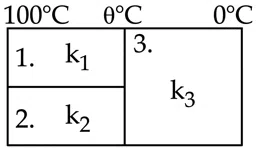
Area of cross sections of $$ 1^{st} \text{ and }2^{nd}$$ conductor are same and for $$3^{rd}$$ conductor it is double of the $$1^{st}$$ conductor. The temperatures are given in the figure. In steady state condition, the value of 0 is _______ $$^oC$$.
$$(\text{Given }:k_1=60Js^{-1}m^{-1}K^{-1},k_2= 120Js^{-1}m^{-1}K^{-1}, k_3= 135Js^{-1}m^{-1}K^{-1})$$
correct answer:- 40
Question 27
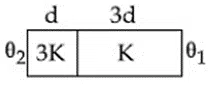
Two materials having coefficients of thermal conductivity 3K and K and thickness d and 3d respectively, are joined to form a slab as shown in the figure. The temperatures of the outer surfaces are $$\theta_2$$ and $$\theta_1$$ respectively, $$(\theta_2 > \theta_1)$$. The temperature at the interface is:
correct answer:- 4
Question 28
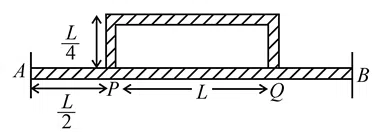
Temperature difference of 120$$^{\circ}$$C is maintained between two ends of a uniform rod $$AB$$ of length $$2L$$. Another bent rod $$PQ$$, of same cross-section as $$AB$$ and length $$\frac{3L}{2}$$, is connected across $$AB$$ (See figure). In steady state, temperature difference between $$P$$ and $$Q$$ will be close to:
correct answer:- 1
Question 29
A hole is drilled in a metal sheet. At 27 °C, the diameter of hole is 5 cm. When the sheet is heated to 177 °C, the change in the diameter of hole is $$d \times 10^{-3}$$ cm. The value of $$d$$ will be _____$$10^{-3} cm$$, if coefficient of linear expansion of the metal is $$1.6 \times 10^{-5}$$ / °C
correct answer:- 12
Question 30
An experiment takes 10 min to raise the temperature of water in a container from 0$$^\circ$$C to 100$$^\circ$$C and another 55 min to convert it totally into steam by a heater supplying heat at a uniform rate. Neglecting the specific heat of the container and taking specific heat of the water to be 1 cal (g$$^\circ$$C)$$^{-1}$$, the heat of vaporization according to this experiment will come out to be:
correct answer:- 2
Question 31
1 kg of water, at 20°C is heated in an electric kettle whose heating element has a mean (temperature averaged) resistance of 20 Ω. The rms voltage in the mains is 200 V. Ignoring heat loss from the kettle, time taken for water to evaporate fully is close to
[Specific heat of water = 4200 J kg$$^{-1}$$ °C$$^{-1}$$ Latent heat of water = 2260 kJ kg$$^{-1}$$]
correct answer:- 3