
Join Our JEE Preparation Group
Prep with like-minded aspirants; Get access to free daily tests and study material.
Sign in
Please select an account to continue using cracku.in
↓ →
Join Our JEE Preparation Group
Prep with like-minded aspirants; Get access to free daily tests and study material.
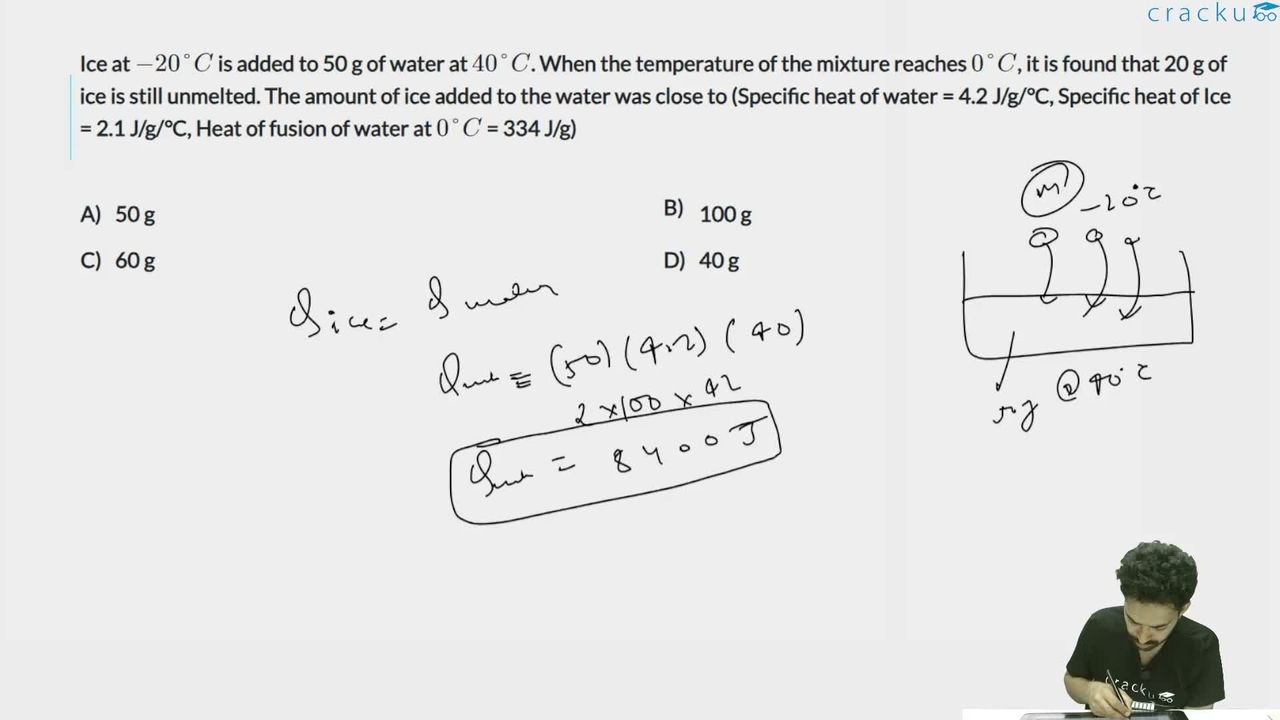
Ice at $$-20°C$$ is added to 50 g of water at $$40°C$$. When the temperature of the mixture reaches $$0°C$$, it is found that 20 g of ice is still unmelted. The amount of ice added to the water was close to (Specific heat of water = 4.2 J/g/°C, Specific heat of Ice = 2.1 J/g/°C, Heat of fusion of water at $$0°C$$ = 334 J/g)
We have 50 g of liquid water whose initial temperature is $$40^{\circ}\text{C}$$. Some mass of ice, say $$m\; \text{g}$$, is added at $$-20^{\circ}\text{C}$$. After thermal equilibrium is attained, the common temperature becomes $$0^{\circ}\text{C}$$ and 20 g of ice still remains unmelted. Therefore only $$m-20\;\text{g}$$ of the originally added ice has actually melted.
The process involves heat exchange between two parts:
1. Cooling of the warm water from $$40^{\circ}\text{C}$$ down to $$0^{\circ}\text{C}$$.
Using the formula for sensible heat $$Q = mc\Delta T$$, the heat released is
$$
Q_{\text{water}}
= (50\;\text{g})(4.2\;\text{J g}^{-1}\!^{\circ}\text{C}^{-1})(40^{\circ}\text{C})
= 50 \times 4.2 \times 40
= 8400\;\text{J}.
$$
2. Warming and partial melting of the ice added at $$-20^{\circ}\text{C}$$.
(a) First, the ice must be warmed from $$-20^{\circ}\text{C}$$ to $$0^{\circ}\text{C}$$.
Again with $$Q = mc\Delta T$$,
$$
Q_{\text{warm}}
= m \,(2.1\;\text{J g}^{-1}\!^{\circ}\text{C}^{-1})(20^{\circ}\text{C})
= 42\,m\;\text{J}.
$$
(b) Next, only $$m-20\;\text{g}$$ of this ice actually melts at $$0^{\circ}\text{C}$$. The latent heat needed is given by
$$
Q_{\text{melt}}
= (m-20)\;\text{g}\times 334\;\text{J g}^{-1}
= 334\,(m-20)\;\text{J}.
$$
The total heat absorbed by the ice is therefore
$$
Q_{\text{ice}}
= Q_{\text{warm}} + Q_{\text{melt}}
= 42\,m + 334\,(m-20)
= 42\,m + 334\,m - 6680
= 376\,m - 6680\;\text{J}.
$$
Because no heat is lost to the surroundings, the heat released by the water must equal the heat gained by the ice:
$$
Q_{\text{water}} = Q_{\text{ice}}.
$$
Substituting the expressions we have just found,
$$
8400 = 376\,m - 6680.
$$
Now we solve algebraically for $$m$$. First add 6680 J to both sides:
$$
8400 + 6680 = 376\,m,
$$
$$
15080 = 376\,m.
$$
Dividing both sides by 376,
$$
m = \frac{15080}{376} \approx 40.1\;\text{g}.
$$
This mass is closest to 40 g among the given choices.
Hence, the correct answer is Option D.
Was this solution helpful?
Click on the Email ☝️ to Watch the Video Solution
Create a FREE account and get:
_1.webp)

Educational materials for JEE preparation

Ask our AI anything

AI can make mistakes. Please verify important information.
AI can make mistakes. Please verify important information.
