For the following questions answer them individually
The force of interaction between two atoms is given by $$F = \alpha\beta \exp\left(-\frac{x^2}{\alpha kT}\right)$$; where $$x$$ is the distance, k is the Boltzmann constant and T is temperature and $$\alpha$$ and $$\beta$$ are two constants. The dimensions of $$\beta$$ is:
A particle is moving along a circular path with a constant speed of $$10 \text{ ms}^{-1}$$. What is the magnitude of the change in velocity of the particle, when it moves through an angle of $$60°$$ around the centre of the circle?
A body is projected at $$t = 0$$ with a velocity $$10 \text{ ms}^{-1}$$ at an angle of $$60°$$ with the horizontal. The radius of curvature of its trajectory at $$t = 1$$ s is $$R$$. Neglecting air resistance and taking acceleration due to gravity $$g = 10 \text{ ms}^{-2}$$, the value of $$R$$ is:
A body of mass 1 kg falls freely from a height of 100 m, on a platform of mass 3 kg which is mounted on a spring having spring constant $$k = 1.25 \times 10^6$$ N/m. The body sticks to the platform and the spring's maximum compression is found to be $$x$$. Given that $$g = 10 \text{ ms}^{-2}$$, the value of $$x$$ will be close to:
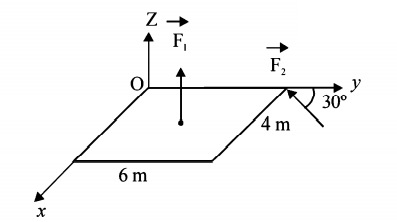
A slab is subjected to two forces $$\vec{F_1}$$ and $$\vec{F_2}$$ of same magnitude $$F$$ as shown in the figure. Force $$\vec{F_2}$$ is in XY-plane while force $$\vec{F_1}$$ acts along z-axis at the point $$(2\hat{i} + 3\hat{j})$$. The moment of these forces about point O will be:
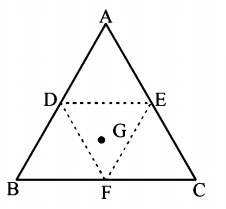
An equilateral triangle ABC is cut from a thin solid sheet of wood. (See figure) D, E and F are the mid-points of its sides as shown and G is the centre of the triangle. The moment of inertia of the triangle about an axis passing through G and perpendicular to the plane of the triangle is $$I_0$$. If the smaller triangle DEF is removed from ABC, the moment of inertia of the remaining figure about the same axis is $$I$$. Then
A satellite is revolving in a circular orbit at a height h from the earth surface, such that $$h \ll R$$ where R is the radius of the earth. Assuming that the effect of earth's atmosphere can be neglected the minimum increase in the speed required so that the satellite could escape from the gravitational field of earth is
A liquid of density $$\rho$$ is coming out of a hose pipe of radius $$a$$ with horizontal speed $$v$$ and hits a mesh. 50% of the liquid passes through the mesh unaffected. 25% loses all of its momentum and 25% comes back with the same speed. The resultant pressure on the mesh will be:
Ice at $$-20°C$$ is added to 50 g of water at $$40°C$$. When the temperature of the mixture reaches $$0°C$$, it is found that 20 g of ice is still unmelted. The amount of ice added to the water was close to (Specific heat of water = 4.2 J/g/°C, Specific heat of Ice = 2.1 J/g/°C, Heat of fusion of water at $$0°C$$ = 334 J/g)
A rigid diatomic ideal gas undergoes an adiabatic process at room temperature. The relation between temperature and volume for this process is $$TV^x$$ = constant, then x is: