
Join Our JEE Preparation Group
Prep with like-minded aspirants; Get access to free daily tests and study material.
Sign in
Please select an account to continue using cracku.in
↓ →
Join Our JEE Preparation Group
Prep with like-minded aspirants; Get access to free daily tests and study material.
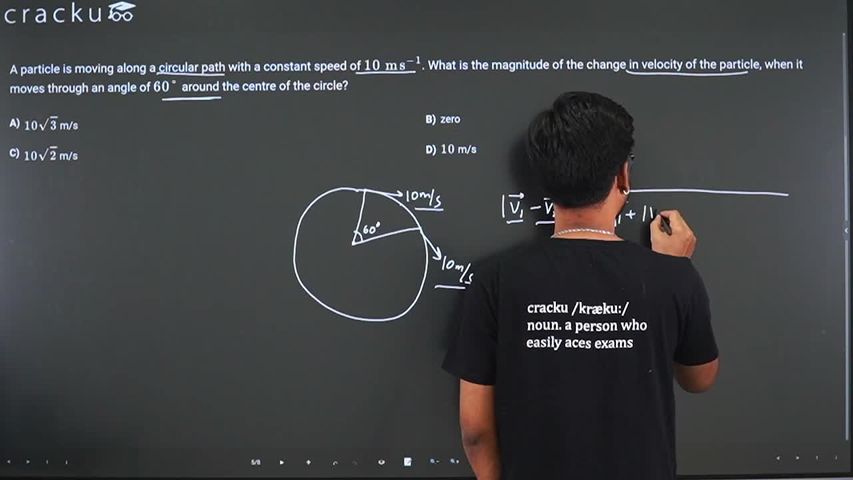
A particle is moving along a circular path with a constant speed of $$10 \text{ ms}^{-1}$$. What is the magnitude of the change in velocity of the particle, when it moves through an angle of $$60°$$ around the centre of the circle?
We start by recalling that in uniform circular motion the speed is constant, but the velocity vector is continuously changing its direction. At any point on the circle, the velocity is tangent to the path and perpendicular to the radius drawn to that point. Let the constant speed be denoted by $$v = 10\ \text{m s}^{-1}$$.
Suppose the particle is at point $$P_{1}$$ on the circle. Its velocity vector at this point is $$\vec v_{1}$$, tangent to the circle. After the particle has moved through a central angle of $$\theta = 60^{\circ}$$ (which is $$\theta = \dfrac{\pi}{3}\ \text{radians}$$) it reaches point $$P_{2}$$. The speed is still $$v$$, and the velocity vector there is $$\vec v_{2}$$, also tangent to the circle.
The two velocity vectors $$\vec v_{1}$$ and $$\vec v_{2}$$ have the same magnitude $$v$$ but they are directed along tangents that make an angle $$\theta$$ with each other, because each tangent is perpendicular to its corresponding radius and the radii themselves are separated by the same central angle $$\theta$$.
We want the magnitude of the change in velocity:
$$|\Delta \vec v| = |\vec v_{2} - \vec v_{1}|$$.
For two vectors of equal magnitude $$v$$ with an included angle $$\theta$$ between them, we can use the law of cosines (vector form) to find the magnitude of their difference. The formula is stated as:
$$|\vec a - \vec b| = \sqrt{a^{2} + b^{2} - 2ab\cos\theta}$$.
Here $$a = b = v$$ and $$\theta = 60^{\circ}$$, so
$$|\Delta \vec v| = \sqrt{v^{2} + v^{2} - 2v\,v\cos\theta}$$.
Substituting $$v = 10\ \text{m s}^{-1}$$ and $$\cos 60^{\circ} = \dfrac{1}{2}$$, we get
$$|\Delta \vec v| = \sqrt{10^{2} + 10^{2} - 2 \cdot 10 \cdot 10 \cdot \dfrac{1}{2}}$$ $$= \sqrt{100 + 100 - 100}$$ $$= \sqrt{100}$$ $$= 10\ \text{m s}^{-1}.$$
Many students also memorize a simpler equivalent relation for uniform circular motion: $$|\Delta \vec v| = 2v\sin\left(\dfrac{\theta}{2}\right)$$. Stating and using that formula gives the same result. We have $$\theta/2 = 30^{\circ}$$ and $$\sin 30^{\circ} = \dfrac{1}{2}$$, so $$|\Delta \vec v| = 2 \times 10 \times \dfrac{1}{2} = 10\ \text{m s}^{-1}$$.
Either way, the magnitude of the change in velocity is $$10\ \text{m s}^{-1}$$. Hence, the correct answer is Option D.
Was this solution helpful?
Click on the Email ☝️ to Watch the Video Solution
Create a FREE account and get:
_1.webp)

Educational materials for JEE preparation

Ask our AI anything

AI can make mistakes. Please verify important information.
AI can make mistakes. Please verify important information.
