
Join Our JEE Preparation Group
Prep with like-minded aspirants; Get access to free daily tests and study material.
Sign in
Please select an account to continue using cracku.in
↓ →
Join Our JEE Preparation Group
Prep with like-minded aspirants; Get access to free daily tests and study material.
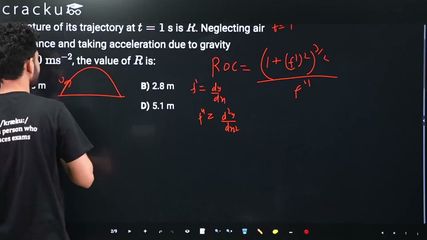
A body is projected at $$t = 0$$ with a velocity $$10 \text{ ms}^{-1}$$ at an angle of $$60°$$ with the horizontal. The radius of curvature of its trajectory at $$t = 1$$ s is $$R$$. Neglecting air resistance and taking acceleration due to gravity $$g = 10 \text{ ms}^{-2}$$, the value of $$R$$ is:
We have a projectile launched at time $$t = 0$$ with initial speed $$u = 10 \text{ ms}^{-1}$$ making an angle $$\theta = 60^{\circ}$$ with the horizontal. Neglecting air resistance, the horizontal and vertical coordinates of the particle at any instant $$t$$ are obtained from elementary kinematics:
$$x = u\cos\theta \; t, \qquad y = u\sin\theta \; t \;-\; \dfrac12\,g\,t^{2}.$$
For the radius of curvature of a plane curve $$y(x)$$ we use the standard formula
$$R \;=\; \dfrac{\bigl(1 + (dy/dx)^{2}\bigr)^{3/2}}{\left|\,d^{2}y/dx^{2}\right|}.$$
Hence we first need the first and second derivatives of $$y$$ with respect to $$x$$. As derivatives with respect to $$t$$ are easier to obtain, we start there and then convert.
The time-derivatives of the coordinates are the velocity components:
$$\frac{dx}{dt} \;=\; u\cos\theta, \qquad \frac{dy}{dt} \;=\; u\sin\theta - g\,t.$$
Therefore the slope of the trajectory is
$$\frac{dy}{dx} \;=\; \frac{\dfrac{dy}{dt}}{\dfrac{dx}{dt}} \;=\; \frac{u\sin\theta - g\,t}{u\cos\theta} \;=\; \tan\theta \;-\;\frac{g\,t}{u\cos\theta}.$$
Now the second derivative is obtained by differentiating this result with respect to $$x$$. Using the chain rule $$\dfrac{d}{dx} = \dfrac{1}{dx/dt}\dfrac{d}{dt}$$, we write
$$\frac{d^{2}y}{dx^{2}} \;=\; \frac{1}{dx/dt}\, \frac{d}{dt}\!\Bigl(\frac{dy}{dx}\Bigr) \;=\; \frac{1}{u\cos\theta}\; \frac{d}{dt}\!\Bigl(\tan\theta - \frac{g\,t}{u\cos\theta}\Bigr).$$
The term $$\tan\theta$$ is a constant, so its derivative is zero, and we get
$$\frac{d^{2}y}{dx^{2}} \;=\; \frac{1}{u\cos\theta}\; \Bigl(-\frac{g}{u\cos\theta}\Bigr) \;=\; -\,\frac{g}{u^{2}\cos^{2}\theta}.$$
Observe that this quantity is a constant; it does not depend on time. We may now substitute the numerical values $$u = 10 \text{ ms}^{-1}, \quad g = 10 \text{ ms}^{-2}, \quad \cos\theta = \cos60^{\circ} = \tfrac12.$$ This gives
$$\frac{d^{2}y}{dx^{2}} \;=\; -\frac{10}{(10)^{2}(1/2)^{2}} \;=\; -\frac{10}{100 \times 1/4} \;=\; -\frac{10}{25} \;=\; -0.4.$$
Next we evaluate the first derivative at the required instant $$t = 1 \text{ s}$$:
$$\biggl(\frac{dy}{dx}\biggr)_{t=1} \;=\; \tan60^{\circ} - \frac{g\,(1)}{u\cos60^{\circ}} \;=\; \sqrt{3} - \frac{10}{10 \times \tfrac12} \;=\; \sqrt{3} - 2.$$
Because $$\sqrt{3} \approx 1.732$$, this numerically equals
$$\frac{dy}{dx}\;\approx\; 1.732 - 2 = -0.268.$$
Now we assemble the parts of the curvature formula. First,
$$1 + \bigl(dy/dx\bigr)^{2} = 1 + (-0.268)^{2} = 1 + 0.0717 = 1.0717.$$
Taking the power $$3/2$$:
$$\bigl(1 + (dy/dx)^{2}\bigr)^{3/2} = (1.0717)^{3/2} = \sqrt{1.0717}\;\times 1.0717 \approx 1.0355 \times 1.0717 \approx 1.110.$$
The denominator in the curvature expression is the magnitude of the second derivative, i.e. $$|d^{2}y/dx^{2}| = 0.4.$$
Thus the radius of curvature at $$t = 1 \text{ s}$$ becomes
$$R = \frac{1.110}{0.4} = 2.775 \text{ m} \;\approx\; 2.8 \text{ m}.$$
Hence, the correct answer is Option B.
Was this solution helpful?
Click on the Email ☝️ to Watch the Video Solution
Create a FREE account and get:
_1.webp)

Educational materials for JEE preparation

Ask our AI anything

AI can make mistakes. Please verify important information.
AI can make mistakes. Please verify important information.
