
Join Our JEE Preparation Group
Prep with like-minded aspirants; Get access to free daily tests and study material.
Sign in
Please select an account to continue using cracku.in
↓ →
Join Our JEE Preparation Group
Prep with like-minded aspirants; Get access to free daily tests and study material.
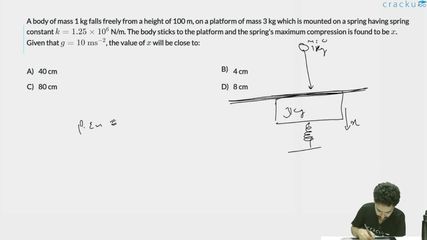
A body of mass 1 kg falls freely from a height of 100 m, on a platform of mass 3 kg which is mounted on a spring having spring constant $$k = 1.25 \times 10^6$$ N/m. The body sticks to the platform and the spring's maximum compression is found to be $$x$$. Given that $$g = 10 \text{ ms}^{-2}$$, the value of $$x$$ will be close to:
We have a body of mass $$m_1 = 1\;\text{kg}$$ that is released from rest at a height $$h = 100\;\text{m}$$ above a platform of mass $$m_2 = 3\;\text{kg}$$. The platform is fixed to the upper end of a vertical spring whose force constant is $$k = 1.25 \times 10^{6}\;\text{N\,m}^{-1}$$. During the motion the body falls, strikes the platform, sticks to it (perfectly inelastic impact) and then the combined system moves downward, compressing the spring.
The body of mass $$m_1$$ possesses an initial gravitational potential energy (taking the top of the spring as the reference level) equal to
$$U_{\text{g,\,initial}} \;=\; m_1 g h \;=\; 1 \times 10 \times 100 \;=\; 1000\;\text{J}. $$
After impact the two masses move together. Let $$x$$ be the maximum compression of the spring measured from its natural (unstretched) length. While the spring is being compressed, the centre of mass of the combined load $$M = m_1 + m_2 = 4\;\text{kg}$$ moves downward through the same distance $$x$$, so its gravitational potential energy decreases by
$$\Delta U_{\text{g,\,down}} \;=\; Mgx \;=\; 4 \times 10 \times x \;=\; 40x\;\text{J}. $$
At the instant of maximum compression the kinetic energy of the system has become zero, and the entire mechanical energy that was available has been stored as elastic potential energy of the spring. The elastic potential energy of a compressed spring is given by the well-known formula
$$U_{\text{spring}} \;=\; \frac12 k x^{2}. $$
Applying conservation of mechanical energy between the moment just before compression starts and the moment of maximum compression, we have
$$\underbrace{m_1 g h}_{1000} \;+\; \underbrace{Mgx}_{40x} \;=\; \underbrace{\frac12 k x^{2}}_{ \tfrac12 (1.25 \times 10^{6}) x^{2} }. $$
Substituting the numerical values,
$$1000 \;+\; 40x \;=\; \frac{1}{2}\bigl(1.25 \times 10^{6}\bigr)x^{2}. $$
Simplifying the right-hand side first,
$$\frac{1}{2}\bigl(1.25 \times 10^{6}\bigr) \;=\; 6.25 \times 10^{5},$$
so the equation becomes
$$6.25 \times 10^{5}\,x^{2} \;-\; 40x \;-\; 1000 \;=\; 0.$$
To solve the quadratic equation we divide every term by $$6.25 \times 10^{5}$$:
$$x^{2} \;-\; \frac{40}{6.25 \times 10^{5}}\,x \;-\; \frac{1000}{6.25 \times 10^{5}} \;=\; 0,$$
and evaluate the small fractions:
$$\frac{40}{6.25 \times 10^{5}} \;=\; 6.4 \times 10^{-5},\qquad \frac{1000}{6.25 \times 10^{5}} \;=\; 1.6 \times 10^{-3}.$$
Thus the quadratic is
$$x^{2} \;-\; 6.4 \times 10^{-5}x \;-\; 1.6 \times 10^{-3} \;=\; 0.$$
Using the quadratic-formula $$x = \dfrac{-b + \sqrt{\,b^{2} - 4ac\,}}{2a}$$ with $$a = 1,\; b = -6.4 \times 10^{-5},\; c = -1.6 \times 10^{-3},$$ we get
$$x \;=\; \frac{6.4 \times 10^{-5} \;+\; \sqrt{\bigl(6.4 \times 10^{-5}\bigr)^{2} + 4 \times 1.6 \times 10^{-3}}} {2}.$$
The term $$(6.4 \times 10^{-5})^{2}$$ is negligibly small, so we have approximately
$$x \;\approx\; \frac{6.4 \times 10^{-5} \;+\; \sqrt{0.0064}}{2} \;=\; \frac{6.4 \times 10^{-5} \;+\; 0.08}{2} \;=\; \frac{0.080064}{2} \;\approx\; 0.040\;\text{m}.$$
Converting metres to centimetres,
$$x \;\approx\; 0.040\;\text{m} = 4.0\;\text{cm}.$$
Hence, the correct answer is Option B.
Was this solution helpful?
Click on the Email ☝️ to Watch the Video Solution
Create a FREE account and get:
_1.webp)

Educational materials for JEE preparation

Ask our AI anything

AI can make mistakes. Please verify important information.
AI can make mistakes. Please verify important information.
