
Join Our JEE Preparation Group
Prep with like-minded aspirants; Get access to free daily tests and study material.
Sign in
Please select an account to continue using cracku.in
↓ →
Join Our JEE Preparation Group
Prep with like-minded aspirants; Get access to free daily tests and study material.
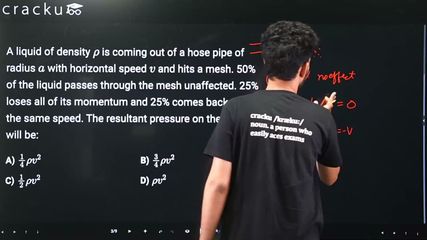
A liquid of density $$\rho$$ is coming out of a hose pipe of radius $$a$$ with horizontal speed $$v$$ and hits a mesh. 50% of the liquid passes through the mesh unaffected. 25% loses all of its momentum and 25% comes back with the same speed. The resultant pressure on the mesh will be:
We have a horizontal jet emerging from a hose of radius $$a$$. The cross-sectional area of the jet is
$$A=\pi a^{2}\;.$$
Density of the liquid is $$\rho$$ and its speed is $$v$$, so the total mass that leaves the pipe per second (the mass flow rate) is, by definition,
$$\dot m=\rho A v=\rho\pi a^{2}v\;.$$
The mesh divides this stream into three parts:
• 50 % of the mass passes straight through without any change in velocity.
• 25 % of the mass is completely stopped, that is, its final velocity becomes $$0$$.
• 25 % of the mass reverses direction and returns with the same speed $$v$$ (so its final velocity is $$-v$$, opposite to the incident direction).
The force exerted on the mesh equals the rate of change of linear momentum of the fluid. In symbols,
$$F=\sum \dot m_i\,(v_{f,i}-v_{i,i})$$
where the summation is taken over the three portions of the jet. We now evaluate each contribution separately.
1. 50 % passes through unchanged
The mass flow in this part is $$\dot m_1=0.50\,\dot m$$, the initial velocity is $$v$$, and the final velocity is also $$v$$. Therefore
$$v_{f,1}-v_{i,1}=v-v=0\quad\Longrightarrow\quad \dot m_1\,(v_{f,1}-v_{i,1})=0\;.$$
This part gives no force.
2. 25 % is stopped
Here the mass flow rate is $$\dot m_2=0.25\,\dot m$$. Initial velocity is $$v$$ and final velocity is $$0$$, hence
$$v_{f,2}-v_{i,2}=0-v=-v\;.$$
The momentum change per second for this portion is
$$\dot m_2\,(v_{f,2}-v_{i,2})=0.25\,\dot m\,(-v)=-0.25\,\rho A v^{2}\;.$$
The negative sign shows that the fluid loses forward momentum; the mesh receives an equal and opposite impulse, so the force magnitude from this part is
$$F_2=0.25\,\rho A v^{2}\;.$$
3. 25 % rebounds with speed $$v$$
This portion has $$\dot m_3=0.25\,\dot m$$, initial velocity $$v$$, and final velocity $$-v$$. Hence
$$v_{f,3}-v_{i,3}=-v-v=-2v\;,$$
and the momentum change per second is
$$\dot m_3\,(v_{f,3}-v_{i,3})=0.25\,\dot m\,(-2v)=-0.50\,\rho A v^{2}\;.$$
Again the negative sign merely signals direction; the force on the mesh has magnitude
$$F_3=0.50\,\rho A v^{2}\;.$$
Total force on the mesh
Adding the magnitudes (the contributions act in the same direction against the mesh), we get
$$F=F_2+F_3=\left(0.25+0.50\right)\rho A v^{2}=0.75\,\rho A v^{2}=\frac{3}{4}\,\rho A v^{2}\;.$$
Pressure on the mesh
Pressure is force divided by the area over which the force acts. The jet area is $$A=\pi a^{2}$$, so
$$P=\frac{F}{A}=\frac{0.75\,\rho A v^{2}}{A}=0.75\,\rho v^{2} =\frac{3}{4}\,\rho v^{2}\;.$$
Hence, the correct answer is Option B.
Was this solution helpful?
Click on the Email ☝️ to Watch the Video Solution
Create a FREE account and get:
_1.webp)

Educational materials for JEE preparation

Ask our AI anything

AI can make mistakes. Please verify important information.
AI can make mistakes. Please verify important information.
