
Join Our JEE Preparation Group
Prep with like-minded aspirants; Get access to free daily tests and study material.
Sign in
Please select an account to continue using cracku.in
↓ →
Join Our JEE Preparation Group
Prep with like-minded aspirants; Get access to free daily tests and study material.
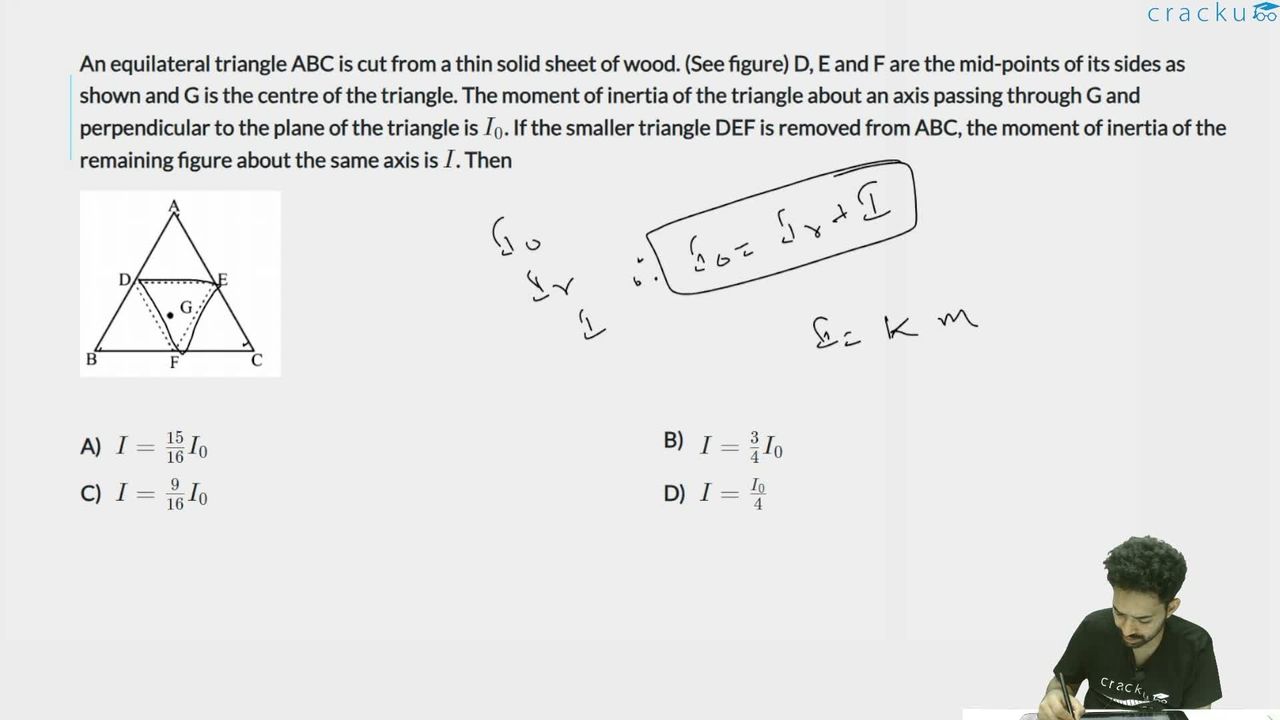
An equilateral triangle ABC is cut from a thin solid sheet of wood. (See figure) D, E and F are the mid-points of its sides as shown and G is the centre of the triangle. The moment of inertia of the triangle about an axis passing through G and perpendicular to the plane of the triangle is $$I_0$$. If the smaller triangle DEF is removed from ABC, the moment of inertia of the remaining figure about the same axis is $$I$$. Then
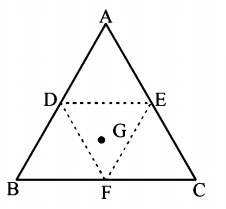
Let the side length of the original equilateral triangle $$ABC$$ be denoted by $$a$$ and let its mass (proportional to its area, because the sheet has uniform density and uniform thickness) be $$m$$.
For any planar body the moment of inertia about an axis perpendicular to the plane and passing through its centre of mass can always be written in the form
$$I = k\, m\, (\text{characteristic length})^2,$$
where $$k$$ is a numerical constant which depends only on the shape. For an equilateral triangle this “characteristic length’’ is its side $$a$$, so we may write
$$I_0 = k\,m\,a^2 \qquad\text{(1)}$$
for the complete triangle $$ABC$$ (given in the problem as $$I_0$$).
Now join the mid-points of the three sides; these mid-points are labelled $$D,\,E,\,F$$ in the figure. Because each of $$D,\,E,\,F$$ is the midpoint of a side, the triangle $$DEF$$ is similar to $$ABC$$ and its linear dimensions are exactly one-half of those of $$ABC$$. Hence
$$\text{side of } DEF = \frac{a}{2}. \qquad\qquad\text{(2)}$$
The triangle $$DEF$$ is cut from the same sheet, so its mass is proportional to its area. For similar figures
Area $$\propto (\text{side})^2,$$ therefore
$$\frac{m_{\small DEF}}{m} = \left(\frac{a/2}{a}\right)^2 = \left(\frac12\right)^2 = \frac14. \qquad\qquad\text{(3)}$$
Because $$DEF$$ is similar to $$ABC$$, it has the same constant $$k$$ in the formula for the moment of inertia. Using (2) and (3) in the general form $$I = k\, m\, a^2$$, we get
$$\begin{aligned} I_{\small DEF} &= k \, m_{\small DEF} \left(\frac{a}{2}\right)^2 \\ &= k \left(\frac14 m\right) \left(\frac{a^2}{4}\right) \\ &= k\,m\,a^2 \left(\frac14\right)\left(\frac14\right) \\ &= \frac{1}{16}\,k\,m\,a^2. \qquad\qquad\text{(4)} \end{aligned}$$
But from (1) we have $$k\,m\,a^2 = I_0$$, so (4) immediately gives
$$I_{\small DEF} = \frac{I_0}{16}. \qquad\qquad\text{(5)}$$
The centroid (centre of mass) of $$DEF$$ coincides with the centroid $$G$$ of $$ABC$$ (for any triangle, the centroid of the medial triangle is the same point), so the required axis passes through the centres of both triangles. Therefore the moment of inertia of the residual lamina (shaded region) is simply the difference
$$I = I_0 - I_{\small DEF}.$$
Substituting the value from (5), we obtain
$$I = I_0 - \frac{I_0}{16} = I_0\left(1 - \frac{1}{16}\right) = I_0 \left(\frac{15}{16}\right).$$
Hence, the correct answer is Option A.
Was this solution helpful?
Click on the Email ☝️ to Watch the Video Solution
Create a FREE account and get:
_1.webp)

Educational materials for JEE preparation

Ask our AI anything

AI can make mistakes. Please verify important information.
AI can make mistakes. Please verify important information.
