
Join Our JEE Preparation Group
Prep with like-minded aspirants; Get access to free daily tests and study material.
Sign in
Please select an account to continue using cracku.in
↓ →
Join Our JEE Preparation Group
Prep with like-minded aspirants; Get access to free daily tests and study material.
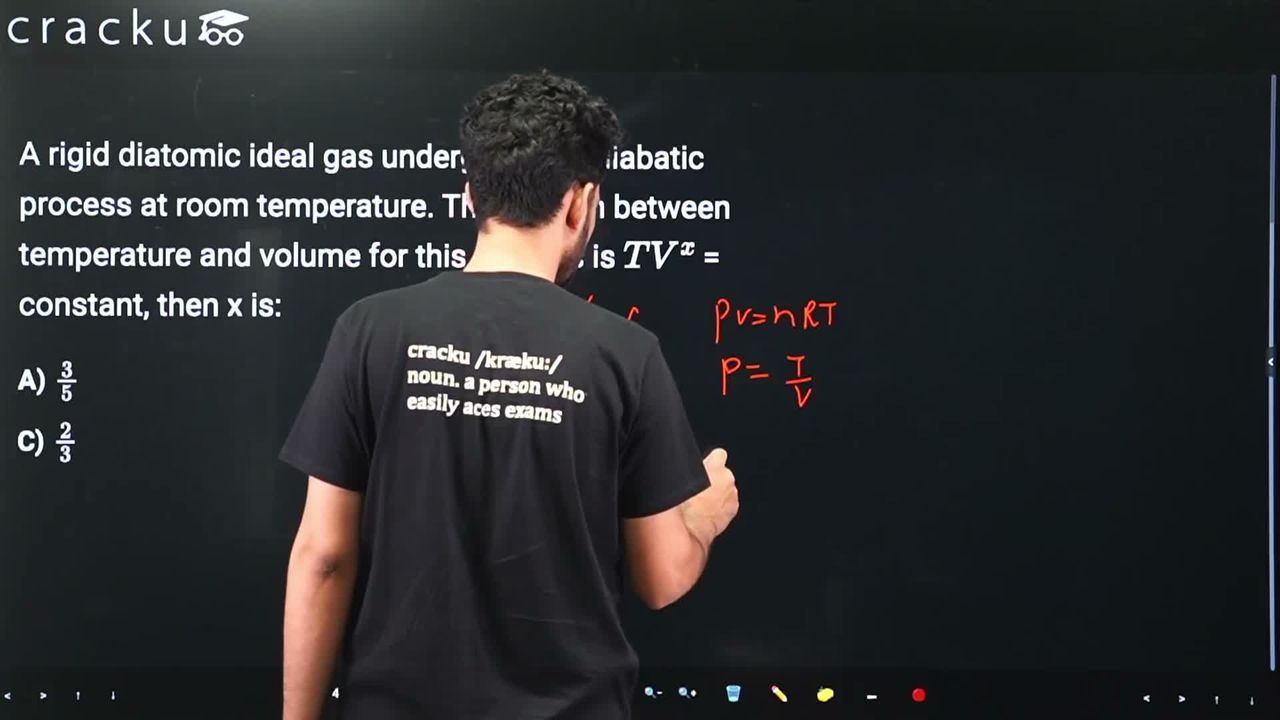
A rigid diatomic ideal gas undergoes an adiabatic process at room temperature. The relation between temperature and volume for this process is $$TV^x$$ = constant, then x is:
For an adiabatic process of an ideal gas we first recall the fundamental relation
$$P\,V^{\gamma}= \text{constant},$$
where $$\gamma=\dfrac{C_P}{C_V}$$ is the ratio of molar heat capacities at constant pressure and at constant volume.
Because the gas is diatomic and rigid at room temperature, it possesses three translational and two rotational degrees of freedom, making a total of $$f=5$$ degrees of freedom. The vibrational modes are not excited at room temperature, so we neglect them.
Using the formula $$C_V=\dfrac{f}{2}R,$$ we obtain
$$C_V=\dfrac{5}{2}R.$$
Next we employ the relation $$C_P=C_V+R.$$ Substituting the value of $$C_V$$ gives
$$C_P=\dfrac{5}{2}R+R=\dfrac{7}{2}R.$$
Now we find $$\gamma$$:
$$\gamma=\dfrac{C_P}{C_V}=\dfrac{\dfrac{7}{2}R}{\dfrac{5}{2}R}=\dfrac{7}{5}=1.4.$$
The ideal-gas equation is $$P V = n R T.$$ Solving it for pressure, we have
$$P=\dfrac{nRT}{V}.$$
We substitute this expression for $$P$$ into the adiabatic condition $$P\,V^{\gamma}= \text{constant}$$:
$$\left(\dfrac{nRT}{V}\right) V^{\gamma}= \text{constant}.$$ $$nRT\,V^{\gamma-1}= \text{constant}.$$
The factors $$n$$ and $$R$$ are fixed for a given sample, so they can be absorbed into the constant. Thus we may write
$$T\,V^{\gamma-1}= \text{constant}.$$
Comparing this with the form given in the problem statement, namely $$T V^{x}= \text{constant},$$ we immediately identify
$$x=\gamma-1.$$
Substituting the value $$\gamma=\dfrac{7}{5},$$ we obtain
$$x=\dfrac{7}{5}-1=\dfrac{2}{5}.$$
Hence, the correct answer is Option B.
Was this solution helpful?
Click on the Email ☝️ to Watch the Video Solution
Create a FREE account and get:
_1.webp)

Educational materials for JEE preparation

Ask our AI anything

AI can make mistakes. Please verify important information.
AI can make mistakes. Please verify important information.
