
Join Our JEE Preparation Group
Prep with like-minded aspirants; Get access to free daily tests and study material.
Sign in
Please select an account to continue using cracku.in
↓ →
Join Our JEE Preparation Group
Prep with like-minded aspirants; Get access to free daily tests and study material.
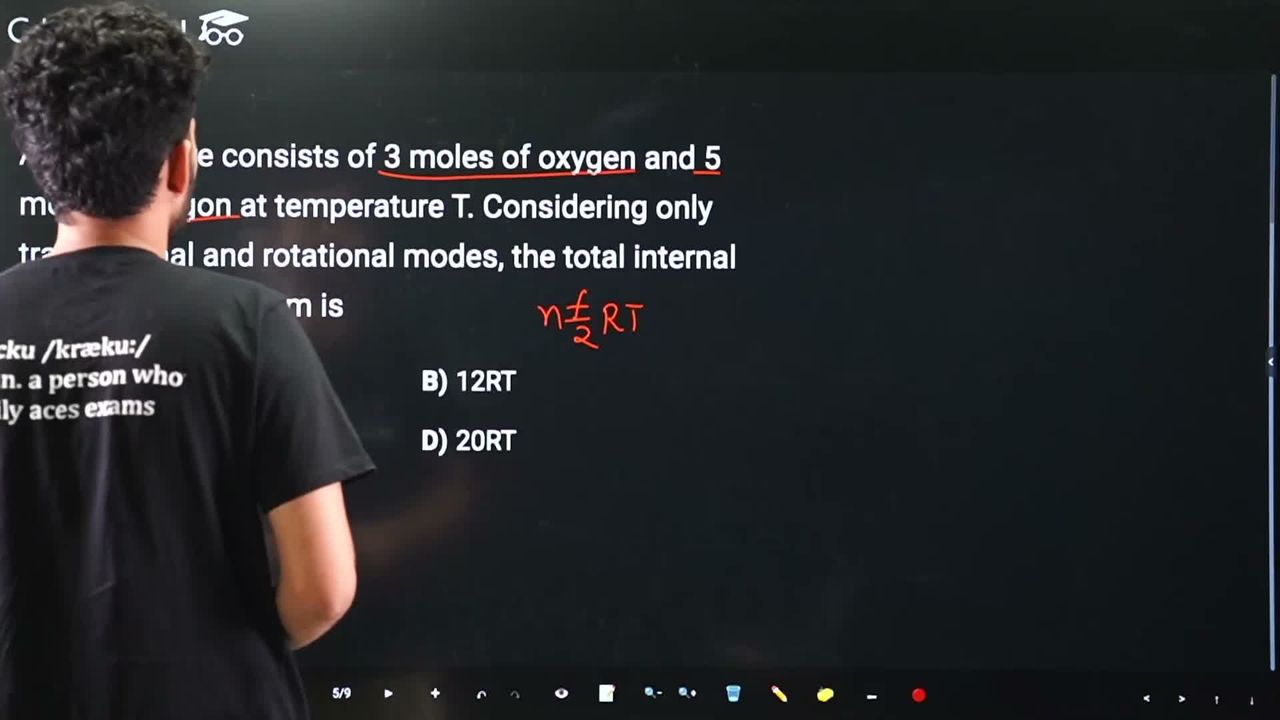
A gas mixture consists of 3 moles of oxygen and 5 moles of argon at temperature T. Considering only translational and rotational modes, the total internal energy of the system is
For an ideal gas, the molar internal energy is linked to the number of degrees of freedom $$f$$ by the well-known expression
$$U_{\text{molar}}=\dfrac{f}{2}RT$$
because each quadratic degree of freedom contributes an average energy of $$\tfrac12kT$$ per molecule or $$\tfrac12RT$$ per mole.
Now we examine the two components of the mixture one by one.
Argon (Ar) is mono-atomic. A mono-atomic molecule can translate along the three Cartesian axes but cannot rotate in a way that stores energy (its moment of inertia about any axis through the centre is negligible). Hence, for argon
$$f_{\text{Ar}} = 3 \quad\Longrightarrow\quad U_{\text{molar, Ar}}=\dfrac{3}{2}RT$$
Oxygen (O2) is diatomic. At the given temperature range we are told to consider only translational and rotational motion; vibrational modes are “frozen out”. A diatomic molecule has three translational and two rotational degrees of freedom (rotation about the internuclear axis contributes negligibly). Thus, for oxygen
$$f_{\text{O}_2}=3+2=5 \quad\Longrightarrow\quad U_{\text{molar, O}_2}=\dfrac{5}{2}RT$$
The mixture contains 5 moles of argon and 3 moles of oxygen, so the total internal energy is the sum of the individual contributions:
$$\begin{aligned} U_{\text{total}} &= \left(5\;\text{mol}\right)\left(\dfrac{3}{2}RT\right) + \left(3\;\text{mol}\right)\left(\dfrac{5}{2}RT\right)\\[4pt] &= \dfrac{15}{2}RT + \dfrac{15}{2}RT\\[4pt] &= \dfrac{30}{2}RT\\[4pt] &= 15RT \end{aligned}$$
Hence, the correct answer is Option A.
Was this solution helpful?
Click on the Email ☝️ to Watch the Video Solution
Create a FREE account and get:
_1.webp)

Educational materials for JEE preparation

Ask our AI anything

AI can make mistakes. Please verify important information.
AI can make mistakes. Please verify important information.
