
Join Our JEE Preparation Group
Prep with like-minded aspirants; Get access to free daily tests and study material.
Sign in
Please select an account to continue using cracku.in
↓ →
Join Our JEE Preparation Group
Prep with like-minded aspirants; Get access to free daily tests and study material.
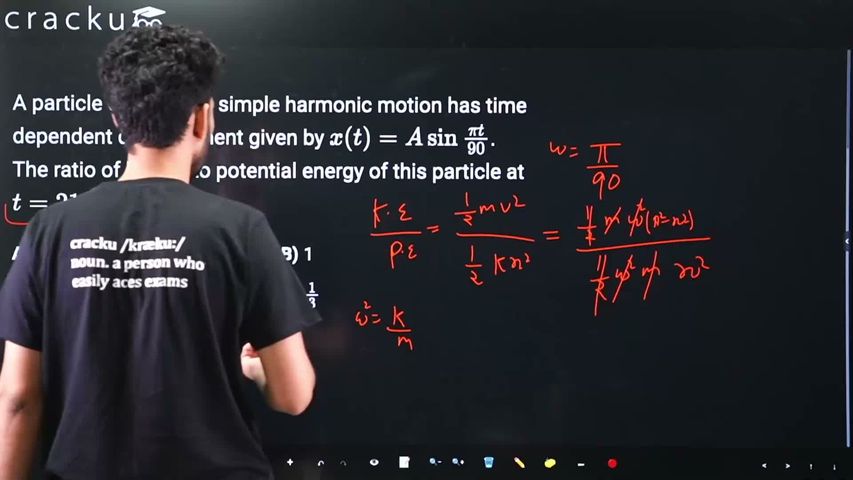
A particle undergoing simple harmonic motion has time dependent displacement given by $$x(t) = A \sin\frac{\pi t}{90}$$. The ratio of kinetic to potential energy of this particle at $$t = 210$$ s will be
We have a particle that performs simple harmonic motion and its displacement as a function of time is given to us as
$$x(t)=A\sin\frac{\pi t}{90}.$$
The standard form of a simple harmonic motion is $$x(t)=A\sin(\omega t),$$ so by direct comparison we identify the angular frequency as
$$\omega=\frac{\pi}{90}\;\text{rad s}^{-1}.$$
For a simple harmonic oscillator of mass $$m$$, the potential energy $$U$$ and kinetic energy $$K$$ at any instant are expressed through the well-known formulas
$$U=\frac12 kx^{2},\qquad K=\frac12 m v^{2},$$
where the force constant $$k$$ is related to $$\omega$$ by $$k=m\omega^{2}.$$ Using this relation, the expressions may be rewritten entirely in terms of $$m$$, $$\omega$$, $$A$$ and $$x$$:
$$U=\frac12 m\omega^{2}x^{2},$$
$$K=\frac12 m\omega^{2}\left(A^{2}-x^{2}\right).$$
We now evaluate the displacement at the specified instant $$t=210\;\text{s}$$. Substituting $$t=210\;\text{s}$$ in the given displacement equation gives
$$x(210)=A\sin\!\Bigl(\frac{\pi}{90}\times210\Bigr)=A\sin\!\Bigl(\frac{210\pi}{90}\Bigr)=A\sin\!\Bigl(\frac{21\pi}{9}\Bigr).$$
Simplifying the fraction,
$$\frac{21\pi}{9}=\frac{7\pi}{3}=2\pi+\frac{\pi}{3},$$
and using the periodicity of the sine function $$\bigl(\sin(\theta+2\pi)=\sin\theta\bigr)$$ we obtain
$$\sin\!\Bigl(2\pi+\frac{\pi}{3}\Bigr)=\sin\frac{\pi}{3}=\frac{\sqrt3}{2}.$$
Therefore
$$x(210)=A\left(\frac{\sqrt3}{2}\right).$$
Next we compute the squares that appear in the energy expressions:
$$x^{2}=\left(A\frac{\sqrt3}{2}\right)^{2}=A^{2}\frac{3}{4},$$
and consequently
$$A^{2}-x^{2}=A^{2}-\frac{3}{4}A^{2}=\frac14 A^{2}.$$
We are asked for the ratio of kinetic energy to potential energy, i.e.
$$\frac{K}{U}=\frac{\tfrac12 m\omega^{2}\left(A^{2}-x^{2}\right)}{\tfrac12 m\omega^{2}x^{2}}.$$
The common factors $$\tfrac12 m\omega^{2}$$ cancel out, leaving
$$\frac{K}{U}=\frac{A^{2}-x^{2}}{x^{2}}.$$
Substituting the values just obtained, we find
$$\frac{K}{U}=\frac{\tfrac14 A^{2}}{\tfrac34 A^{2}}=\frac14\div\frac34=\frac14\times\frac43=\frac13.$$
Hence, the correct answer is Option D.
Was this solution helpful?
Click on the Email ☝️ to Watch the Video Solution
Create a FREE account and get:
_1.webp)

Educational materials for JEE preparation

Ask our AI anything

AI can make mistakes. Please verify important information.
AI can make mistakes. Please verify important information.
