
Join Our JEE Preparation Group
Prep with like-minded aspirants; Get access to free daily tests and study material.
Sign in
Please select an account to continue using cracku.in
↓ →
Join Our JEE Preparation Group
Prep with like-minded aspirants; Get access to free daily tests and study material.
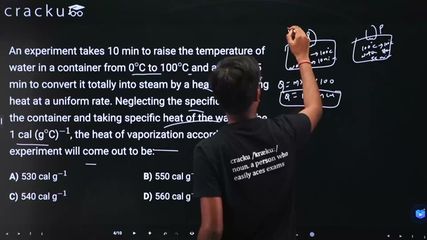
An experiment takes 10 min to raise the temperature of water in a container from 0$$^\circ$$C to 100$$^\circ$$C and another 55 min to convert it totally into steam by a heater supplying heat at a uniform rate. Neglecting the specific heat of the container and taking specific heat of the water to be 1 cal (g$$^\circ$$C)$$^{-1}$$, the heat of vaporization according to this experiment will come out to be:
Let the mass of water present in the container be $$m$$ grams. The heater supplies heat at a perfectly uniform rate, so the amount of heat given to the water is proportional to the time for which the heater operates.
First, the water is heated from $$0^\circ{\rm C}$$ to $$100^\circ{\rm C}$$. We use the basic formula for heat absorbed during a temperature change:
$$Q = mc\Delta T,$$
where $$Q$$ is the heat absorbed, $$m$$ is the mass, $$c$$ is the specific heat capacity and $$\Delta T$$ is the rise in temperature. Here, $$c = 1\;{\rm cal}\,( {\rm g}^\circ{\rm C} )^{-1}$$ and $$\Delta T = 100^\circ{\rm C} - 0^\circ{\rm C} = 100^\circ{\rm C}$$. Hence the heat needed for this stage is
$$Q_1 = m \times 1 \times 100 = 100m\;{\rm cal}.$$
This stage takes 10 minutes. Because the heater’s power is constant, the heat supplied per minute is the same throughout the whole experiment. Denote this unknown constant rate by $$P$$ (cal per minute). Then, for the first stage,
$$Q_1 = P \times (\text{time for stage 1}) = P \times 10.$$
Equating the two expressions for $$Q_1$$ gives us
$$P \times 10 = 100m \quad\rightarrow\quad P = \frac{100m}{10} = 10m\;{\rm cal\;min^{-1}}.$$
Next, the entire mass of water at $$100^\circ{\rm C}$$ is converted into steam at the same temperature. The heat required for a complete change of state is the latent heat:
$$Q_2 = mL,$$
where $$L$$ is the heat of vaporization per gram, which we wish to find. The time taken for this stage is 55 minutes, so by the same constant-power reasoning,
$$Q_2 = P \times (\text{time for stage 2}) = P \times 55.$$
Substituting the value of $$P$$ obtained earlier,
$$mL = (10m)\times 55.$$
Now we divide both sides by $$m$$ to eliminate the mass (since it is the same in both stages and non-zero):
$$L = 10 \times 55 = 550\;{\rm cal\,g^{-1}}.$$
Hence, the measured heat of vaporization from this experiment is $$550\;{\rm cal\,g^{-1}}$$.
Hence, the correct answer is Option B.
Was this solution helpful?
Click on the Email ☝️ to Watch the Video Solution
Create a FREE account and get:
_1.webp)

Educational materials for JEE preparation

Ask our AI anything

AI can make mistakes. Please verify important information.
AI can make mistakes. Please verify important information.
