Join WhatsApp Icon JEE WhatsApp Group

NTA JEE Main 11th April 2015 Online

For the following questions answer them individually

A vector $$\vec{A}$$ is rotated by a small angle $$\Delta\theta$$ radians $$(\Delta\theta \ll 1)$$ to get a new vector $$\vec{B}$$. In that case $$\left|\vec{B} - \vec{A}\right|$$ is:

A beaker contains a fluid of density $$\rho$$ $$\frac{kg}{m^3}$$, specific heat $$S$$ $$\frac{J}{kg \cdot ^\circ C}$$ and viscosity $$\eta$$. The beaker is filled up to height h. To estimate the rate of heat transfer per unit area $$\left(\frac{Q}{A}\right)$$ by convection when beaker is put on a hot plate, a student proposes that it should depend on $$\eta$$, $$\left(\frac{S\Delta\theta}{h}\right)$$ and $$\left(\frac{1}{\rho g}\right)$$ when $$\Delta\theta$$ (in $$^\circ C$$) is the difference in the temperature between the bottom and top of the fluid. In that situation the correct option for $$\left(\frac{Q}{A}\right)$$ is:

If electronic charge $$e$$, electron mass $$m$$, speed of light in vacuum $$c$$ and Planck's constant $$h$$ are taken as fundamental quantities, the permeability of vacuum $$\mu_0$$ can be expressed in units of:

From the top of a 64 metres high tower, a stone is thrown upwards vertically with the velocity of 48 m/s. The greatest height (in metres) attained by the stone, assuming the value of the gravitational acceleration $$g = 32$$ m/s$$^2$$, is:

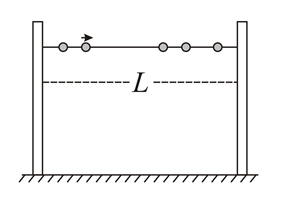
A large number $$(n)$$ of identical beads, each of mass $$m$$ and radius $$r$$ are strung on a thin smooth rigid horizontal rod of length $$L(L \gg r)$$ and are at rest at random positions. The rod is mounted between two rigid supports (see the figure below). If one of the beads is now given a speed $$v$$, the average force experienced by each support after a long time is (assume all collisions are elastic):

A particle is moving in a circle of radius $$r$$ under the action of a force $$F = \alpha r^2$$ which is directed towards centre of the circle. Total mechanical energy (kinetic energy + potential energy) of the particle is (take potential energy = 0 for $$r = 0$$):

A uniform thin rod AB of length $$L$$ has linear mass density $$\mu(x) = a + \frac{bx}{L}$$, where $$x$$ is measured from A. If the CM of the rod lies at a distance of $$\left(\frac{7}{12}L\right)$$ from A, then $$a$$ and $$b$$ are related as:

A particle of mass 2 kg is on a smooth horizontal table and moves in a circular path of radius 0.6 m. The height of the table from the ground is 0.8 m. If the angular speed of the particle is 12 rad s$$^{-1}$$, the magnitude of its angular momentum about a point on the ground right under the center of the circle is:

Which of the following most closely depicts the correct variation of the gravitation potential, $$V(r)$$ with distance $$r$$ due to a large planet of radius $$R$$ and uniform mass density? (figures are not drawn to scale)

An experiment takes 10 min to raise the temperature of water in a container from 0$$^\circ$$C to 100$$^\circ$$C and another 55 min to convert it totally into steam by a heater supplying heat at a uniform rate. Neglecting the specific heat of the container and taking specific heat of the water to be 1 cal (g$$^\circ$$C)$$^{-1}$$, the heat of vaporization according to this experiment will come out to be:

A pendulum with the time period of 1 s is losing energy due to damping. At a certain time, its energy is 45 J. If after completing 15 oscillations its energy has become 15 J, then its damping constant (in s$$^{-1}$$) will be

A cylindrical block of wood (density = 650 kg m$$^{-3}$$), of base area 30 cm$$^2$$ and height 54 cm, floats in a liquid of density 900 kg m$$^{-3}$$. The block is depressed slightly and then released. The time period of the resulting oscillations of the block would be equal to that of a simple pendulum of length (nearly):

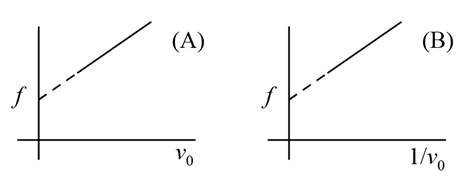
A source of sound emits sound waves at frequency $$f_0$$. It is moving towards an observer with fixed speed $$v_s$$ $$(v_s < v)$$, where $$v$$ is the speed of sound in air. If the observer were to move towards the source with speed $$v_0$$, one of the following two graphs (A and B) will give the correct variation of the frequency $$f$$ heard by the observer as $$v_0$$ is changed.

The variation of $$f$$ with $$v_0$$ is given correctly by:

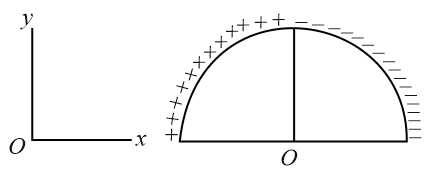
A wire of length $$L = 20$$ cm is bent into a semi-circular arc and the two equal halves of the arc are uniformly charged with charges $$+Q$$ and $$-Q$$ as shown in the figure. The magnitude of the charge on each half is $$|Q| = 10^3\varepsilon_0$$, where $$\varepsilon_0$$ is the permittivity of free space. The net electric field at the centre $$O$$ is

An electric field $$\vec{E} = \left(25\hat{i} + 30\hat{j}\right)$$ N C$$^{-1}$$ exists in a region of space. If the potential at the origin is taken to be zero then the potential at $$x = 2$$ m, $$y = 2$$ m is:

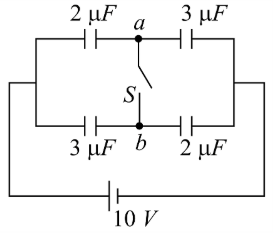
In the figure is shown a system of four capacitors connected across a 10 V battery. The charge that will flow from switch S when it is closed is:

image

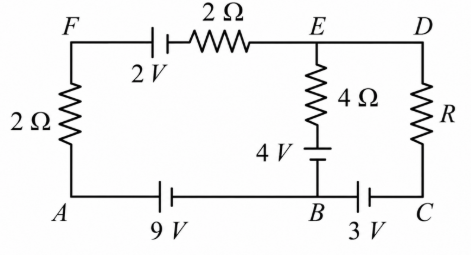
In the electric network shown, when no current flows through the 4 $$\Omega$$ resistor in the arm EB, the potential difference between the points A and D will be:

image

A short bar magnet is placed in the magnetic meridian of the earth with North Pole pointing north. Neutral points are found at a distance of 30 cm from the magnet on the East-West line, drawn through the middle point of the magnet. The magnetic moment of the magnet in Am$$^2$$ is close to: (Given $$\frac{\mu_0}{4\pi} = 10^{-7}$$ in SI units and $$B_H$$ = Horizontal component of earth's magnetic field = $$3.6 \times 10^{-5}$$ Tesla.)

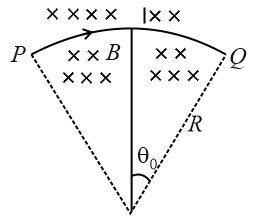
A wire carrying current $$I$$ is tied between points $$P$$ and $$Q$$ and is in the shape of a circular arc of radius $$R$$ due to a uniform magnetic field $$B$$ (perpendicular to the plane of the paper, as shown in the figure) in the vicinity of the wire. If the wire subtends an angle $$2\theta_0$$ at the center of the circle (of which it forms an arch) then the tension in the wire is:

Two long straight parallel wires, carrying (adjustable) currents $$I_1$$ and $$I_2$$, are kept at a distance $$d$$ apart. If the force $$F$$ between the two wires is taken as 'positive' when the wires repel each other and 'negative' when the wires attract each other, the graph showing the dependence of $$F$$, on the product $$I_1 I_2$$, would be:

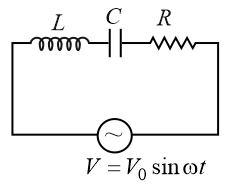
For the LCR circuit, shown here, the current is observed to lead the applied voltage. An additional capacitor $$C'$$, when joined with the capacitor C present in the circuit, makes the power factor of the circuit unity. The capacitor $$C'$$, must have been connected in:

For plane electromagnetic waves propagating in the $$+z$$-direction, which one of the following combinations gives the correct possible direction for $$\vec{E}$$ and $$\vec{B}$$ field respectively?

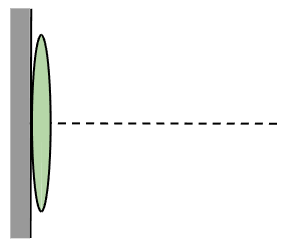
A thin convex lens of focal length $$f$$ is put on a plane mirror as shown in the figure. When an object is kept at a distance $$a$$ from the lens-mirror combination, its image is formed at a distance $$\dfrac{a}{3}$$ in front of the combination. The value of $$a$$ is:

image

In a Young's double slit experiment with light of wavelength $$\lambda$$, the separation of slits is $$d$$ and distance of screen is $$D$$ such that $$D \gg d \gg \lambda$$. If the Fringe width is $$\beta$$, the distance from point of maximum intensity to the point where intensity falls to half of the maximum intensity on either side is:

Unpolarized light of intensity $$I_0$$ is incident on surface of a block of glass at Brewster's angle. In that case, which one of the following statements is true?

The de-Broglie wavelength associated with the electron in the $$n = 4$$ level is:

Let $$N_\beta$$ be the number of $$\beta$$ particle emitted by 1 gram of Na$$^{24}$$ radioactive nuclei having a half life of 15 h. In 7.5 h, the number $$N_\beta$$ is close to $$[N_A = 6.023 \times 10^{23}$$ mole$$^{-1}]$$

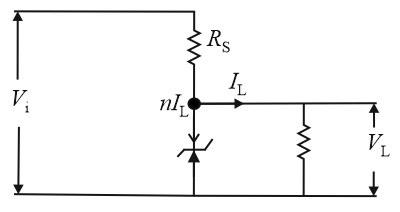
The value of the resistor, $$R_S$$, needed in the DC voltage regulator circuit shown here, equals:

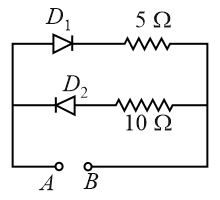
A 2 V battery is connected across AB as shown in the figure. The value of the current supplied by the battery when in first case battery's positive terminal is connected to A and in second case when positive terminal of battery is connected to B will respectively be:

In the following reaction:
$$A + 2B + 3C \rightleftharpoons AB_2C_3$$
6.0 g of A, $$6.0 \times 10^{23}$$ atoms of B and 0.036 mol of C reacted and formed 4.8 g of compound $$AB_2C_3$$. If the atomic mass of A and C are 60 and 80 amu, respectively. What is the atomic mass of B in amu? (Avogadro number = $$6 \times 10^{23}$$)

An element X shows +3, oxidation state in its compounds. Out of the four compounds given below, choose the incorrect formula for the element X.

At temperature T, the average kinetic energy of any particle is $$\frac{3}{2}kT$$. The de Broglie wavelength follows the order:

Molecule AB has a bond length of 1.617 $$\mathring{A}$$ and a dipole moment of 0.38 D. The fractional charge on each atom (absolute magnitude) is: $$(e_0 = 4.802 \times 10^{-10}$$ esu$$)$$

When does a gas deviate the most from its ideal behavior?

The increase of pressure on ice $$\rightleftharpoons$$ water system at constant temperature will lead to:

Match the organic compounds in column - I with the Lassaigne's test result in column - II appropriately:

Column - I                                   Column - II
A. Aniline                                i. Red colour with FeCl$$_3$$
B. Benzene sulfonic acid     ii. Violet color with sodium nitroprusside
C. Thiourea                            iii. Blue color with acidic solution of FeSO$$_4$$

Addition of phosphate fertilizers to water bodies causes:

At 298 K, the standard reduction potentials are 1.51 V for $$MnO_4^- | Mn^{2+}$$, 1.36 V for $$Cl_2|Cl^-$$, 1.07 V for $$Br_2|Br^-$$, 0.54 V for $$I_2|I^-$$. At pH = 3, permanganate is expected to oxidize: $$\left(\frac{RT}{F} = 0.059\right)$$

$$A + 2B \rightarrow C$$, the rate equation for the reaction is given as Rate = k[A][B]. If the concentration of A is kept the same but that of B is doubled what will happen to the rate itself?

For the equilibrium, $$A(g) \rightleftharpoons B(g)$$, $$\Delta H$$ is $$-40$$ kJ/mol. If the ratio of the activation energies of the forward $$(E_f)$$ and reverse $$(E_b)$$ reactions is $$\frac{2}{3}$$ then:

Under ambient conditions, which among the following surfactants will form micelles in aqueous solution at lowest molar concentration?

Which of the following statements is/are false?

Which of the following complex ions has electrons that are symmetrically filled in both $$t_{2g}$$ and $$e_g$$ orbitals?

When concentrated HCl is added to aqueous solution of $$CoCl_2$$, its colour changes from reddish pink to deep blue. Which complex ion gives blue colour in reaction?

In the reaction sequence $$2CH_3CHO \xrightarrow{OH^-} A \xrightarrow{\Delta} B$$; the product B is:

If the two roots of the equation, $$(a-1)(x^4 + x^2 + 1) + (a+1)(x^2 + x + 1)^2 = 0$$ are real and distinct, then the set of all values of $$a$$ is equal to

Let $$A = \{x_1, x_2, \ldots, x_7\}$$ and $$B = \{y_1, y_2, y_3\}$$ be two sets containing seven and three distinct elements respectively. Then the total number of functions $$f : A \rightarrow B$$ that are onto, if there exist exactly three elements $$x$$ in $$A$$ such that $$f(x) = y_2$$, is equal to:

The sum of the 3$$^{rd}$$ and the 4$$^{th}$$ terms of a G.P. is 60 and the product of its first three terms is 1000. If the first term of this G.P. is positive, then its 7$$^{th}$$ term is:

If $$\cos \alpha + \cos \beta = \frac{3}{2}$$ and $$\sin \alpha + \sin \beta = \frac{1}{2}$$ and $$\theta$$ is the arithmetic mean of $$\alpha$$ and $$\beta$$, then $$\sin 2\theta + \cos 2\theta$$ is equal to:

A straight line $$L$$ through the point $$(3, -2)$$ is inclined at an angle of $$60^\circ$$ to the line $$\sqrt{3}x + y = 1$$. If $$L$$ also intersects the X-axis, then the equation of $$L$$ is:

If the incentre of an equilateral triangle is $$(1, 1)$$ and the equation of its one side is $$3x + 4y + 3 = 0$$, then the equation of the circumcircle of this triangle is:

If $$PQ$$ be a double ordinate of the parabola, $$y^2 = -4x$$, where $$P$$ lies in the second quadrant. If $$R$$ divides $$PQ$$ in the ratio 2 : 1, then the locus of $$R$$ is

If the distance between the foci of an ellipse is half the length of its latus rectum, then the eccentricity of the ellipse is:

Consider the following statements:
P: Suman is brilliant
Q: Suman is rich
R: Suman is honest

The negation of the statement, "Suman is brilliant and dishonest if and only if Suman is rich" can be equivalently expressed as

Let 10 vertical poles standing at equal distances on a straight line, subtend the same angle of elevation $$\alpha$$ at a point $$O$$ on this line and all the poles are on the same side of $$O$$. If the height of the longest pole is $$h$$ and the distance of the foot of the smallest pole from $$O$$ is $$a$$; then the distance between two consecutive poles, is

Let $$k$$ be a non-zero real number. If $$f(x) = \begin{cases} \frac{(e^x - 1)^2}{\sin\left(\frac{x}{k}\right)\log\left(1 + \frac{x}{4}\right)}, & x \neq 0 \\ 12, & x = 0 \end{cases}$$ is a continuous function at $$x = 0$$, then the value of $$k$$ is

The equation of a normal to the curve, $$\sin y = x\sin\left(\frac{\pi}{3} + y\right)$$ at $$x = 0$$, is:

Let $$k$$ and $$K$$ be the minimum and the maximum values of the function $$f(x) = \frac{(1+x)^{0.6}}{1+x^{0.6}}$$ in $$[0, 1]$$, respectively, then the ordered pair $$(k, K)$$ is equal to:

If $$\int \frac{\log\left(t + \sqrt{1+t^2}\right)}{\sqrt{1+t^2}} dt = \frac{1}{2}(g(t))^2 + c$$, where c is a constant, then $$g(2)$$ is equal to

Let $$f : R \rightarrow R$$ be a function such that $$f(2-x) = f(2+x)$$ and $$f(4-x) = f(4+x)$$, for all $$x \in R$$ and $$\int_0^2 f(x)dx = 5$$. Then the value of $$\int_{10}^{50} f(x)dx$$ is

Let $$f : (-1, 1) \rightarrow R$$ be a continuous function. If $$\int_0^{\sin x} f(t) dt = \frac{\sqrt{3}}{2}x$$, then $$f\left(\frac{\sqrt{3}}{2}\right)$$ is equal to:

In a parallelogram $$ABCD$$, $$\left|\overrightarrow{AB}\right| = a$$, $$\left|\overrightarrow{AD}\right| = b$$ and $$\left|\overrightarrow{AC}\right| = c$$. $$\overrightarrow{DB} \cdot \overrightarrow{AB}$$ has the value:

A plane containing the point $$(3, 2, 0)$$ and the line $$\frac{x-1}{1} = \frac{y-2}{5} = \frac{z-3}{4}$$ also contains the point

If the mean and the variance of a binomial variate $$X$$ are 2 and 1 respectively, then the probability that $$X$$ takes a value greater than or equal to one is:

If the lengths of the sides of a triangle are decided by the three throws of a single fair die, then the probability that the triangle is of maximum area given that it is an isosceles triangle, is: