
Join Our JEE Preparation Group
Prep with like-minded aspirants; Get access to free daily tests and study material.
Sign in
Please select an account to continue using cracku.in
↓ →
Join Our JEE Preparation Group
Prep with like-minded aspirants; Get access to free daily tests and study material.
We begin by recalling the general formula for an acyclic (open-chain) alkane. For any alkane containing $$n$$ carbon atoms, the number of hydrogen atoms is given by the relation $$H = 2n + 2$$. Putting $$n = 6$$ gives $$H = 2(6) + 2 = 14$$, so the molecular formula $$C_6H_{14}$$ indeed represents an alkane.
Next, we need to enumerate every distinct way of connecting six carbon atoms in a single, continuous skeleton without forming any rings, because each distinct connectivity corresponds to a different structural (constitutional) isomer. Whenever a carbon chain is shortened in the parent skeleton and one or more side chains (alkyl groups) are attached, a new structural isomer can arise, provided that its carbon-carbon connectivity is not identical (upon any possible rotation or flipping) to a structure already counted.
We systematically construct each possibility, beginning with the longest unbranched chain and then considering all permissible branchings.
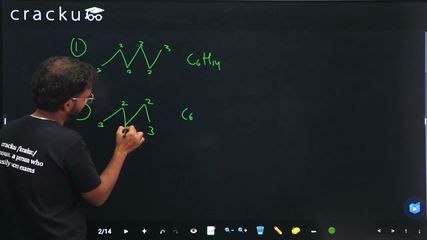
1. The straight chain containing all six carbons end-to-end is called normal hexane, written as $$CH_3-CH_2-CH_2-CH_2-CH_2-CH_3$$. This is the first isomer.
2. Now we shorten the parent chain by one carbon atom (making a five-carbon backbone) and attach the removed carbon as a single-carbon branch. Attaching that branch to the second carbon of the chain yields $$2$$-methylpentane. Because numbering from either end puts the branch on carbon $$2$$, there is only one distinct isomer of this kind for a single branch on a five-carbon backbone. This is the second isomer.
3. When the methyl group is attached to the middle carbon of the same five-carbon backbone, we obtain $$3$$-methylpentane. Rotation or reflection cannot convert this into $$2$$-methylpentane, so this is a distinct structure, giving the third isomer.
4. We now shorten the parent chain to four carbons and keep two carbons as branches. If both methyl branches are placed on the same second carbon of the butane backbone, the structure is $$2,2$$-dimethylbutane. This differs from every structure already listed, providing the fourth isomer.
5. Keeping the four-carbon backbone but placing the two methyl branches on adjacent carbons—one on carbon $$2$$ and the other on carbon $$3$$—gives $$2,3$$-dimethylbutane. There is no way to rotate or flip this skeleton so that it becomes identical to $$2,2$$-dimethylbutane$, to any of the earlier monomethyl isomers, or to $$n$$-hexane. Hence this is the fifth and final structural isomer.
At this point every conceivable carbon skeleton for six carbons has been exhausted. There are no further distinct arrangements: a parent chain of three carbons with more and longer branches would necessarily duplicate one of the skeletons already obtained, and any structure containing a ring would violate the requirement of an acyclic alkane.
So, the total count of unique carbon connectivities compatible with $$C_6H_{14}$$ is $$5$$.
Hence, the correct answer is Option B.
Was this solution helpful?
Click on the Email ☝️ to Watch the Video Solution
Create a FREE account and get:
_1.webp)

Educational materials for JEE preparation

Ask our AI anything

AI can make mistakes. Please verify important information.
AI can make mistakes. Please verify important information.
