
Join Our JEE Preparation Group
Prep with like-minded aspirants; Get access to free daily tests and study material.
Sign in
Please select an account to continue using cracku.in
↓ →
Join Our JEE Preparation Group
Prep with like-minded aspirants; Get access to free daily tests and study material.
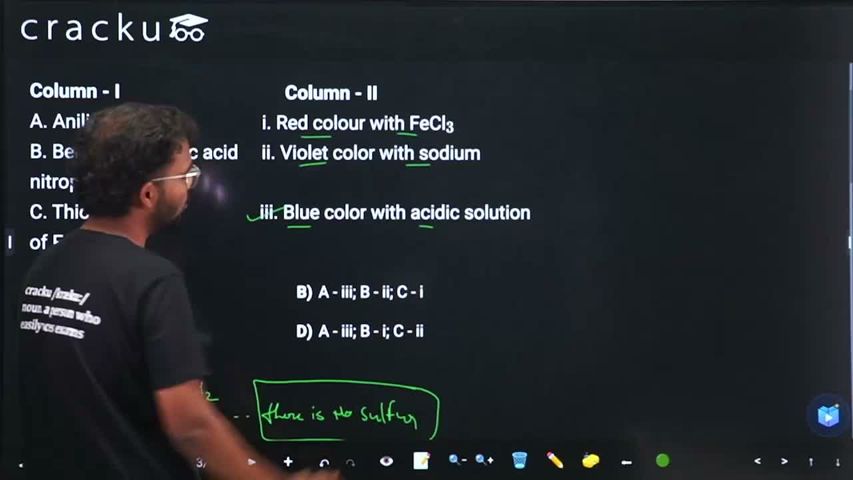
Match the organic compounds in column - I with the Lassaigne's test result in column - II appropriately:
Column - I Column - II
A. Aniline i. Red colour with FeCl$$_3$$
B. Benzene sulfonic acid ii. Violet color with sodium nitroprusside
C. Thiourea iii. Blue color with acidic solution of FeSO$$_4$$
We have to recognise which coloured reaction is produced by the Lassaigne’s extract of each given compound. In every case the organic compound is first fused with metallic sodium so that the hetero-atoms (N, S, X) are converted into water-soluble ionic species. Then the extract is tested with suitable reagents.
For nitrogen alone, the sodium fusion converts N into the cyanide ion:
$$Na + C + N \;\rightarrow\; NaCN$$
The classical Prussian-blue test is then carried out. The formula applied is:
$$NaCN + FeSO_4 + \text{alkaline medium} \;\longrightarrow\; Na_4[Fe(CN)_6]$$
$$3\,Na_4[Fe(CN)_6] + 4\,FeCl_3 \;\overset{\,HCl\,}{\rightarrow}\; Fe_4[Fe(CN)_6]_3 + NaCl$$
The complex $$Fe_4[Fe(CN)_6]_3$$ is Prussian blue. So, if a compound contains nitrogen but no sulphur, the Lassaigne’s extract gives a blue colour with an acidic solution of $$FeSO_4$$.
Aniline, $$C_6H_5NH_2$$, contains nitrogen only. Hence its extract develops the blue colour with $$FeSO_4$$. Therefore,
$$\text{Aniline} \;\longrightarrow\; \text{Blue colour with acidic } FeSO_4$$
So A matches (iii).
For sulphur alone, the sodium fusion gives the sulphide ion:
$$Na + S \;\rightarrow\; Na_2S$$
The standard sulphur test employs sodium nitroprusside. The reaction is:
$$Na_2S + Na_2[Fe(CN)_5NO] \;\longrightarrow\; [Fe(CN)_5NOS]^{4-}$$
This complex imparts a violet or purple colour. Hence a compound containing only sulphur gives a violet colour with sodium nitroprusside.
Benzene sulphonic acid, $$C_6H_5SO_3H$$, contains sulphur but not nitrogen. Its extract therefore gives the violet colour.
$$\text{Benzene sulphonic acid} \;\longrightarrow\; \text{Violet colour with sodium nitroprusside}$$
Thus B matches (ii).
When both nitrogen and sulphur are present simultaneously, fusion produces the thiocyanate ion:
$$Na + C + N + S \;\rightarrow\; NaSCN$$
On treating the extract with neutral or slightly acidic $$FeCl_3$$ solution, a deep blood-red complex $$[Fe(SCN)]^{2+}$$ appears:
$$3\,NaSCN + FeCl_3 \;\rightarrow\; Fe(SCN)_3 + 3\,NaCl$$
The characteristic observation is a red colour with $$FeCl_3$$.
Thiourea, $$SC(NH_2)_2$$, contains both N and S. Therefore its extract produces the red colour with ferric chloride.
$$\text{Thiourea} \;\longrightarrow\; \text{Red colour with } FeCl_3$$
Consequently, C matches (i).
Collecting the three correct pairings, we get
$$A \;-\; iii,\quad B \;-\; ii,\quad C \;-\; i$$
Looking at the given options, this correspondence is listed as Option B.
Hence, the correct answer is Option B.
Was this solution helpful?
Click on the Email ☝️ to Watch the Video Solution
Create a FREE account and get:
Educational materials for JEE preparation

Ask our AI anything

AI can make mistakes. Please verify important information.
AI can make mistakes. Please verify important information.

_1.webp)
