
Join Our JEE Preparation Group
Prep with like-minded aspirants; Get access to free daily tests and study material.
Sign in
Please select an account to continue using cracku.in
↓ →
Join Our JEE Preparation Group
Prep with like-minded aspirants; Get access to free daily tests and study material.
A wire carrying current $$I$$ is tied between points $$P$$ and $$Q$$ and is in the shape of a circular arc of radius $$R$$ due to a uniform magnetic field $$B$$ (perpendicular to the plane of the paper, as shown in the figure) in the vicinity of the wire. If the wire subtends an angle $$2\theta_0$$ at the center of the circle (of which it forms an arch) then the tension in the wire is:
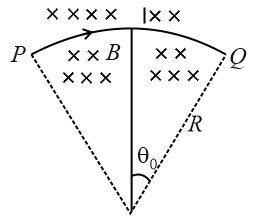
Consider a small element of the wire subtending an angle $$d\theta$$ at the center. The length of this element is $$dl = R d\theta$$
The magnetic force $$dF$$ acting on this element is given by $$d\vec{F} = I(d\vec{l} \times \vec{B})$$
Since the magnetic field $$B$$ is uniform and perpendicular to the plane of the wire, the magnitude of the force is $$dF = I B dl = I B R d\theta$$
Using the Right-Hand Rule, this force $$dF$$ acts radially outward from the center.
The components of tension parallel to the tangent at the center of the element cancel out.
The components directed toward the center (radial components) add up.
$$\sum F_{radial} = 2T \sin\left(\frac{d\theta}{2}\right)$$
For the element to be in equilibrium, the net radial force must be zero:
$$2T \sin\left(\frac{d\theta}{2}\right) = dF$$
$$2T \sin\left(\frac{d\theta}{2}\right) = I B R d\theta$$
Using the small-angle approximation where $$\sin(\alpha) \approx \alpha$$ for very small angles:
$$2T \left(\frac{d\theta}{2}\right) = I B R d\theta$$
$$T d\theta = I B R d\theta$$
$$T = I B R$$
Was this solution helpful?
Create a FREE account and get:
_1.webp)

Educational materials for JEE preparation

Ask our AI anything

AI can make mistakes. Please verify important information.
AI can make mistakes. Please verify important information.
