
Join Our JEE Preparation Group
Prep with like-minded aspirants; Get access to free daily tests and study material.
Sign in
Please select an account to continue using cracku.in
↓ →
Join Our JEE Preparation Group
Prep with like-minded aspirants; Get access to free daily tests and study material.
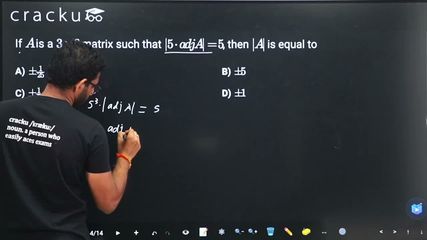
If $$A$$ is a $$3 \times 3$$ matrix such that $$|5 \cdot adj A| = 5$$, then $$|A|$$ is equal to
We are given that $$ A $$ is a $$ 3 \times 3 $$ matrix and $$ |5 \cdot \text{adj } A| = 5 $$. We need to find $$ |A| $$.
Recall that for any square matrix $$ A $$ of order $$ n $$, the determinant of the adjugate matrix satisfies $$ |\text{adj } A| = |A|^{n-1} $$. Since $$ A $$ is $$ 3 \times 3 $$, $$ n = 3 $$, so $$ |\text{adj } A| = |A|^{3-1} = |A|^2 $$.
Now, consider the expression $$ |5 \cdot \text{adj } A| $$. Multiplying a matrix by a scalar $$ k $$ scales its determinant by $$ k^n $$. Here, $$ k = 5 $$ and $$ n = 3 $$, so:
$$ |5 \cdot \text{adj } A| = 5^3 \cdot |\text{adj } A| = 125 \cdot |\text{adj } A| $$
Given that $$ |5 \cdot \text{adj } A| = 5 $$, we substitute:
$$ 125 \cdot |\text{adj } A| = 5 $$
Solving for $$ |\text{adj } A| $$:
$$ |\text{adj } A| = \frac{5}{125} = \frac{1}{25} $$
But we know $$ |\text{adj } A| = |A|^2 $$, so:
$$ |A|^2 = \frac{1}{25} $$
Taking square roots on both sides:
$$ |A| = \pm \sqrt{\frac{1}{25}} = \pm \frac{1}{5} $$
Was this solution helpful?
Click on the Email ☝️ to Watch the Video Solution
Create a FREE account and get:
_1.webp)

Educational materials for JEE preparation

Ask our AI anything

AI can make mistakes. Please verify important information.
AI can make mistakes. Please verify important information.
