
Join Our JEE Preparation Group
Prep with like-minded aspirants; Get access to free daily tests and study material.
Sign in
Please select an account to continue using cracku.in
↓ →
Join Our JEE Preparation Group
Prep with like-minded aspirants; Get access to free daily tests and study material.
A large number $$(n)$$ of identical beads, each of mass $$m$$ and radius $$r$$ are strung on a thin smooth rigid horizontal rod of length $$L(L \gg r)$$ and are at rest at random positions. The rod is mounted between two rigid supports (see the figure below). If one of the beads is now given a speed $$v$$, the average force experienced by each support after a long time is (assume all collisions are elastic):
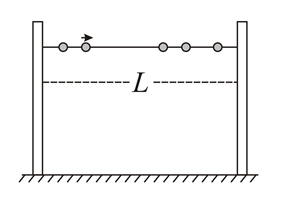
In elastic collisions between identical masses ($$m$$), the two bodies simply exchange velocities.
Since the beads have a finite radius $$r$$, they occupy space on the rod. Diameter of one bead $$= 2r$$. Total length occupied by $$n$$ beads $$= 2nr$$.
The actual free distance the momentum has to travel between the two supports is $$L_{eff} = L - 2nr$$
The time interval between two consecutive collisions with the same support is $$T = \frac{2 \times L_{eff}}{v} = \frac{2(L - 2nr)}{v}$$
change in momentum ($$\Delta p$$) during one collision is $$\Delta p = mv - (-mv) = 2mv$$
$$F_{avg} = \frac{\Delta p}{T}$$
$$F_{avg} = \frac{2mv}{\frac{2(L - 2nr)}{v}}$$
$$F_{avg} = \frac{mv^2}{L - 2nr}$$
Was this solution helpful?
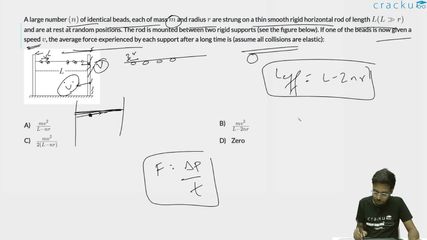
Click on the Email ☝️ to Watch the Video Solution
Create a FREE account and get:
_1.webp)

Educational materials for JEE preparation

Ask our AI anything

AI can make mistakes. Please verify important information.
AI can make mistakes. Please verify important information.
