
Join Our JEE Preparation Group
Prep with like-minded aspirants; Get access to free daily tests and study material.
Sign in
Please select an account to continue using cracku.in
↓ →
Join Our JEE Preparation Group
Prep with like-minded aspirants; Get access to free daily tests and study material.
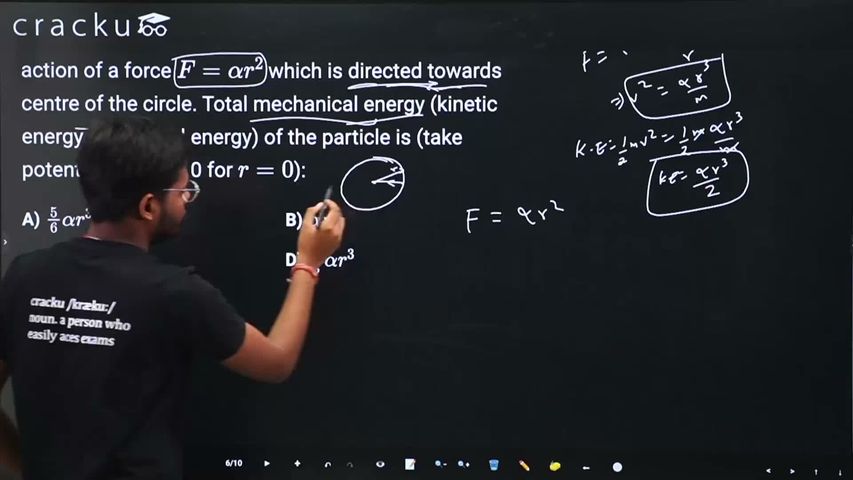
A particle is moving in a circle of radius $$r$$ under the action of a force $$F = \alpha r^2$$ which is directed towards centre of the circle. Total mechanical energy (kinetic energy + potential energy) of the particle is (take potential energy = 0 for $$r = 0$$):
We begin by noting that the force acting on the particle is central and is given in magnitude by $$F = \alpha r^2$$, always directed toward the centre of the circle. A central force is conservative, so we can define a potential energy function $$U(r)$$ such that $$F_r = -\dfrac{dU}{dr}$$, where the minus sign indicates that the force is attractive (towards the centre).
Because the particle is executing uniform circular motion of radius $$r$$, the required centripetal force is provided entirely by this central force. Hence we equate the magnitudes
$$\dfrac{mv^2}{r} = \alpha r^2.$$
Solving this relation for the square of the speed $$v^2$$, we multiply both sides by $$r$$:
$$mv^2 = \alpha r^3 \quad \Rightarrow \quad v^2 = \dfrac{\alpha r^3}{m}.$$
Now we write the kinetic energy. The standard formula for kinetic energy is $$K = \dfrac12 m v^2$$, so substituting the value of $$v^2$$ obtained above gives
$$K = \dfrac12 m \left( \dfrac{\alpha r^3}{m} \right) = \dfrac12 \alpha r^3.$$
Next we calculate the potential energy. From the definition $$F_r = -\dfrac{dU}{dr}$$ and using $$F_r = -\alpha r^2$$ (negative sign because the force is inward), we have
$$-\alpha r^2 = -\dfrac{dU}{dr} \quad \Rightarrow \quad \dfrac{dU}{dr} = \alpha r^2.$$
We integrate from the reference point $$r = 0$$, where the problem states $$U = 0$$, up to the general radius $$r$$:
$$U(r) = \int_{0}^{r} \alpha s^2 \, ds = \alpha \int_{0}^{r} s^2 \, ds = \alpha \left[ \dfrac{s^3}{3} \right]_{0}^{r} = \dfrac{\alpha r^3}{3}.$$
Finally, the total mechanical energy $$E$$ is the sum of kinetic and potential energies:
$$E = K + U = \dfrac12 \alpha r^3 + \dfrac13 \alpha r^3 = \left(\dfrac{3}{6} + \dfrac{2}{6}\right)\alpha r^3 = \dfrac56 \alpha r^3.$$
Hence, the correct answer is Option A.
Was this solution helpful?
Click on the Email ☝️ to Watch the Video Solution
Create a FREE account and get:
_1.webp)

Educational materials for JEE preparation

Ask our AI anything

AI can make mistakes. Please verify important information.
AI can make mistakes. Please verify important information.
