Join Our JEE Preparation Group
Prep with like-minded aspirants; Get access to free daily tests and study material.
Sign in
Please select an account to continue using cracku.in
↓ →
Join Our JEE Preparation Group
Prep with like-minded aspirants; Get access to free daily tests and study material.
Asn (N-terminus): Contains a free primary amine ($$-NH_2$$) and a side-chain primary amide ($$-CONH_2$$).
Ser (C-terminus): Contains a side-chain hydroxyl group ($$-OH$$).
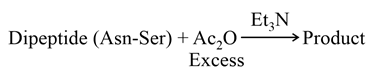
Acetic anhydride ($$Ac_2O$$) in excess acts as a powerful acetylating agent. In the presence of a base ($$Et_3N$$), it replaces the active hydrogen atoms of nucleophilic functional groups with acetyl groups ($$-COCH_3$$ or $$-Ac$$).
Under excess conditions, all accessible nucleophilic sites are acetylated:
N-terminal Amine: $$-NH_2 \xrightarrow{Ac_2O} -NHCOCH_3$$ (Forms an acetamide).
Serine Side-chain: $$-OH \xrightarrow{Ac_2O} -OCOCH_3$$ (Forms an ester).
Asparagine Side-chain: $$-CONH_2 \xrightarrow{Ac_2O} -CONH-COCH_3$$ (Primary amides are acetylated to $$N$$-acetyl amides when the reagent is in excess).
Option B is the correct product because it correctly shows the acetylation of all three reactive sites: the N-terminus, the serine hydroxyl, and the asparagine side-chain amide. The C-terminal carboxylic acid ($$-COOH$$) remains in its acidic form.
Was this solution helpful?
Create a FREE account and get:
_1.webp)

Educational materials for JEE preparation

Ask our AI anything

AI can make mistakes. Please verify important information.
AI can make mistakes. Please verify important information.