
Join Our JEE Preparation Group
Prep with like-minded aspirants; Get access to free daily tests and study material.
Sign in
Please select an account to continue using cracku.in
↓ →
Join Our JEE Preparation Group
Prep with like-minded aspirants; Get access to free daily tests and study material.
A thin convex lens of focal length $$f$$ is put on a plane mirror as shown in the figure. When an object is kept at a distance $$a$$ from the lens-mirror combination, its image is formed at a distance $$\dfrac{a}{3}$$ in front of the combination. The value of $$a$$ is:
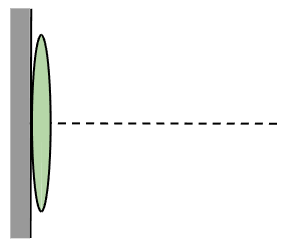
We start by noting that every ray emerging from the object has to cross the same convex lens twice: once on its way to the plane mirror and once again after reflection. A very convenient way to treat such a situation is to replace the two successive passages through the same lens by a single equivalent thin lens.
The standard result for two thin lenses in contact is stated first:
For two lenses of focal lengths $$f_1$$ and $$f_2$$ kept in contact, their combined focal length $$F$$ is given by
$$\frac{1}{F}=\frac{1}{f_1}+\frac{1}{f_2}\,.$$
In our arrangement the light crosses the same lens twice, so both focal lengths are equal, $$f_1=f_2=f$$. Substituting these values we obtain
$$\frac{1}{F}=\frac{1}{f}+\frac{1}{f}=\frac{2}{f}\; \Longrightarrow \; F=\frac{f}{2}.$$
Hence the lens-mirror combination behaves exactly like a single thin lens whose focal length is $$\dfrac{f}{2}$$.
Next we apply the usual lens formula to this equivalent lens:
The lens formula (Cartesian sign convention) is
$$\frac{1}{F}=\frac{1}{v}-\frac{1}{u},$$
where
The object is placed at a distance $$a$$ in front of the combination, i.e. on the side from which light is incident. Therefore
$$u=-\,a.$$
The final image is produced at a distance $$\dfrac{a}{3}$$ in front of the combination but on the side of the reflected rays (towards the mirror side). According to the sign convention this position lies on the opposite side of the incident light, so
$$v=+\frac{a}{3}.$$
Substituting $$F=\dfrac{f}{2},\; u=-a,\; v=\dfrac{a}{3}$$ in the lens formula we get
$$\frac{1}{\frac{f}{2}}=\frac{1}{\frac{a}{3}}-\frac{1}{-a}.$$
Now we carry out every algebraic step carefully.
The left-hand side simplifies to
$$\frac{1}{\frac{f}{2}}=\frac{2}{f}.$$
The first term on the right-hand side is
$$\frac{1}{\frac{a}{3}}=\frac{3}{a}.$$
The second term is
$$-\frac{1}{-a}=+\frac{1}{a}.$$
So the right-hand side becomes
$$\frac{3}{a}+\frac{1}{a}=\frac{4}{a}.$$
Equating the two sides, we have
$$\frac{2}{f}=\frac{4}{a}.$$
Cross-multiplying gives
$$2\,a = 4\,f.$$
Dividing both sides by 2, we arrive at
$$a = 2\,f.$$
Hence, the correct answer is Option A.
Was this solution helpful?
Create a FREE account and get:
_1.webp)

Educational materials for JEE preparation

Ask our AI anything

AI can make mistakes. Please verify important information.
AI can make mistakes. Please verify important information.
