
Join Our JEE Preparation Group
Prep with like-minded aspirants; Get access to free daily tests and study material.
Sign in
Please select an account to continue using cracku.in
↓ →
Join Our JEE Preparation Group
Prep with like-minded aspirants; Get access to free daily tests and study material.
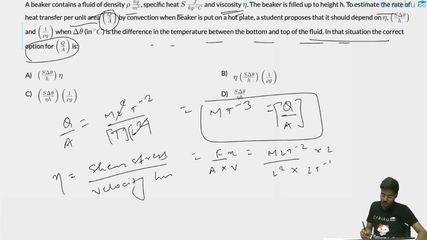
A beaker contains a fluid of density $$\rho$$ $$\frac{kg}{m^3}$$, specific heat $$S$$ $$\frac{J}{kg \cdot ^\circ C}$$ and viscosity $$\eta$$. The beaker is filled up to height h. To estimate the rate of heat transfer per unit area $$\left(\frac{Q}{A}\right)$$ by convection when beaker is put on a hot plate, a student proposes that it should depend on $$\eta$$, $$\left(\frac{S\Delta\theta}{h}\right)$$ and $$\left(\frac{1}{\rho g}\right)$$ when $$\Delta\theta$$ (in $$^\circ C$$) is the difference in the temperature between the bottom and top of the fluid. In that situation the correct option for $$\left(\frac{Q}{A}\right)$$ is:
We are asked to find an expression for the rate of heat transfer per unit area, written as $$\dfrac{Q}{A}$$. Because this is a rate of energy flow through a unit surface, its physical dimension is that of power per unit area.
First let us write down the basic dimensions in the $$M\;L\;T$$ system:
Power $$P$$ has dimension $$[P]=M L^2 T^{-3}$$ (since $$P=\dfrac{\text{energy}}{\text{time}}$$ and energy is work $$F\! \cdot\! d = (M L T^{-2})L$$). Dividing by area $$A\;(=[L^2])$$ gives
$$\left[\dfrac{Q}{A}\right]=M L^0 T^{-3}=M T^{-3}.$$
Now we list the three quantities on which the student believes $$\dfrac{Q}{A}$$ depends and write their dimensions.
1. Dynamic viscosity $$\eta$$ Formula for its dimension: $$\eta=\dfrac{\text{shear stress}}{\text{velocity gradient}}.$$ Shear stress has dimension $$M L^{-1} T^{-2}$$, and velocity gradient has dimension $$T^{-1}$$, so $$[\eta]=M L^{-1} T^{-1}.$$
2. The factor $$\dfrac{S\Delta\theta}{h}$$ Specific heat $$S$$ is defined by $$Q=m S \Delta\theta \;.$$ Re-arranging, $$S=\dfrac{Q}{m\,\Delta\theta}$$, hence $$[S]=\dfrac{M L^2 T^{-2}}{M\,\Theta}=L^{2} T^{-2} \Theta^{-1},$$ where $$\Theta$$ stands for temperature. Multiplying by the temperature difference $$\Delta\theta$$ removes the temperature dimension, so $$\left[S\Delta\theta\right]=L^{2} T^{-2}.$$ Dividing by height $$h\;(=[L])$$ gives $$\left[\dfrac{S\Delta\theta}{h}\right]=L T^{-2}.$$
3. The factor $$\dfrac{1}{\rho g}$$ Density $$\rho$$ has dimension $$M L^{-3}$$. Acceleration due to gravity $$g$$ has dimension $$L T^{-2}$$. Hence $$\left[\dfrac{1}{\rho g}\right]=\dfrac{1}{(M L^{-3})(L T^{-2})}=M^{-1} L^{2} T^{2}.$$
We now search for a product of the above three quantities, each possibly raised to some power, that reproduces $$M T^{-3}$$. Inspection of the options shows that only direct products have been proposed, so we can test them one by one.
Option A : $$\left(\dfrac{S\Delta\theta}{h}\right)\eta$$
Combining the dimensions we have
$$\left[L T^{-2}\right]\left[M L^{-1} T^{-1}\right] = M\,L^{(1-1)}\,T^{(-2-1)} = M\,T^{-3}.$$
This exactly matches the required $$M T^{-3}$$, so Option A is dimensionally consistent.
Option B : $$\eta\left(\dfrac{S\Delta\theta}{h}\right)\left(\dfrac{1}{\rho g}\right)$$
$$\left[M L^{-1} T^{-1}\right] \left[L T^{-2}\right] \left[M^{-1} L^{2} T^{2}\right] = M^{(1-1)}\,L^{(-1+1+2)}\,T^{(-1-2+2)} = L^{2}\,T^{-1}.$$
This gives $$L^{2} T^{-1}$$, which is not $$M T^{-3}$$, so Option B is incorrect.
Option C : $$\left(\dfrac{S\Delta\theta}{\eta h}\right)\left(\dfrac{1}{\rho g}\right)$$
First compute $$\dfrac{S\Delta\theta}{\eta h}$$:
$$\dfrac{[S\Delta\theta]}{[\eta][h]} = \dfrac{L^{2} T^{-2}}{(M L^{-1} T^{-1})(L)} = \dfrac{L^{2} T^{-2}}{M L^{0} T^{-1}} = M^{-1} L^{2} T^{-1}.$$
Multiplying this by $$\left[M^{-1} L^{2} T^{2}\right]$$ from $$\dfrac{1}{\rho g}$$ gives
$$M^{-2} L^{4} T^{1},$$
which again fails to match $$M T^{-3}$$, so Option C is incorrect.
Option D : $$\dfrac{S\Delta\theta}{\eta h}$$
We already found above that its dimension is $$M^{-1} L^{2} T^{-1}$$, clearly not $$M T^{-3}$$, hence Option D is also incorrect.
Among all the choices, only Option A reproduces the correct physical dimension for heat flux. Therefore the student’s dimensional reasoning leads to
$$\dfrac{Q}{A}\;=\;\eta\left(\dfrac{S\Delta\theta}{h}\right).$$
Hence, the correct answer is Option A.
Was this solution helpful?
Click on the Email ☝️ to Watch the Video Solution
Create a FREE account and get:
_1.webp)

Educational materials for JEE preparation

Ask our AI anything

AI can make mistakes. Please verify important information.
AI can make mistakes. Please verify important information.
