
Join Our JEE Preparation Group
Prep with like-minded aspirants; Get access to free daily tests and study material.
Sign in
Please select an account to continue using cracku.in
↓ →
Join Our JEE Preparation Group
Prep with like-minded aspirants; Get access to free daily tests and study material.
A wire of length $$L = 20$$ cm is bent into a semi-circular arc and the two equal halves of the arc are uniformly charged with charges $$+Q$$ and $$-Q$$ as shown in the figure. The magnitude of the charge on each half is $$|Q| = 10^3\varepsilon_0$$, where $$\varepsilon_0$$ is the permittivity of free space. The net electric field at the centre $$O$$ is
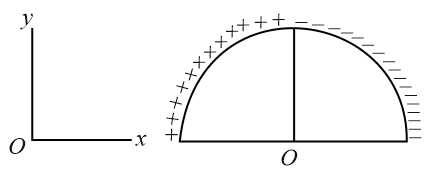
$$L = \pi R \implies R = \frac{L}{\pi}$$
The wire is divided into two equal halves (quadrants), each having a length $$l = L/2$$. The magnitude of the charge on each half is given as $$|Q| = 10^3 \epsilon_0$$.
$$\lambda = \frac{Q}{L/2} = \frac{2Q}{L}$$
By symmetry, the y-components of the two fields are equal in magnitude but opposite in direction, so they cancel out. The x-components are in the same direction ($$+\hat{i}$$) and add up.
$$E_x = E_y = \frac{k\lambda}{R} = \frac{1}{4\pi\epsilon_0} \frac{\lambda}{R}$$
$$\vec{E}_{net} = (E_{1x} + E_{2x}) \hat{i} = 2 \left( \frac{\lambda}{4\pi\epsilon_0 R} \right) \hat{i} = \frac{\lambda}{2\pi\epsilon_0 R} \hat{i}$$
$$\vec{E}_{net} = \frac{2Q/L}{2\pi\epsilon_0 (L/\pi)} \hat{i} = \frac{2Q}{L} \cdot \frac{1}{2\epsilon_0 L} \hat{i} = \frac{Q}{\epsilon_0 L^2} \hat{i}$$
$$\vec{E}_{net} = \frac{10^3 \epsilon_0}{\epsilon_0 (0.2)^2} \hat{i}$$
$$\vec{E}_{net} = \frac{1000}{0.04} \hat{i} = \frac{100000}{4} \hat{i} = 25000 \hat{i} \text{ N C}^{-1}$$
$$\vec{E}_{net} = (25 \times 10^3) \hat{i} \text{ N C}^{-1}$$
Was this solution helpful?
Create a FREE account and get:
_1.webp)

Educational materials for JEE preparation

Ask our AI anything

AI can make mistakes. Please verify important information.
AI can make mistakes. Please verify important information.
