
Join Our JEE Preparation Group
Prep with like-minded aspirants; Get access to free daily tests and study material.
Sign in
Please select an account to continue using cracku.in
↓ →
Join Our JEE Preparation Group
Prep with like-minded aspirants; Get access to free daily tests and study material.
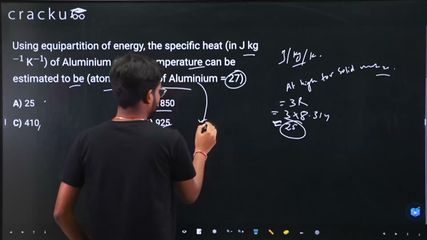
Using equipartition of energy, the specific heat (in J kg$$^{-1}$$ K$$^{-1}$$) of Aluminium at high temperature can be estimated to be (atomic weight of Aluminium = 27)
According to the equipartition theorem of energy, each quadratic degree of freedom contributes an average energy of $$\dfrac12 k_B T$$ to a system in thermal equilibrium, where $$k_B$$ is the Boltzmann constant and $$T$$ is the absolute temperature.
An atom bound inside a crystalline solid behaves like a three-dimensional harmonic oscillator. Such an oscillator possesses
• three kinetic energy terms (one for motion along each axis), and
• three potential energy terms (one for the restoring force along each axis).
Thus the number of quadratic terms per atom is
$$6 = 3 \text{(kinetic)} + 3 \text{(potential)}.$$
Using equipartition, the average energy of one atom is therefore
$$\bigl(6\bigr)\left(\dfrac12 k_B T\right)=3 k_B T.$$
For one mole we have Avogadro’s number $$N_A$$ of atoms, so the molar internal energy becomes
$$U_{\text{molar}} = N_A \left(3 k_B T\right)=3 N_A k_B T.$$
But the universal gas constant is defined as $$R = N_A k_B,$$ so we can write
$$U_{\text{molar}} = 3 R T.$$
The molar heat capacity at constant volume is the temperature derivative of this energy:
$$C_V^{\text{molar}} = \dfrac{dU_{\text{molar}}}{dT}=3R.$$
At high temperatures the difference between $$C_P$$ and $$C_V$$ for a solid is negligible, so we may take the molar specific heat simply as
$$C^{\text{molar}} = 3R.$$
The numerical value of the gas constant is
$$R = 8.314\ \text{J mol}^{-1}\ \text{K}^{-1}.$$
Hence
$$C^{\text{molar}} = 3 \times 8.314
= 24.942\ \text{J mol}^{-1}\ \text{K}^{-1}.$$
To convert this molar specific heat to a mass specific heat (J kg$$^{-1}$$ K$$^{-1}$$) we divide by the molar mass (atomic weight expressed in kg per mole). Aluminium has an atomic weight of 27 g mol$$^{-1}$$, which is
$$M = 27\ \text{g mol}^{-1} = 0.027\ \text{kg mol}^{-1}.$$
Therefore the specific heat per kilogram is
$$
C^{\text{mass}}
= \dfrac{C^{\text{molar}}}{M}
= \dfrac{24.942\ \text{J mol}^{-1}\ \text{K}^{-1}}
{0.027\ \text{kg mol}^{-1}}
= 924.9\ \text{J kg}^{-1}\ \text{K}^{-1}.
$$
Rounding to a convenient integer gives approximately $$925\ \text{J kg}^{-1}\ \text{K}^{-1}.$$
Hence, the correct answer is Option D.
Was this solution helpful?
Click on the Email ☝️ to Watch the Video Solution
Create a FREE account and get:
_1.webp)

Educational materials for JEE preparation

Ask our AI anything

AI can make mistakes. Please verify important information.
AI can make mistakes. Please verify important information.
