
Join Our JEE Preparation Group
Prep with like-minded aspirants; Get access to free daily tests and study material.
Sign in
Please select an account to continue using cracku.in
↓ →
Join Our JEE Preparation Group
Prep with like-minded aspirants; Get access to free daily tests and study material.
For the LCR circuit, shown here, the current is observed to lead the applied voltage. An additional capacitor $$C'$$, when joined with the capacitor C present in the circuit, makes the power factor of the circuit unity. The capacitor $$C'$$, must have been connected in:
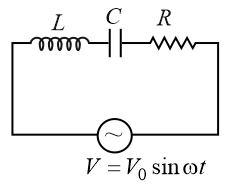
A unity power factor ($$\cos \phi = 1$$) occurs when the circuit is in resonance.
$$X_L = X_{C_{eq}}$$
$$\omega L = \frac{1}{\omega C_{eq}}$$
$$C_{eq} = \frac{1}{\omega^2 L}$$
It is given that the current leads the applied voltage. This indicates that the circuit is predominantly capacitive.
The capacitive reactance ($$X_C$$) is greater than the inductive reactance ($$X_L$$)
$$X_C > X_L$$
$$\frac{1}{\omega C} > \omega L \implies 1 > \omega^2 LC$$
Since the initial capacitance $$C$$ satisfies $$C < \frac{1}{\omega^2 L}$$, we need to increase the total capacitance to reach the resonance value $$C_{eq}$$.
To increase total capacitance, the additional capacitor $$C'$$ must be connected in parallel with $$C$$.
$$C_{eq} = C + C'$$
$$C + C' = \frac{1}{\omega^2 L}$$
$$C' = \frac{1}{\omega^2 L} - C$$
$$C' = \frac{1 - \omega^2 LC}{\omega^2 L}$$
Was this solution helpful?
Create a FREE account and get:
_1.webp)

Educational materials for JEE preparation

Ask our AI anything

AI can make mistakes. Please verify important information.
AI can make mistakes. Please verify important information.
