
Join Our JEE Preparation Group
Prep with like-minded aspirants; Get access to free daily tests and study material.
Sign in
Please select an account to continue using cracku.in
↓ →
Join Our JEE Preparation Group
Prep with like-minded aspirants; Get access to free daily tests and study material.
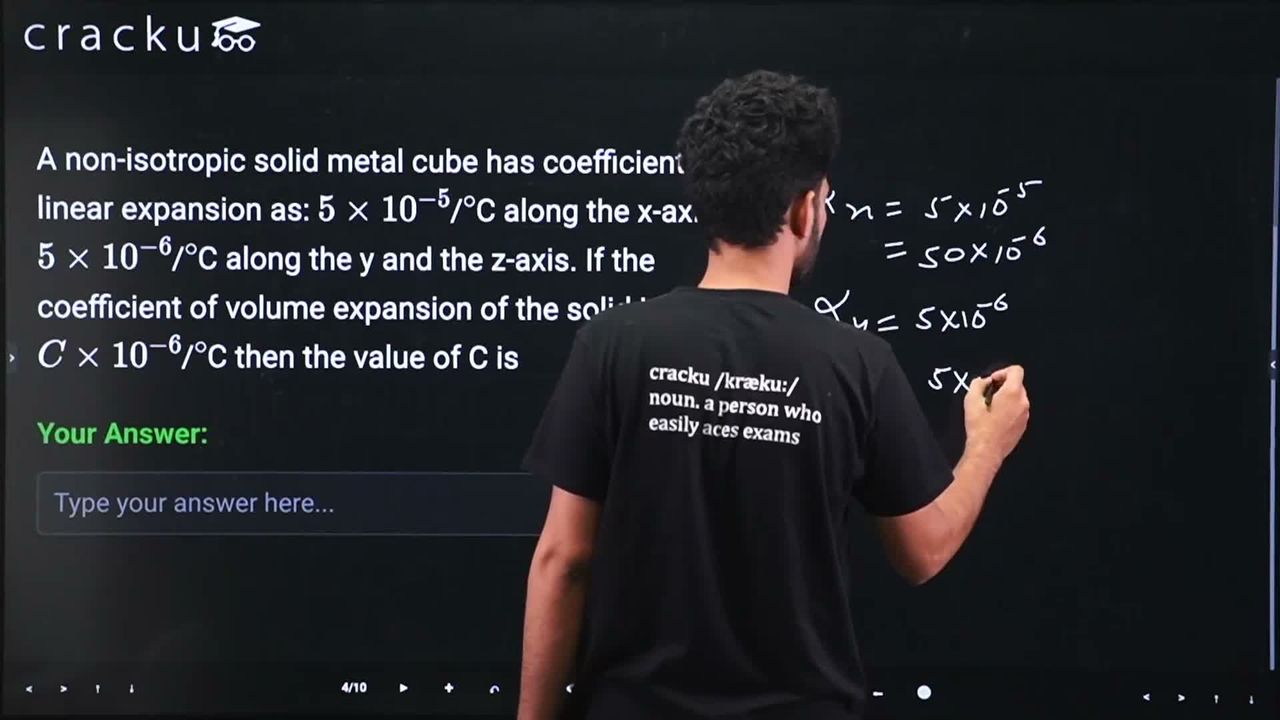
A non-isotropic solid metal cube has coefficients of linear expansion as: $$5 \times 10^{-5}$$/$$^\circ$$C along the x-axis and $$5 \times 10^{-6}$$/$$^\circ$$C along the y and the z-axis. If the coefficient of volume expansion of the solid is $$C \times 10^{-6}$$/$$^\circ$$C then the value of C is
Correct Answer: 60
We are told that the solid metal cube expands differently along the three mutually perpendicular directions. Let the coefficients of linear expansion along these directions be denoted by $$\alpha_x,\;\alpha_y$$ and $$\alpha_z$$.
From the statement of the problem we have
$$\alpha_x = 5 \times 10^{-5}\;{}^\circ\!{\rm C}^{-1},$$
$$\alpha_y = 5 \times 10^{-6}\;{}^\circ\!{\rm C}^{-1},$$
$$\alpha_z = 5 \times 10^{-6}\;{}^\circ\!{\rm C}^{-1}.$$
The basic relation connecting the linear and volume expansion coefficients for small temperature changes is:
$$\beta = \alpha_x + \alpha_y + \alpha_z,$$
where $$\beta$$ is the coefficient of volume expansion. This formula simply states that the fractional increase in volume equals the sum of the fractional increases in length along the three perpendicular axes.
Substituting the given numerical values, we get
$$\beta = 5 \times 10^{-5} + 5 \times 10^{-6} + 5 \times 10^{-6}.$$
To combine these terms easily, we convert every term to the same power of ten. Note that
$$5 \times 10^{-5} = 50 \times 10^{-6}.$$
Hence
$$\beta = 50 \times 10^{-6} + 5 \times 10^{-6} + 5 \times 10^{-6}.$$
Adding the coefficients:
$$\beta = (50 + 5 + 5) \times 10^{-6} = 60 \times 10^{-6}\;{}^\circ\!{\rm C}^{-1}.$$
In the problem the volume expansion coefficient is written as $$C \times 10^{-6}\;{}^\circ\!{\rm C}^{-1}$$, so on comparison
$$C = 60.$$
So, the answer is $$60$$.
Was this solution helpful?
Click on the Email ☝️ to Watch the Video Solution
Create a FREE account and get:
_1.webp)

Educational materials for JEE preparation

Ask our AI anything

AI can make mistakes. Please verify important information.
AI can make mistakes. Please verify important information.


