
Join Our JEE Preparation Group
Prep with like-minded aspirants; Get access to free daily tests and study material.
Sign in
Please select an account to continue using cracku.in
↓ →
Join Our JEE Preparation Group
Prep with like-minded aspirants; Get access to free daily tests and study material.
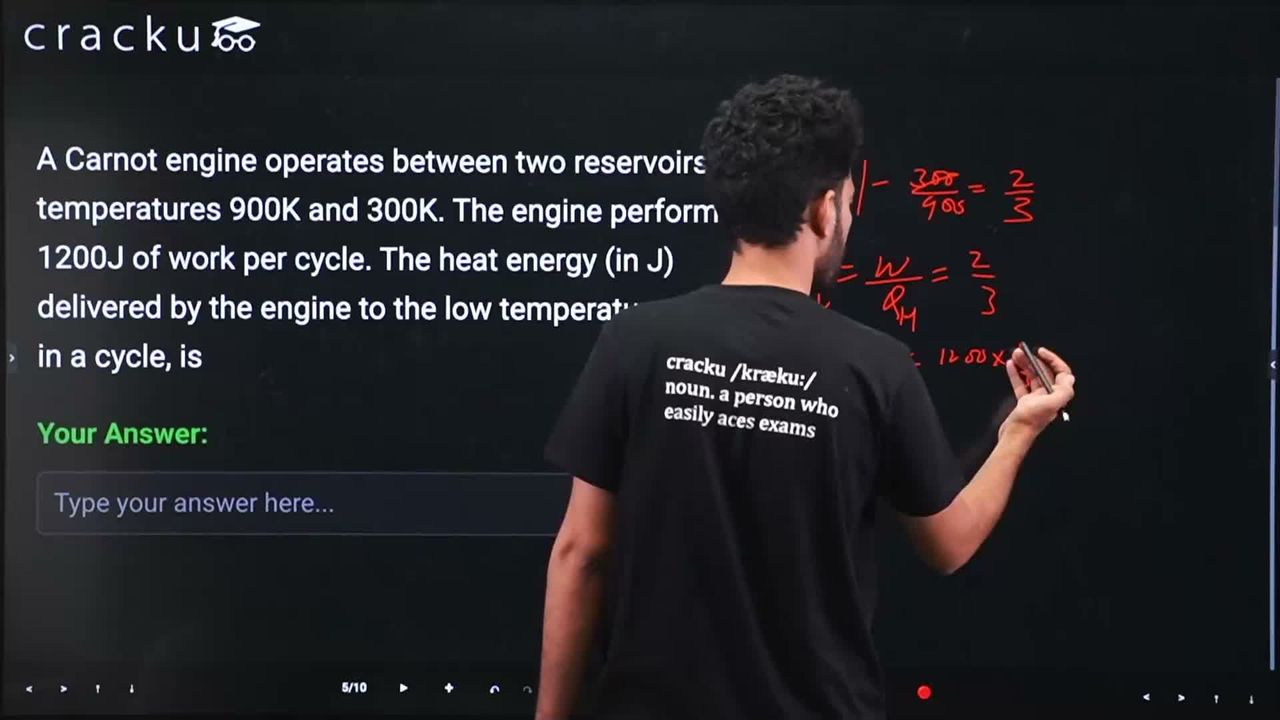
A Carnot engine operates between two reservoirs of temperatures 900K and 300K. The engine performs 1200J of work per cycle. The heat energy (in J) delivered by the engine to the low temperature reservoir, in a cycle, is
Correct Answer: 600
We have a Carnot heat engine working between two thermal reservoirs whose absolute temperatures are $$T_h = 900\,\text{K}$$ (hot reservoir) and $$T_c = 300\,\text{K}$$ (cold reservoir).
The thermal efficiency $$\eta$$ of an ideal Carnot engine is given by the well-known formula
$$\eta = 1 - \frac{T_c}{T_h}.$$
Substituting the given temperatures, we obtain
$$\eta = 1 - \frac{300}{900} = 1 - \frac{1}{3} = \frac{2}{3}.$$
By definition, the efficiency is also the ratio of the useful work output $$W$$ to the heat energy $$Q_h$$ absorbed from the hot reservoir:
$$\eta = \frac{W}{Q_h}.$$
The work done per cycle is given as $$W = 1200\,\text{J}.$$ Solving the above relation for $$Q_h$$, we have
$$Q_h = \frac{W}{\eta}.$$
Substituting the numerical values,
$$Q_h = \frac{1200}{\dfrac{2}{3}} = 1200 \times \frac{3}{2} = 1800\,\text{J}.$$
The heat rejected to the cold reservoir, denoted by $$Q_c$$, is found using the first law of thermodynamics for a complete cycle, which states that the net heat absorbed equals the work done:
$$Q_h - Q_c = W.$$
Rearranging gives
$$Q_c = Q_h - W.$$
Substituting $$Q_h = 1800\,\text{J}$$ and $$W = 1200\,\text{J},$$ we get
$$Q_c = 1800 - 1200 = 600\,\text{J}.$$
So, the answer is $$600\,\text{J}.$$
Was this solution helpful?
Click on the Email ☝️ to Watch the Video Solution
Create a FREE account and get:
_1.webp)

Educational materials for JEE preparation

Ask our AI anything

AI can make mistakes. Please verify important information.
AI can make mistakes. Please verify important information.


